
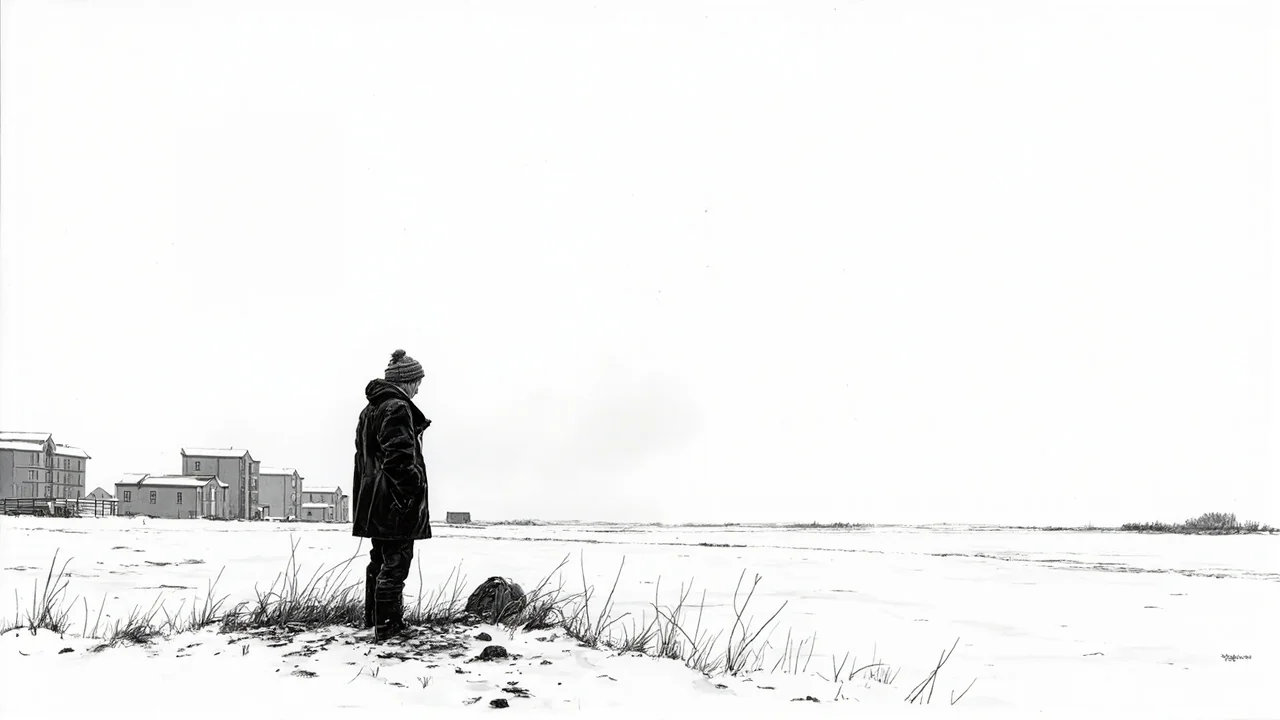
Danish society news confronts a stark reality each winter as police remove homeless individuals from warm shelters into life-threatening cold. The story of Tom, an 80-year-old man evicted from a Copenhagen parking garage, highlights a critical tension between law enforcement and survival. This incident forces a difficult conversation about Denmark's welfare system and its capacity to protect its most vulnerable residents during extreme weather.
Tom's high voice precedes him through the green door of the city's Sundhedsrummet, a health and care center for the homeless. "Hellooo!" he calls in English with an Irish accent, waving his captain's hat. Neither it nor the beanie underneath covered his 80-year-old ears, now red from the cold. He had spent the previous night walking to stay warm and awake, knowing that falling asleep in the frost could be fatal. He was one of many in line for the center's warm bath and care for his freezing feet. His story began hours earlier in the relative warmth of a public parking garage, a common refuge for those with nowhere else to go.
A Common Refuge, A Sudden Eviction
Underground parking garages, known as 'P-kældre', become informal shelters for homeless individuals across Danish cities during winter. They offer a reprieve from the wind and a few degrees of warmth above the sub-zero temperatures outside. For Tom and others, these spaces are a matter of basic survival on the coldest nights. Copenhagen police, however, frequently conduct patrols to move people along from these public and private spaces. The official line often cites safety regulations, anti-loitering rules, or complaints from residents and property owners. On this freezing night, officers told Tom he had to leave the garage. They left him on the street with no alternative shelter offered, a practice that homeless advocates call a routine and dangerous failure of duty of care.
This practice exists in a paradoxical space within Denmark's social policy framework. The country is renowned for its comprehensive welfare state, designed to provide a safety net for all citizens. Municipalities are legally obligated to provide shelter to anyone without a home if they request it. Yet, the system relies on individuals navigating complex bureaucratic pathways to access help. For an elderly man like Tom, potentially struggling with health issues, language barriers, or distrust of systems, that navigation can be impossible in a moment of crisis. The police action, while perhaps procedurally correct, created a direct threat to his life by exposing him to the cold.
The Fragile Safety Net in Winter
Centers like Sundhedsrummet in Copenhagen's Nørrebro district operate as critical frontline responses. They provide warm meals, medical care for frostbite and other cold-related injuries, showers, and social counseling. Their staff, often a mix of healthcare professionals and social workers, see the human cost of the gap between policy and street-level reality every day. "We are the band-aid," one social worker at a similar center told me, requesting anonymity as they were not authorized to speak publicly. "The municipal system is supposed to be the cure. But when someone is turned away from a garage at 2 a.m., we are the only thing stopping them from freezing. The police know we exist, but there is no formal protocol to bring people here."
Data on homelessness in Denmark is complex, but a 2023 report by the Danish National Center for Social Research estimated that over 6,000 people experience outright homelessness. A significant portion are, like Tom, older men. Many have intersecting issues of mental health, addiction, or are migrants who fall outside certain welfare entitlements. During winter, Copenhagen and other major cities activate emergency cold weather plans, opening additional night shelters. However, these are often first-come, first-served and can feel unsafe or restrictive for some, leading individuals to seek alternatives like parking garages.
Between Policy and Compassion
The incident raises urgent questions for Danish integration and social policy. If a society is judged by how it treats its weakest members, what does this eviction say? Police authorities have a challenging mandate to uphold public order, which includes enforcing rules against unauthorized occupation of spaces. Yet, human rights organizations argue that the right to life and dignity must supersede bureaucratic order in extreme conditions. There is no national directive mandating police to connect evicted homeless individuals with shelter services, leaving it to the discretion of individual officers. This creates a dangerous lottery where survival depends on which officer responds and their personal judgment.
Copenhagen Municipality states that anyone can contact the city's social services or visit a shelter directly. A spokesperson for the city's social services department said, "Our goal is to ensure no one sleeps outdoors in this weather. We have expanded capacity and work with partners." They did not comment on specific coordination with police. The police, for their part, maintain that their primary role is not social work but law enforcement. A senior officer from the Copenhagen Police, speaking on background, noted, "Our job is to ensure public spaces are safe and accessible. We are not equipped to assess social needs. We inform people of the rules and, if they are in clear distress, we can call an ambulance."
A Call for Coordinated Action
Experts in social policy see this as a systemic failure of coordination. "The left hand does not know what the right hand is doing, and the person in the middle freezes," says Karen Nielsen, a researcher focusing on urban marginalization at the University of Copenhagen. "The municipalities have a responsibility, the police have a different mandate, and the health system deals with the consequences. There is no joined-up 'winter survival protocol' that prioritizes life over procedure. In a country with Denmark's resources, this is a choice, not an inevitability." She suggests establishing clear, city-wide protocols where police are required to call a dedicated social services hotline when evicting someone in freezing weather, ensuring a handover to the welfare system.
Other Nordic capitals have experimented with different models. Oslo has outreach teams that patrol with police on cold nights, offering immediate shelter placements. Stockholm funds church and volunteer groups to provide mobile "night cafes" that act as safe havens. These approaches recognize that the traditional, office-hours social service model is incompatible with the realities of street homelessness, especially in a climate where winter can be deadly.
The Human Cost of Procedure
Back at Sundhedsrummet, Tom's immediate needs are met. His feet are treated, he gets a warm meal, and the staff try to connect him with a shelter bed for the coming night. But his story is not unique. It repeats itself dozens of times each winter across Denmark. The psychological impact is profound. "It tells you that you are not seen as human," said Michael, another regular at the center who experienced a similar eviction last week. "You are just a problem to be moved from one place to another. The cold is bad, but that feeling is worse."
The Danish welfare system was built on principles of solidarity and universal care. Stories like Tom's test those principles at their absolute limit. They ask whether the system's complex rules and separated responsibilities have created cracks so wide that people can fall through and perish. As climate change brings more frequent and severe cold snaps to Scandinavia, this question will only grow more urgent. The challenge for Danish society is not just one of resources, but of philosophy: will it prioritize procedural order or human survival when the two conflict on a freezing street? For Tom and hundreds like him, the answer, on a cold night in a Copenhagen parking garage, still feels dangerously unclear.