
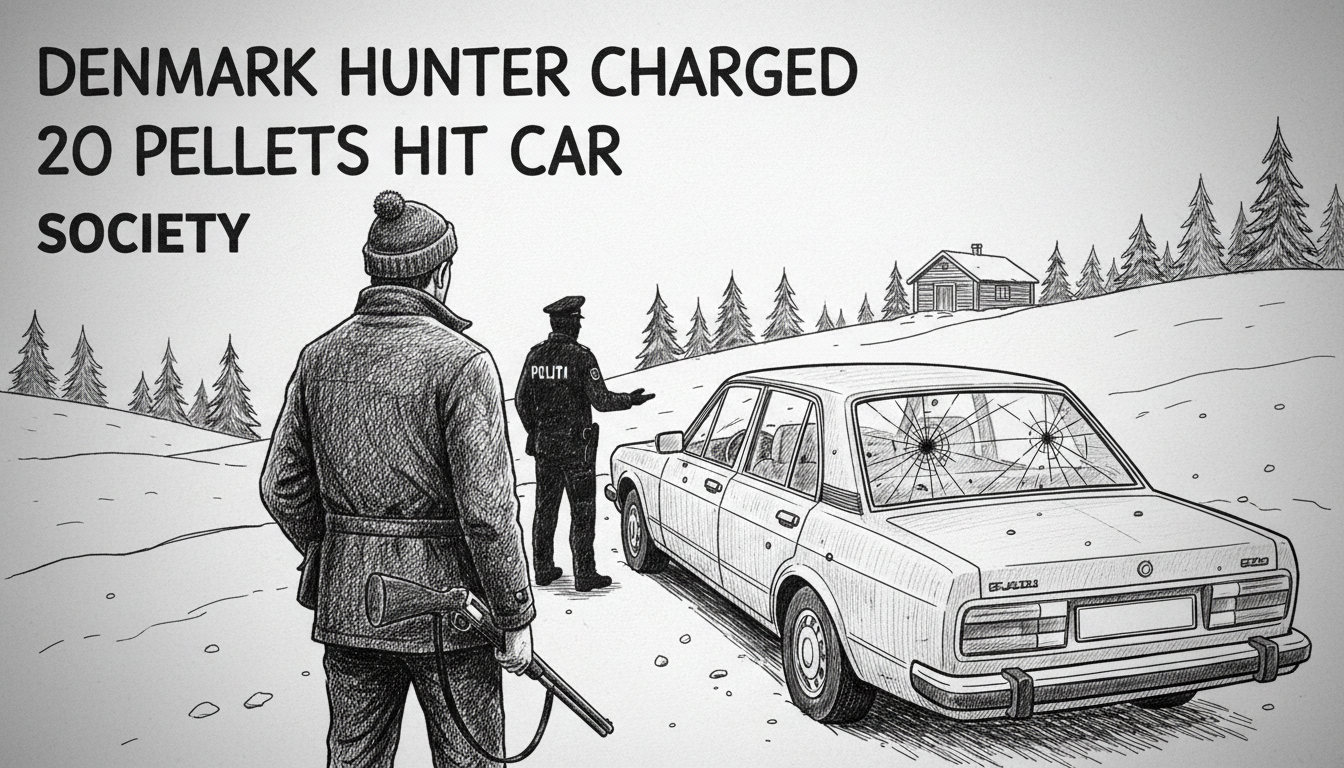
Denmark's strict hunting laws are under scrutiny after North Zealand Police charged a 63-year-old hunter with hitting a personal vehicle with shotgun pellets. The incident, reported in a daily police bulletin, led to a charge of violating the Danish Hunting Act, known as Jagtloven. It highlights the critical balance between a deep-rooted cultural tradition and public safety in a densely populated country. As a reporter who often explores the intersections of Danish society, policy, and community life, this case reveals more than a simple violation. It opens a window into how Denmark manages its cherished outdoor pursuits within a modern, safety-conscious framework.
An Incident in North Zealand
Police provided limited details, stating only that a hunter was suspected of striking a car with approximately 20 pellets from his shotgun. No injuries were reported, a fortunate outcome that underscores the potential danger of such events. The location within North Zealand, an area containing both expansive forests and affluent suburban communities, is telling. It represents a common Danish reality where recreational spaces and residential zones exist in close proximity. This geographical closeness demands exceptionally high safety standards from the estimated 165,000 licensed hunters in Denmark. The immediate legal consequence for the hunter is a charge under the Hunting Act, a move that initiates a formal legal process which could result in fines or further penalties.
The Framework of Danish Hunting Law
The Danish Hunting Act serves as the comprehensive rulebook for all hunting activity. Its primary objectives are sustainable wildlife management and the prevention of accidents. The law meticulously defines safe practices, including mandatory hunting licenses obtained through rigorous testing, strict seasonal calendars for different game, and approved methods for hunting. Crucially, it establishes mandatory safety distances from roads, buildings, and public paths. A fundamental rule requires a hunter to have a clear line of sight to what lies 300 meters beyond their target. In a flat landscape like Denmark's, this rule is a cornerstone of accident prevention. Violations are treated seriously by authorities, reflecting a societal consensus that the privilege of hunting carries significant responsibility. The system is designed to be preventative, but as this case shows, it relies ultimately on individual adherence.
A Culture of Safety and Responsibility
Hunting in Denmark is not merely a sport; it is a deeply embedded cultural tradition tied to nature management and rural life. The community generally prides itself on a strong ethos of safety and responsibility. Most hunters undergo thorough training through the Danish Hunters' Association, which emphasizes safe firearm handling and ethical practices. This incident, while isolated, sends a ripple of concern through that community. It challenges the carefully maintained social license that hunters operate under. "Every hunter knows that one accident can damage the reputation of all," said Lars Hansen, a veteran hunting instructor from Roskilde, who agreed to speak on the broader context. "Our training is extensive, focusing on identifying the target and what lies beyond it. An incident involving a vehicle suggests a catastrophic failure in applying those basic principles." This breach of protocol is what triggers the legal response and the collective unease.
Expert Analysis: Gaps in a Robust System
To understand the implications, I consulted policy analysts familiar with Danish regulatory frameworks. While the Hunting Act is considered robust, experts point to enforcement and situational factors as potential gaps. "The law is clear, but its application exists in the real world," noted Karen Møller, a social policy researcher who has studied outdoor recreation regulations. "Factors like fatigue, overconfidence, or a momentary lapse in judgment can bypass even the best training. The system's effectiveness relies on a combination of legal deterrence, peer pressure within the hunting community, and personal discipline." She explained that penalties under the Act are scaled to the severity of the violation and its outcome. A case with no physical injuries typically results in a substantial fine and potential court-mandated revocation of the hunting license for a period. The judicial process also considers the hunter's prior record. This graduated system aims to be both punitive and corrective, seeking to remove repeat offenders from the field.
The Broader Social Contract
This event touches on the broader Danish social contract, where individual freedoms are balanced with collective welfare. The right to hunt is conditional upon respecting the safety of others. In a nation with a renowned welfare system and low tolerance for preventable public risk, such incidents are notable. They prompt municipal safety boards and hunting associations to review local practices and communication. Furthermore, it intersects with public access rights. Denmark's 'Right to Roam' allows people to enjoy nature freely, which includes walking in many forests even during hunting seasons. This creates a shared space where responsibility is paramount. The charged hunter now faces not only legal proceedings but also likely scrutiny from his local hunting association, which has its own codes of conduct and can impose additional sanctions.
Looking Ahead: Compliance and Community
The case will proceed through the Danish legal system, offering a clear reminder of the consequences of neglecting hunting safety protocols. For the public, it reinforces the importance of the regulations that govern potentially dangerous activities. For the hunting community, it is a call to recommit to its safety ethos. The incident may also fuel discussions about whether additional preventative measures, such as enhanced signage in mixed-use areas or refresher safety courses, are needed. Ultimately, Denmark's approach to managing hunting reflects a societal model that trusts citizens with significant responsibility while holding them firmly accountable. The true test of the system is not in the absence of incidents, but in its consistent and fair response to them. This single charge in North Zealand is a small but sharp reminder of the contract that preserves a traditional practice in a modern society.