
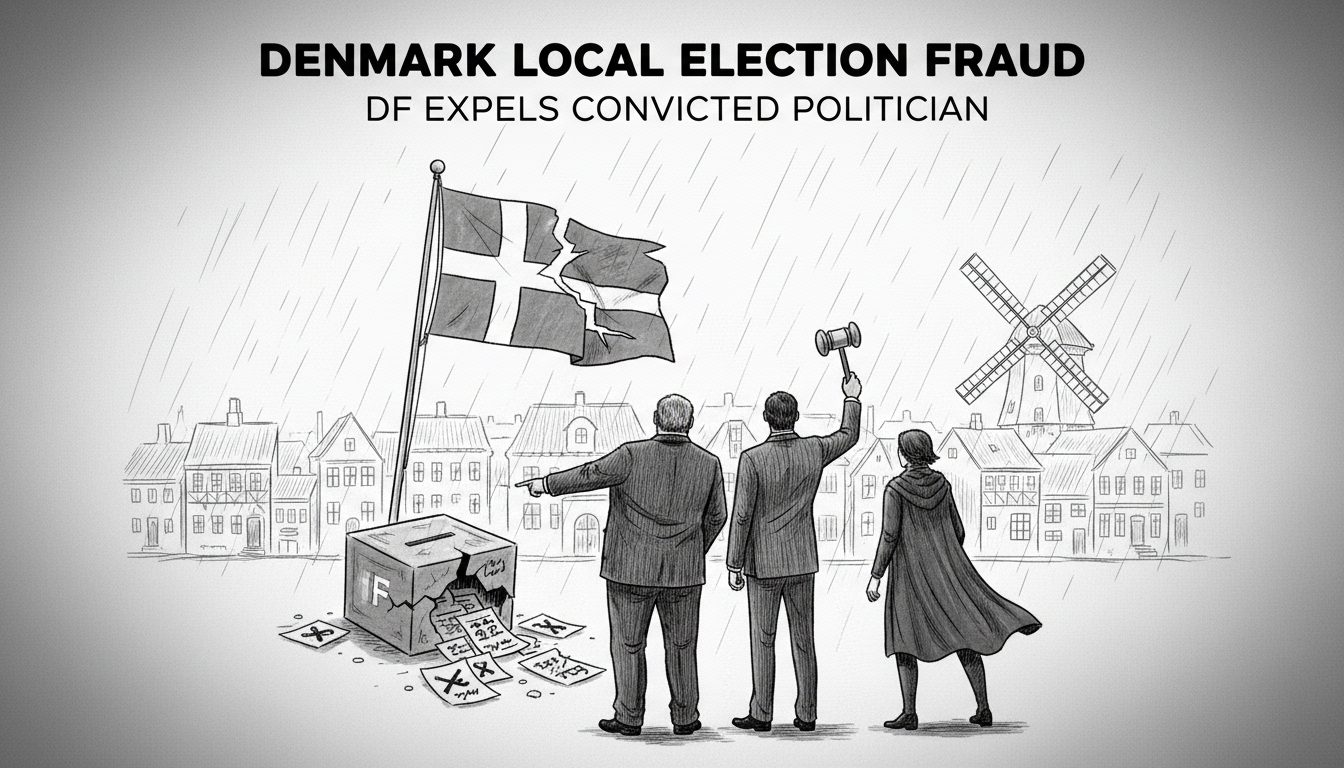
Denmark local election fraud has led to the expulsion of a newly elected politician from the Danish People's Party. Thomas Rasmussen, elected to the Norddjurs Kommune council last month, was thrown out of DF after revelations he was convicted of defrauding a man with a cognitive disability of nearly 100,000 kroner. The party's secretary, Erik Bjørn Møller, confirmed the expulsion, stating Rasmussen's actions 'in no way represent the values that Dansk Folkeparti stands for.' This scandal cuts to the core of political integrity and exposes a critical failure in candidate vetting within a party that champions law and order.
A Conviction Hidden from Voters
The case centers on a prior conviction for data fraud. A court sentenced Rasmussen to six months in prison and ordered him to pay at least 104,000 kroner in compensation to the victim. According to reports, the victim, a man with a cognitive disability, claims he has never received the money. The Danish People's Party asserts it was completely unaware of this criminal record until journalists contacted them with the story. This lack of knowledge allowed Rasmussen to run under the DF banner, securing one of the party's two seats in Norddjurs. 'The behavior he has shown in this case, and which he exhibits every day, where he does not pay back the money he cheated another man out of, does not harmonize with DF's fundamental values,' Møller said.
The Legal Loophole of Eligibility
Despite his conviction, Rasmussen was legally eligible to run for office. Danish municipal election law allows individuals to stand for election three years after serving a sentence, provided the punishment was not unconditional imprisonment exceeding six months. Rasmussen's six-month sentence fell precisely within this limit. He remains a member of the municipal council as an independent, having confirmed his expulsion from DF but offering no substantive comment. This legal framework places the onus on political parties, not the electoral system, to screen candidates for past misconduct that may contradict their professed values. The incident raises immediate questions about the depth of background checks conducted by political organizations, especially for local candidates.
Political Fallout and Reputational Damage
The expulsion reduces the Danish People's Party's representation in Norddjurs Kommune from two seats to one when the new council begins work on January 1. The political damage, however, extends far beyond a single lost mandate. For DF, a party that has built its brand on strict principles concerning Danish values, justice, and social order, the hypocrisy is stark. The case provides ammunition for political opponents who can argue the party fails to uphold its own standards internally. It also undermines voter trust at a local level, where personal integrity and community standing are paramount. Analysts suggest this will force a painful internal review of candidate selection processes across all party branches.
A Test of Core Values in Danish Politics
This scandal presents a fundamental test for the Danish People's Party's stated principles. The party has long positioned itself as a defender of law-abiding citizens and a critic of systemic abuse. Finding one of its own elected representatives guilty of financially exploiting a vulnerable citizen directly contradicts this narrative. The swift expulsion is a necessary first step in damage control, but it does not erase the initial failure of oversight. The case shifts the focus from general political rhetoric to the concrete actions of individuals representing the party. It asks voters to consider whether a party's public stance matches its private diligence in selecting those who wield power.
The Human Cost Behind the Headlines
While the political mechanics dominate the story, the human impact remains. The victim, a man with a cognitive disability, was defrauded of a significant sum and, according to reports, is still awaiting compensation. This aspect transforms the story from a political mishap into a case of profound ethical failure. It highlights how vulnerabilities can be exploited, even by those seeking public office. The case serves as a grim reminder that policies on paper mean little if the people enacting them lack basic moral compass. For the local community in Norddjurs, the scandal erodes faith in the very institution meant to serve and protect their interests.
A Systemic Problem in Local Candidate Vetting?
The incident suggests potential systemic weaknesses in how Danish political parties vet local council candidates. National parties often rely on local associations to handle candidate selection, which may not involve rigorous criminal record checks. The assumption of good faith and local reputation can sometimes override formal scrutiny. This case demonstrates the risks of that approach. It will likely prompt not only DF but all major parties to re-examine their internal protocols to prevent similar embarrassments. The credibility of local democracy depends on voters believing candidates have been thoroughly evaluated before their names appear on the ballot.
Looking Ahead: Accountability and Reform
Thomas Rasmussen now sits as an independent, a constant reminder of the scandal for the next four-year council term. The key question is whether his political career can survive without party backing. Furthermore, the pressure will mount for him to fulfill the court's order and compensate the victim fully. For the Danish People's Party, the path forward involves transparently reforming its candidate vetting process and regaining public trust. This may involve centralizing background checks or implementing mandatory declarations for all prospective candidates. The party's response to this crisis will be closely watched as a measure of its commitment to its own foundational values. Ultimately, this local election fraud case challenges the entire political establishment to ensure those who make the laws are themselves beyond reproach.