
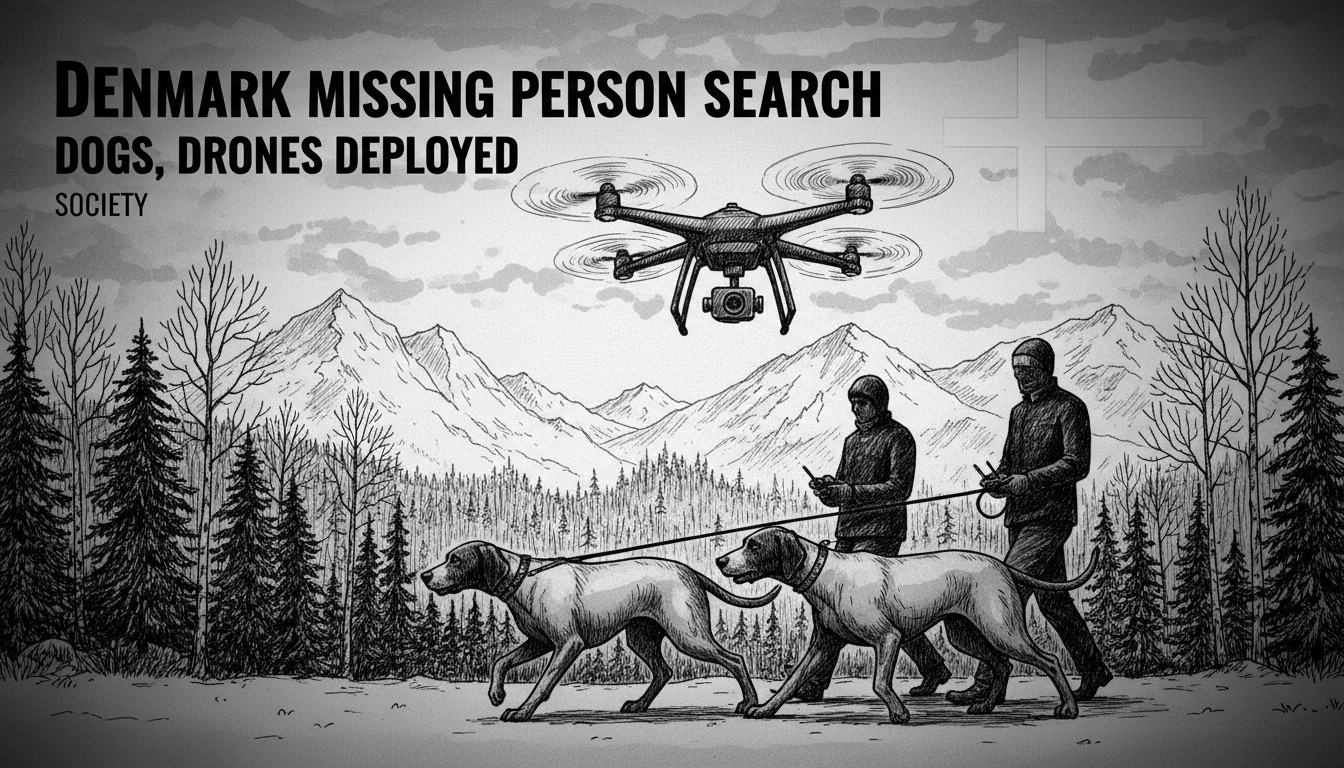
Denmark's Copenhagen Police have escalated the search for a 27-year-old man missing for a week, deploying canine units and aerial drones over a vast natural area. Ibrahim was last seen on Frederiksborgvej in the city's Nordvest district, a diverse neighborhood known for its community ties and cultural vibrancy. The extended disappearance has mobilized significant police resources, highlighting the procedural and human dimensions of such cases in the Danish welfare state.
A Week of Growing Concern
Seven days have passed since anyone reported seeing Ibrahim. The Copenhagen Police confirmed the ongoing search in a statement on social media platform X, expressing direct concern for his welfare. "We are worried about Ibrahim's well-being and ask citizens with information in the case to call us on phone 114," the police said on Monday. The search has now focused on Utterslev Mose, a large wetland and lake system in the northwest part of the capital. This terrain of marshes, reed beds, and wooded paths presents unique challenges, prompting the involvement of the national Beredskabsstyrelsen, or Emergency Management Agency, with its drone capabilities.
For a missing persons case to sustain this level of resource allocation beyond the initial 48-72 hours indicates the seriousness with which authorities are treating Ibrahim's disappearance. In Denmark, police typically classify a person as missing if their absence is contrary to their normal habits and there is concern for their safety. The deployment of drones suggests investigators are covering ground difficult for human searchers, scanning from above for heat signatures or visual clues amidst the dense vegetation.
The Human Story Behind the Search
Ibrahim is described as 183 centimeters tall, of slender build, with a dark complexion. He wears glasses and has a full beard. When last seen, he was likely wearing a brown North Face puffer jacket, blue jeans, and white Nike shoes. These specific details, circulated publicly, are crucial for community-assisted search efforts. They paint a picture of a young man whose sudden absence has created a void. Nordvest, where he was last seen, is one of Copenhagen's most multicultural districts, a place where stories of migration and integration are part of the daily fabric.
As a reporter focused on Danish society, I see these cases through a dual lens. There is the immediate police procedure, which in Denmark is generally systematic and well-resourced. Then there is the community impact, often felt more deeply in neighborhoods where social networks are tightly knit. A missing person disrupts the fundamental sense of security and community well-being that Danish social policy strives to create. It raises unspoken questions about an individual's connection to support systems, whether familial, social, or municipal.
The Mechanics of a Modern Search
The operational shift to Utterslev Mose marks a new phase in the investigation. "As part of the effort, we are searching for him today at Utterslev Mose," police stated. "We have dogs in the terrain, and the Emergency Management Agency has drones in the air." Canine units are invaluable for tracking human scent across difficult landscapes, while drones provide a rapid aerial overview, capable of covering hectares of land that would take ground teams days to traverse thoroughly. This combination represents a standard yet advanced protocol for large-area searches in Denmark.
Utterslev Mose itself is a popular recreational zone, a green lung for the city with walking and cycling paths winding around lakes. Its very nature as a public, accessible space means countless people pass through daily. This paradoxically complicates a search; while many eyes frequent the area, the landscape can conceal. The involvement of a national agency like Beredskabsstyrelsen underscores the cross-governmental coordination common in Danish crisis response, where municipal police can draw on central government assets.
Community and Policy in Times of Crisis
From a social policy perspective, a missing person case tests the interconnectedness of Denmark's safety net. Beyond the police, there are questions about what preceding contacts, if any, existed with municipal social services, healthcare providers, or employment centers. Denmark's integration policy often emphasizes early intervention and support for vulnerable individuals. While there is no indication this case relates to those systems, any prolonged disappearance inevitably leads to a retrospective examination of an individual's engagement with community structures.
In neighborhoods like Nordvest, which have high concentrations of residents with immigrant backgrounds, community organizations often play a vital role as intermediaries. They can assist in disseminating information to diverse linguistic communities and provide grassroots support to worried families. The police appeal for public information relies on this community bridge to be effective. It is a moment where official Denmark actively needs the eyes and ears of civil society to fulfill its duty of care.
The Anxious Wait for Answers
As the search enters its second week, the atmosphere shifts from urgent response to anxious endurance. For the family and friends of Ibrahim, each passing hour is a weight. For the police, the mission continues with a blend of technology and traditional fieldwork. The public is left with a description—a brown jacket, blue jeans, white shoes—and a request to be vigilant. These cases, though statistically rare, resonate deeply because they touch on a universal fear: the unexplained vanishing of someone from their ordinary life.
Denmark's low crime rate and high levels of social trust make a week-long disappearance particularly jarring. It contradicts the narrative of a predictable, safe society. The comprehensive response, using dogs, drones, and public appeals, is the system's attempt to restore that order, to fill in the unsettling blank space with answers. The hope is that the increased attention and specialized search of Utterslev Mose will yield a clue, a trace, a direction.
The coming days will determine the outcome. Will the advanced technology pinpoint what human eyes have missed? Will a casual walker in the Mose recall a crucial detail? The search for Ibrahim is more than a police operation; it is a reminder of the fragility of individual security and the collective effort required to uphold it. In a society that prizes tryghed—a Danish concept encompassing safety, security, and trust—his return is the only acceptable conclusion.