
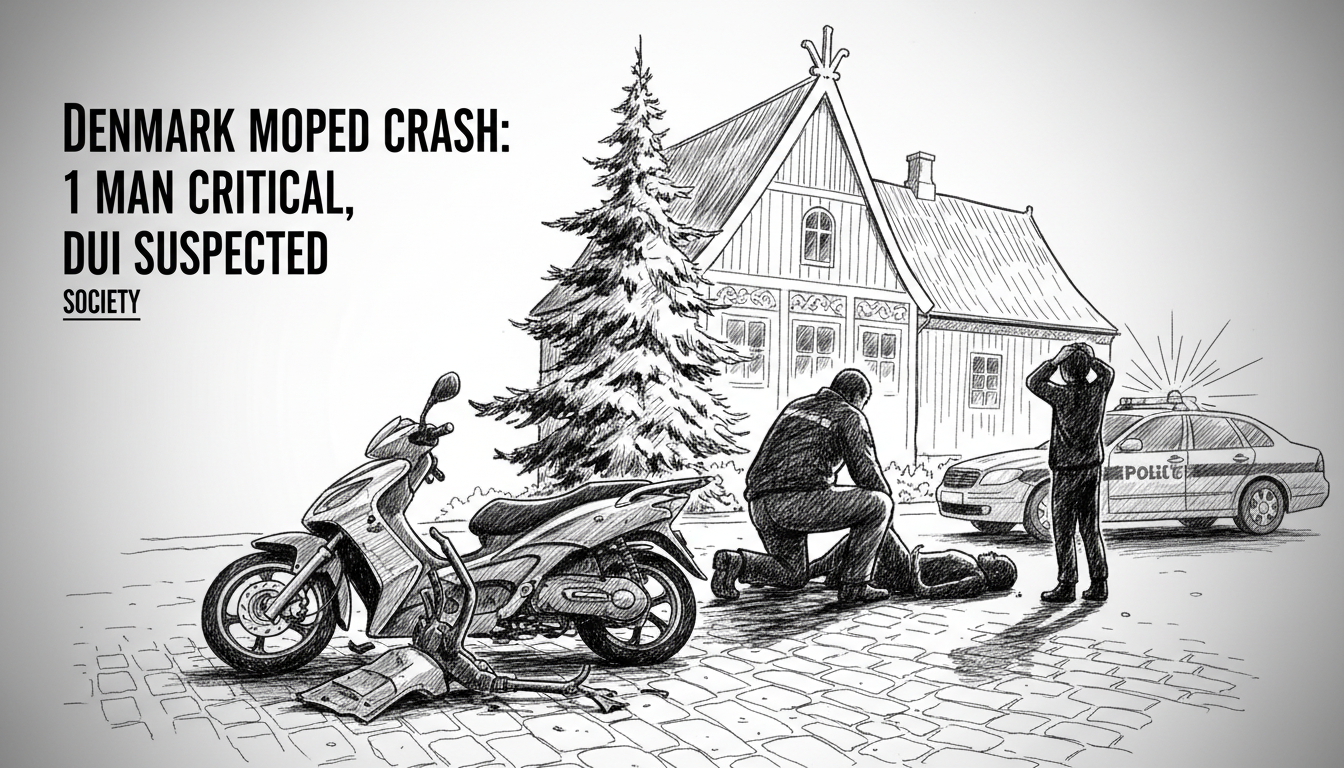
Denmark road accident investigators are piecing together a serious collision in Grindsted that left a 51-year-old man fighting for his life. The Sunday evening crash on Vestergade involved a moped and a car at the intersection near Kvickly supermarket. Police suspect the moped rider failed to yield and was potentially under the influence of alcohol, highlighting the persistent dangers on Danish roads despite generally strong safety records.
The 51-year-old man was airlifted by helicopter to Odense University Hospital, where he remains in critical condition. His 55-year-old passenger sustained minor head injuries and was taken by ambulance to Esbjerg Hospital. The 41-year-old female driver of the car was unharmed in the impact. According to preliminary police assessments, the moped rider had a duty to stop at the intersection but proceeded into the path of the oncoming vehicle from Vestre Boulevard.
Sydøstjyllands Politi confirmed suspicions of alcohol involvement, leading to a blood sample being taken from the critically injured rider. If laboratory analysis confirms alcohol in his system above Denmark's 0.05% legal limit, he will face charges for driving under the influence in addition to potential failure-to-yield violations. The investigation continues as authorities await toxicology results and complete their reconstruction of the crash scene.
A Sunday Evening Shattered by Impact
The quiet of a Sunday evening in the Central Jutland town of Grindsted was broken at 7:55 PM by the sound of a violent collision. The specifics of what happened in that moment at the crossroads of Vestergade and Vestre Boulevard are now the focus of a police investigation. Witness statements, vehicle damage, and road markings will form the narrative of an event that changed multiple lives in an instant.
For the families involved, the news delivered by police officers represents a sudden fracture in their ordinary lives. The air ambulance's journey to Odense, a major trauma center, underscores the severity of the moped rider's injuries. His passenger's transport to Esbjerg for treatment of head trauma, while less critical, still signals the profound physical and psychological shock of a high-impact crash.
The Legal and Human Cost of Impaired Driving
Danish traffic law is unambiguous about the consequences of driving under the influence. The legal blood alcohol content limit of 0.05% is strictly enforced, with penalties escalating based on BAC levels and outcomes. A confirmed DUI charge in connection with an accident causing critical injury carries severe penalties, including substantial fines, lengthy driver's license suspension, and potential imprisonment.
Beyond legal ramifications, such incidents reignite public debate about road safety and personal responsibility. Denmark recorded 164 road fatalities in 2022, a number that represents steady improvement over decades but also 164 individual tragedies. Each statistic corresponds to families plunged into grief, communities affected by loss, and emergency services confronting trauma. The Grindsted case is particularly poignant because the most severely injured person is also the primary suspect, creating a complex web of victimhood and alleged culpability.
Road safety experts consistently identify alcohol impairment as a major preventable factor in serious collisions. Even small amounts of alcohol affect reaction time, judgment, and coordination—critical skills for navigating complex traffic environments like intersections. The decision to operate any vehicle, including a moped, after drinking carries disproportionate risk for the driver, passengers, and other road users.
Moped Safety in the Danish Traffic Landscape
This accident brings specific attention to moped safety, a perennial concern in Danish traffic planning. Mopeds offer affordable mobility but provide minimal physical protection in collisions. Riders are vulnerable road users, much like cyclists, yet they travel at higher speeds and mix with car traffic. A crash that might result in minor damage to a car can be life-altering for someone on a moped.
Danish municipalities and traffic safety councils run continuous education campaigns targeting young and new drivers, but this incident involves middle-aged adults. It suggests that safety messaging must reach all age groups, emphasizing that experience behind the wheel does not confer immunity to the effects of alcohol or the obligation to follow traffic rules. The requirement to yield at certain intersections is fundamental to Denmark's traffic system, designed to prevent exactly this type of cross-path collision.
The Aftermath and Awaiting Answers
As the injured man receives intensive care in Odense, the legal process moves forward deliberately. Police must conclude their investigation before any formal charges are filed. The blood test result is a crucial piece of evidence that will determine the direction of the case. If alcohol is confirmed, it will significantly influence both the criminal charges and any subsequent insurance and liability proceedings.
The passenger's recovery and statement will also be important for understanding the events leading up to the crash. Meanwhile, the uninjured car driver must cope with the psychological impact of being involved in a serious accident, despite being cleared of any wrongdoing by initial police assessment. Such events often leave invisible scars, with the sound of the crash and the sight of injuries haunting those involved.
Local authorities in Grindsted may review the intersection's design and signage in the wake of this crash. While preliminary findings point to driver error rather than infrastructure failure, any opportunity to enhance safety through clearer markings or improved visibility is typically examined. Denmark's proactive approach to road safety often involves learning from specific incidents to implement broader improvements.
A Broader Reflection on Risk and Responsibility
This single Sunday evening incident in a Jutland town connects to universal questions about how societies manage risk. Denmark has successfully reduced road deaths through a combination of strict legislation, effective enforcement, public education, and engineering improvements. Yet, as long as human beings make choices behind the wheel, the potential for tragedy remains.
The suspected alcohol involvement in this case makes it not just a traffic accident but a potential crime. It shifts the narrative from misfortune to preventable misconduct, raising issues of accountability that will unfold in both hospital and courtroom. The community of Grindsted is left to absorb the shock of a violent event in its midst, a reminder that safety is fragile and requires constant vigilance from every road user.
For now, the focus remains on the hospital in Odense, where medical teams work against the odds, and on the police investigators building their case. The final word on what happened at the Kvickly intersection will come from forensic reports and legal findings. But the human cost, measured in trauma, fear, and a life hanging in the balance, is already painfully clear. It serves as a stark, sobering reminder during the summer season when traffic increases and social gatherings often involve alcohol: the decision to drive is a decision that carries profound consequences.