
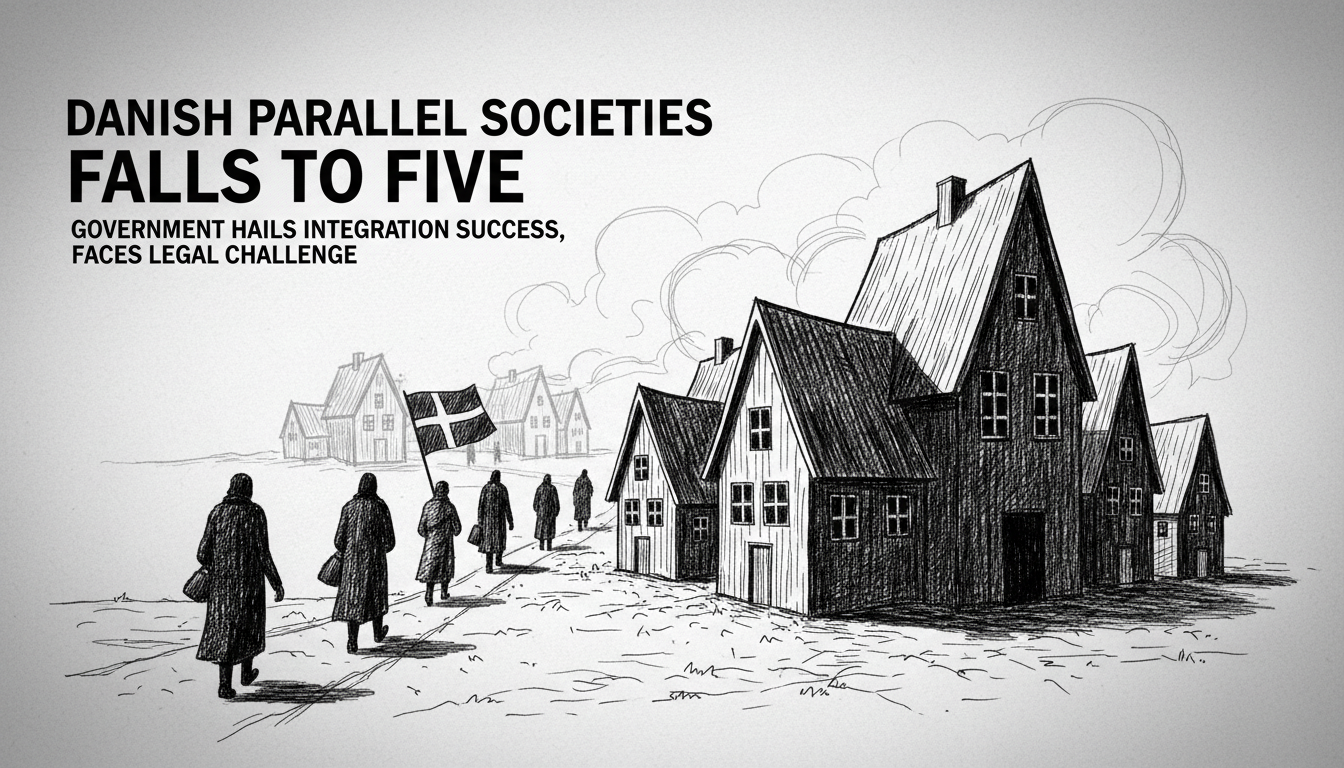
The Danish government's annual list of designated parallel societies has shrunk for the second consecutive year. The Social and Housing Ministry now identifies five residential areas meeting the strict criteria, down from eight the previous year and twelve the year before that. This official list, often a focal point of intense national debate on integration, was published on Monday. The areas remaining are Tåstrupgård in Høje-Taastrup, Sundparken in Horsens, Vollsmose in Odense, and Bispehaven and Gellerupparken/Toveshøj in Aarhus.
Social and Housing Minister Sophie Hæstorp Andersen stated the decline proves the government's legislation is working. She expressed satisfaction that more children can grow up in neighborhoods where the norm is to pursue education and employment. The minister also noted that older residents can feel greater security. Three areas—Askerød in Greve, Stengårdsvej in Esbjerg, and Skovvejen/Skovparken in Kolding—have been removed from the list because their share of convicted residents fell below the threshold.
To be classified as a parallel society, an area must have at least 1,000 residents where over 50% are immigrants or descendants from non-Western countries. It must also meet at least two of four additional criteria related to crime rates, education levels, income, and employment. The policy aims to dismantle residential segregation and has a political goal of eliminating all parallel societies by 2030. Areas on the list for five consecutive years become 'transformation areas,' requiring municipalities and housing organizations to draft plans to reduce social housing to 40% by the end of the decade.
This policy framework, however, faces a critical legal challenge. The Eastern High Court of Denmark has asked the European Court of Justice to rule on whether the Danish law's distinction between 'Western' and 'non-Western' immigrants constitutes ethnic discrimination, violating EU equality directives. The request stems from lawsuits where residents were evicted or relocated from social housing in previously listed areas. A final ruling is expected in the Third Quarter. Minister Andersen emphasized that a full assessment of the ruling's impact on Danish law cannot be made until the final verdict is delivered. She pledged the government would examine any decision carefully.
The concept, first introduced as a 'ghetto list' over a decade ago, was rebranded to 'parallel societies' in recent years. The annual publication consistently sparks discussion about the effectiveness of Denmark's integration model and the balance between social engineering and individual rights. While the government points to the falling numbers as a sign of progress, critics argue the metrics are blunt instruments that stigmatize entire communities. The data from Skovparken in Kolding illustrates this complexity. It was removed due to lower crime, but its proportion of non-Western residents and people outside the labor market actually increased. This shows improvement on one state metric does not necessarily reflect holistic social change. The ongoing EU court case underscores the deep tensions at the heart of Danish social policy, where a robust welfare state and strict immigration controls intersect.