
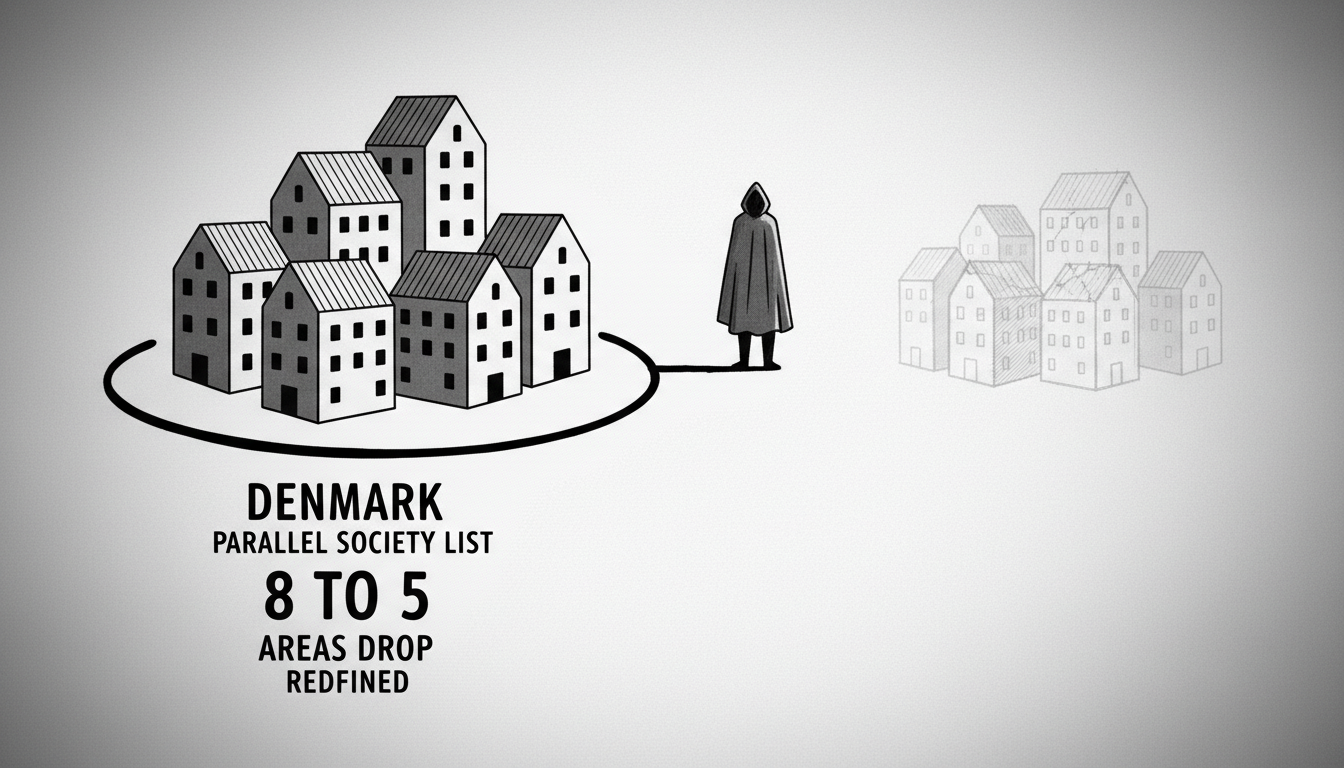
The Danish government has updated its official list of neighborhoods classified as parallel societies. The list now contains five areas, down from eight in the previous assessment. This change reflects ongoing shifts in Danish social policy and integration efforts. The criteria for designation remain strict and multifaceted, focusing on socio-economic integration rather than ethnicity alone.
A residential area can be labeled a parallel society if it has at least 1,000 residents in public housing where more than half are immigrants or descendants from non-Western countries. This demographic threshold alone is not enough. The area must also meet at least two of four additional criteria related to employment, crime, education, and income. These benchmarks are calculated as a two-year average to ensure consistency.
The first criterion examines labor market attachment. It requires that over 40 percent of residents aged 18 to 64 have no connection to employment or education. The second looks at crime, mandating that the conviction rate for serious offenses is at least three times the national average. The third focuses on education, stating that more than 60 percent of residents aged 30 to 59 possess only a basic education. The fourth criterion is economic, where the average gross income for taxpayers aged 15 to 64 must be below 55 percent of the regional average for that group.
This policy has real consequences for municipalities and housing organizations. When an area stays on the list for five consecutive years, it is legally defined as a 'transformation area'. This was previously termed a 'hard ghetto area'. This designation triggers mandatory action. The public housing organization and the local municipality must develop a plan to reduce the proportion of public family housing units to 40 percent.
Plans can include demolishing public housing blocks. Authorities can also build new private rental properties or sell existing public units to private landlords. The goal is to alter the physical and social structure of these neighborhoods. This approach is a cornerstone of Denmark's integration policy, which often links social mixing with successful integration outcomes.
Community leaders in Copenhagen have expressed mixed views on the policy. Some argue the criteria create a stigma that hinders investment and community pride. Others acknowledge the need for targeted interventions but question the emphasis on demolition. Officials maintain the policy is a necessary tool for social cohesion. They point to statistics showing that areas which have undergone transformation often see improved education and employment rates over time.
The reduction from eight to five areas suggests some neighborhoods are meeting benchmarks. This could indicate the effect of local development plans or broader economic trends. It also highlights the dynamic nature of urban communities in Denmark. The Danish welfare system traditionally intervenes actively in spatial planning to achieve social goals. This policy is a clear example of that principle in action.
From a personal perspective, having reported on integration for years, this policy reveals Denmark's pragmatic yet controversial approach. It directly ties welfare resources to measurable integration outcomes. The policy is not just about labels. It mandates concrete physical changes to housing stock. This reflects a belief that environment shapes social opportunity. The challenge remains balancing support for vulnerable communities with the demands of a universal welfare model. The updated list shows progress is possible, but the debate over methods continues.