
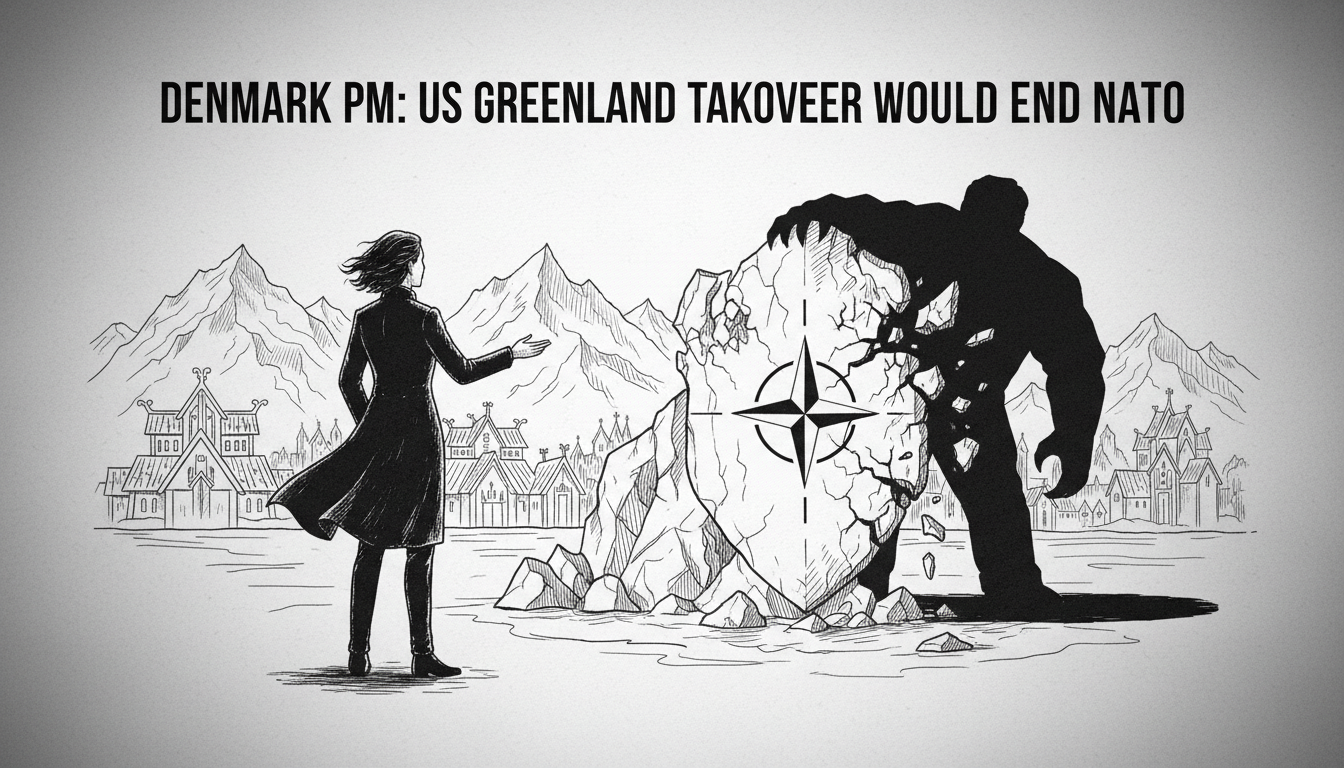
Danish Prime Minister Mette Frederiksen has declared that a potential American takeover of Greenland would signal the collapse of the NATO military alliance. The stark statement, made during a foreign policy debate, frames the island's status as a fundamental test for the alliance's principles and Denmark's sovereignty. It directly addresses long-standing speculation about U.S. strategic interests in the Arctic region, placing Danish and Greenlandic self-determination at the heart of transatlantic security.
A Sovereign Territory, Not a Transaction
Greenland is an autonomous territory within the Kingdom of Denmark, controlling most of its domestic affairs while foreign and defense policy remains in Copenhagen's hands. Prime Minister Frederiksen's comments reject any notion of the island as a geopolitical commodity to be traded. "The alliance is built on the sovereignty and equality of its members," Frederiksen argued. "If that sovereignty can be overridden for strategic gain, the foundational trust that binds NATO together disappears." This position reinforces Denmark's official stance, which has consistently opposed any sale or transfer of sovereignty since a controversial U.S. offer in 1946.
The Arctic Chessboard and Alliance Cohesion
The Prime Minister's warning is set against a backdrop of intense great-power competition in the Arctic. As climate change opens new shipping routes and access to mineral resources, the region's strategic value has soared. Both Russia and China have significantly increased their activities and investments in the Arctic circle. NATO has responded by reaffirming the Arctic as a region of strategic importance, with Denmark and Greenland playing key roles in monitoring and security. Frederiksen's statement suggests that an American annexation of Greenland, even if initially strengthening the U.S. position, would fundamentally undermine the cooperative, multilateral framework NATO relies on. It would transform an allied territory into a unilateral asset, creating deep fractures within the alliance itself.
Historical Echoes and Modern Realities
The specter of an American purchase is not new. In 1946, President Harry S. Truman offered Denmark $100 million in gold for Greenland. The Danish government refused, calling the idea "absurd." The issue resurfaced during the Trump administration, with the former president confirming his interest in buying the island, a proposal met with bewilderment and firm rejection in both Copenhagen and Nuuk. Frederiksen's latest intervention elevates the discussion from a diplomatic oddity to a grave matter of alliance integrity. She connects historical Danish sovereignty with the contemporary security architecture, arguing that compromising the former irrevocably damages the latter.
The Voice of Greenland
Crucially, any discussion of Greenland's future is incomplete without the perspective of its 56,000 inhabitants. The Greenlandic government in Nuuk has full autonomy over its natural resources and has increasingly sought a more independent voice in foreign affairs, particularly those relating to the Arctic. Aaleeraq M. Olsen, a political commentator based in Nuuk, notes, "The Prime Minister's statement aligns with the overwhelming sentiment here. We are not a piece of land to be sold. We are a people with the right to self-determination." He points out that Greenland's parliament would never approve such a transfer, making the hypothetical scenario a non-starter politically. Frederiksen's framing, therefore, also defends the democratic rights of Greenlanders under the Danish realm.
Analysis: A Strategic Line in the Ice
Frederiksen's declaration is less a prediction and more a strategic delineation of boundaries. By stating the consequence so unequivocally—the end of NATO—she aims to permanently take the idea off the table within allied circles. It is a preemptive safeguard against future geopolitical pressures. "She is articulating a red line," explains Lars Trier, a senior fellow at the Danish Institute for International Studies. "The message to Washington is that certain actions, however strategically tempting, have costs that far outweigh the benefits. It questions whether a unilateral gain in the Arctic is worth destroying the trust that enables collective defense in Europe and the North Atlantic." This reinforces Denmark's role as a steadfast NATO ally while firmly protecting its constitutional unity.
The Broader Implications for Danish Foreign Policy
This firm stance on Greenland reflects a broader trend in Danish foreign policy: a commitment to the rules-based international order and multilateral institutions. Denmark is a significant contributor to NATO missions and a consistent supporter of European Union foreign policy. Allowing the integrity of its own kingdom to be compromised would severely weaken its standing and influence in these forums. Furthermore, it would set a dangerous precedent for other alliance members with strategic territories, potentially inviting pressure on nations from the Baltics to the Mediterranean. Frederiksen's statement is thus a defense of a core principle that protects all smaller states within the alliance.
A Question of Trust and Future Security
The ultimate question posed by the Prime Minister's warning is about the nature of the transatlantic partnership. Can an alliance survive if its most powerful member views the territory of its allies as potential acquisitions? The strength of NATO has always relied on the collective guarantee of security, anchored in mutual respect for borders and sovereignty. By framing the issue in existential terms, Frederiksen forces a conversation about the limits of alliance politics in an era of renewed great-power rivalry. The future of Arctic security, she implies, must be managed through cooperation between Nuuk, Copenhagen, and NATO—not through unilateral territorial changes that would shatter the alliance's very foundation. The ice in Greenland, it seems, is not the only thing that would fracture.