
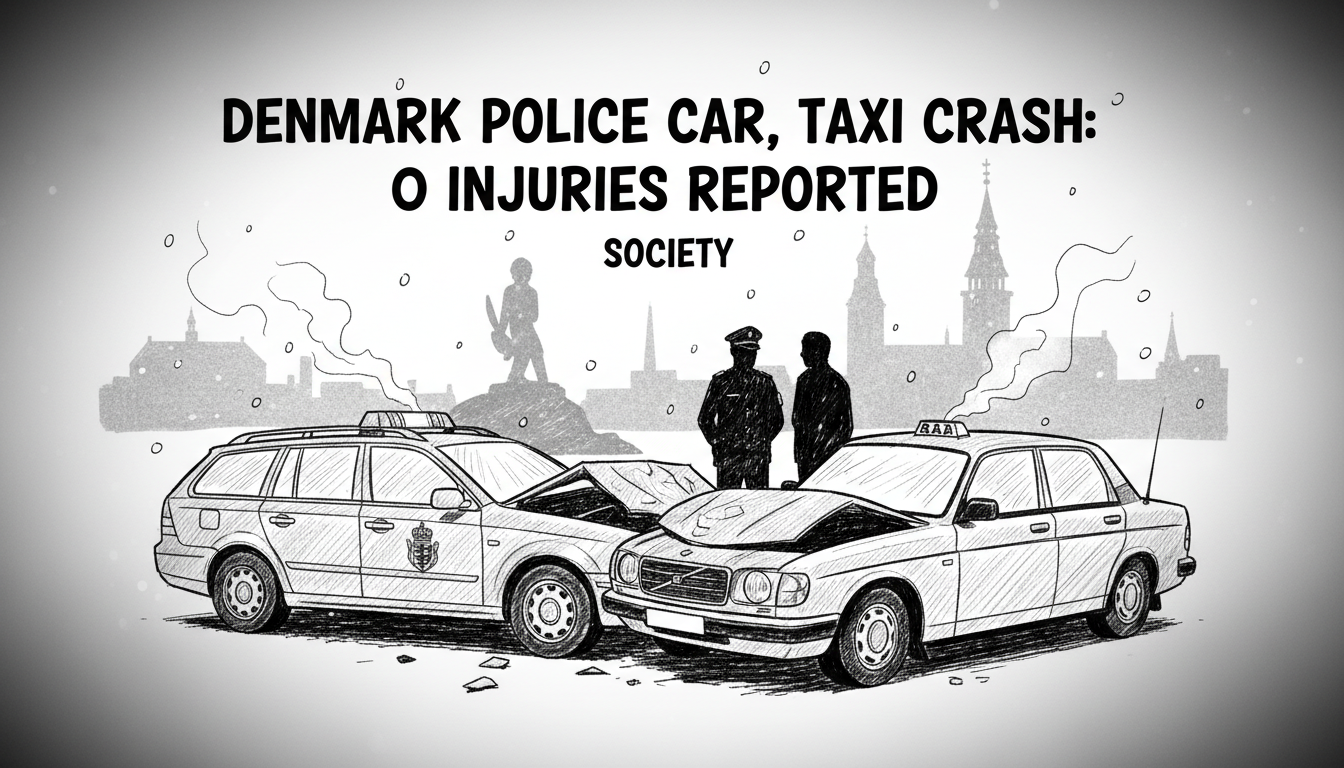
Denmark police car and taxi collided in a dramatic accident at a central Copenhagen intersection early Saturday morning. The incident occurred on Dronning Louises Bro, a major artery connecting the city center with the Nørrebro district, while the police vehicle was responding to an emergency call. Both cars sustained significant material damage, but authorities confirmed no serious injuries resulted from the crash, a fortunate outcome given the potential for tragedy at such a busy location.
I approach this story not just as a reporter, but as a Copenhagen resident who cycles across that very bridge. The screech of tires and the crunch of metal there is a sound no one wants to hear. This specific crash, involving an emergency vehicle with its legal right of way, opens a complex discussion about urban safety, responsibility, and the pressures within our shared public space. It is a stark reminder of the split-second decisions that define safety in a dense, multi-modal city.
A Collision at the Heart of the City
The accident happened in the pre-dawn hours of Saturday at a traffic light intersection on the approach to Dronning Louises Bro. According to Michael Andersen, the watch commander for Copenhagen Police, the patrol car was "under udrykning"—a Danish term meaning it was on an urgent emergency response with activated lights and sirens. The taxi, a common sight at all hours, was involved in the collision at the junction. The bridge itself is a critical piece of Copenhagen's infrastructure, famously crowded with thousands of cyclists and pedestrians daily, though vehicle traffic is also constant.
Initial reports focused on the material damage to both vehicles, which was substantial enough to require recovery. The immediate priority for officers on scene was securing the area to prevent secondary accidents and checking the welfare of both drivers. The fact that neither the police officers nor the taxi driver suffered serious physical harm is the most significant detail of this event. In a different scenario, with different timing, the outcome on such a fast-moving route could have been severe.
The Legal and Investigative Maze of Emergency Response
When a police car on an emergency call is involved in an accident, the investigative process becomes inherently more complex. Standard traffic accident analysis examines right-of-way, traffic light sequences, and speed. An emergency response adds layers of legal interpretation regarding the vehicle's privileges and duties. Danish traffic law grants emergency vehicles certain exemptions when using audible and visual signals, but this does not absolve drivers of a "duty of care" to avoid accidents.
"These investigations are meticulous," explains a former traffic unit officer who wished to remain anonymous as the case is active. "We look at data from the vehicles, the exact timing of the signal cycles, and crucially, witness statements. The question is never just 'who had green?' It's about whether the emergency signals were perceivable in time for other road users to react appropriately." The Copenhagen Police have confirmed that witness interviews are now a key part of their investigation to clarify the sequence of events.
This legal gray zone places a heavy burden on all parties. The police driver must navigate traffic at speed while assessing risks. Civilians, whether in cars, on bikes, or on foot, must identify the direction of sirens and react swiftly and safely. In the dense, echo-prone urban canyon of central Copenhagen, this is a formidable challenge. The stress is palpable for everyone involved in such moments.
Urban Density and the Constant Negotiation of Space
Copenhagen's success as a cycling and walking city comes with its own set of traffic dynamics. Infrastructure is designed to prioritize bicycles and public transport, which can sometimes create unexpected friction points for vehicles. Dronning Louises Bro is a prime example: a wide bridge where cycling lanes are perpetually busy, pedestrian sidewalks are full, and vehicle lanes are relatively narrow. For a driver, the sensory load is high—checking for cyclists, watching lights, and now, potentially listening for the sirens of an approaching emergency vehicle.
Accidents involving vehicles, while not uncommon statistically, always prompt municipal reviews of specific intersections. The City of Copenhagen's technical and environmental administration regularly analyzes collision data to implement design changes, such as improved signage, adjusted light timing, or lane modifications. This incident will likely add another data point to their ongoing work. The goal is a system where all modes of transport, including emergency services, can coexist with minimal conflict, acknowledging that perfect safety is an aspiration, not a guarantee.
The Human Factor in a Split Second
Beyond the legal and infrastructural analysis lies the human element. The taxi driver, going about their nightly work, faced a sudden, terrifying event. The police officers, transitioning from a routine patrol to a high-stakes emergency response, found themselves in a crash. The psychological impact of such an incident, even without physical injury, should not be underestimated. It shakes the sense of security and control that every driver relies upon.
For the community, it serves as a sobering reminder. We share these streets under an implicit social contract. We agree to follow rules and stay alert so that everyone, including those rushing to help in a crisis, can move safely. This contract is tested every time an ambulance, police car, or fire truck needs to pass through. The incident on Dronning Louises Bro questions how well that contract is holding up in the pressure cooker of modern city life. Are we, as a society, still able to make way effectively when it matters most?
A Look Forward: Safety in a Multi-Modal City
The investigation will conclude, insurance claims will be processed, and the vehicles will be repaired or replaced. But the broader conversation this accident sparks is more enduring. How do Danish cities continue to evolve their traffic systems to protect all users? This includes ensuring that the vital work of emergency responders is not unduly hampered by congestion, while also safeguarding civilians from the increased risks that emergency responses unavoidably create.
Copenhagen and other Danish municipalities invest heavily in intelligent traffic systems that can give priority to emergency vehicles by turning lights green along their route. The expansion of such technology could be one tangible outcome from analyzing crashes like this one. Another is renewed public education on how to correctly yield to emergency vehicles in complex urban environments—a skill that is not as intuitive as many assume.
As the morning light washed over Dronning Louises Bro on Saturday, the evidence of the crash was cleared away. The flow of bicycles and cars resumed, uninterrupted. But the questions raised by those few seconds of collision linger. They force us to confront the fragile balance of our urban ecosystem, where law, technology, infrastructure, and human judgment intersect, sometimes with a deafening crash. The true measure of this incident's impact will be whether it leads to quieter, safer streets for everyone, including those who race to our aid when the worst happens.