
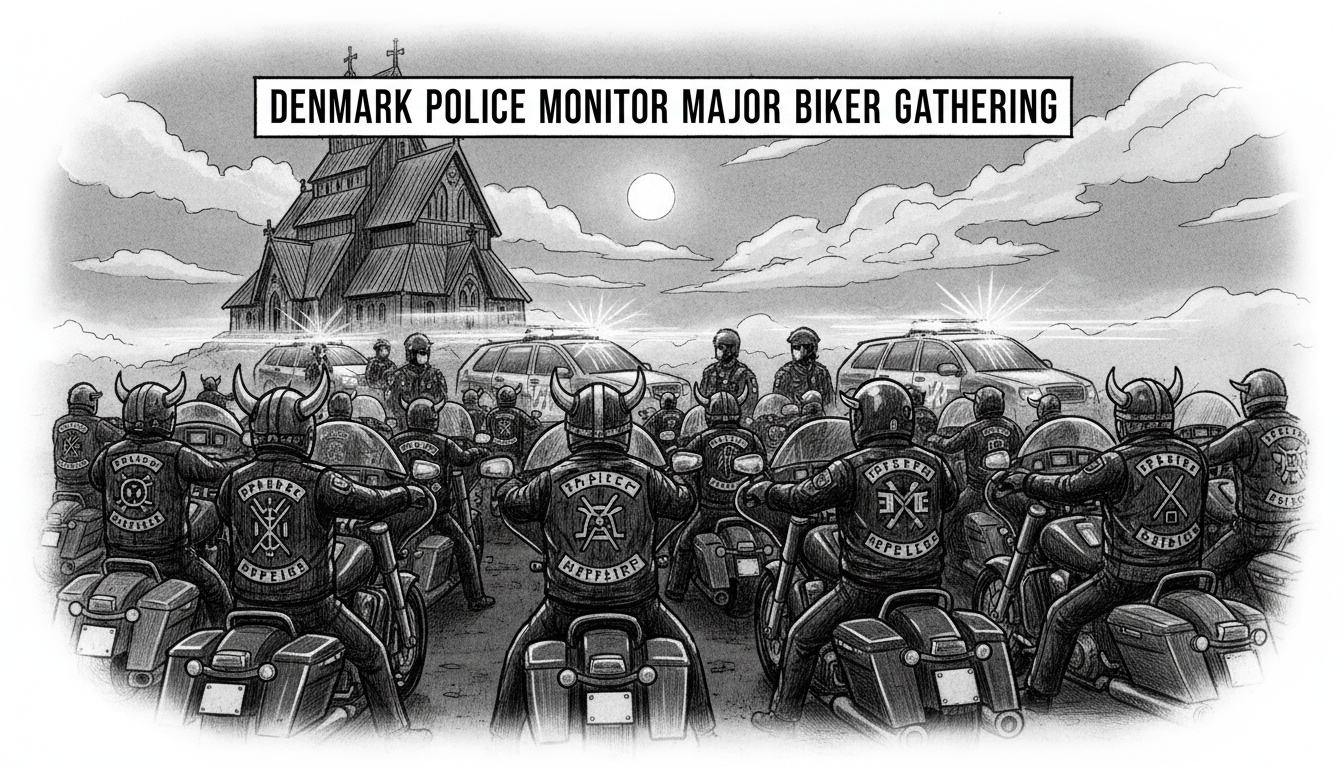
Denmark police maintained a massive, uninvited presence at a motorcycle club gathering in the small East Jutland village of Løsning this weekend. Officers from Sydøstjyllands Politi checked every guest arriving and departing from a property on Skolegade, where the Comanches MC club held a large-scale party. The operation aimed to monitor movements and ensure peace for local residents in Hedensted Municipality, continuing a pattern of intense police scrutiny at similar events.
A Calculated Display of Force
The scene in Løsning was one of deliberate, visible policing. Authorities had announced their intentions beforehand, stating on social media platform X that they would be present around the address. This transparency forms part of a broader Danish strategy of preventive policing against groups labeled as outlaw motorcycle gangs. Police did not wait for an incident to occur but positioned themselves as a constant deterrent throughout the afternoon and evening. Their stated goal was clear: to use every legal tool available to prevent gang-related crime and alleviate unease among citizens and neighbors. This approach treats the gathering itself as a potential public order event requiring management, not merely a private party.
Such operations represent a significant allocation of resources. Deploying teams to monitor a single event in a small village involves personnel from traffic units, local patrols, and sometimes specialized task forces. The cost is justified, authorities argue, by the potential prevention of more serious crime and the symbolic message it sends. For residents of Løsning, the sight of numerous police vehicles creates a paradoxical atmosphere. It simultaneously signals security and underscores a latent threat, transforming a quiet street into a temporary security zone. The welfare state's protective arm extends here in its most direct and unambiguous form.
A Recurring Pattern of Intervention
This weekend's operation is far from an isolated incident in the history of the Comanches MC. Last year, the club planned a major celebration in Esbjerg to mark a chapter's transition from a probationary to a full-status division. That event was preemptively canceled after the local municipality and police district issued a assembly ban in the days leading up to it. The celebration was subsequently moved to Strømmen, near Randers, where police were also present in force. That earlier intervention yielded direct results: seven individuals were charged with narcotics possession, and two reports were filed for possession of doping substances.
These repeated interventions highlight a proactive, and some would argue aggressive, policing model. Danish authorities are not merely reacting to crimes but actively shaping the environment in which these groups operate. The use of assembly bans, a powerful administrative tool, demonstrates a willingness to stop gatherings before they even begin. This legal mechanism shifts the burden, effectively requiring the group to prove their event will not disturb public order. When gatherings do proceed, the police presence ensures a high likelihood of interceptions for minor offenses, from traffic violations to possession charges, which can lead to broader investigations.
The Balancing Act of Security and Liberty
The Danish strategy sits at the complex intersection of community safety and civil liberties. From a law enforcement perspective, the benefits are tangible. A visible presence disrupts potential criminal planning, deters overt displays of force or intimidation, and allows for immediate intervention. It collects intelligence on members and associates, and it reassures the public that the state maintains control. Experts on organized crime often support such high-visibility policing as a necessary tactic to contain groups involved in drug trafficking, violence, and extortion.
However, the approach inevitably draws scrutiny. Civil liberties advocates raise questions about proportionality and the right to peaceful assembly. When does monitoring become intimidation? Does a blanket assumption of criminal intent for all attendees at a private gathering align with principles of innocent until proven guilty? The police operation in Løsning targeted everyone associated with the event, not individuals with specific warrants or probable cause. This collective scrutiny, while legally sanctioned under Danish public order provisions, tests the boundaries of preventive justice in a democratic society.
For the members and guests of the Comanches MC, the police presence is a routine and expected part of their social landscape. It formalizes a relationship of mutual observation and suspicion. The party in Løsning continued despite the police cordon, a testament to a normalized state of affairs where celebration occurs under the watchful eye of the state. This dynamic creates a peculiar social theater where both sides perform their roles—one of fellowship, the other of oversight—within a tightly managed framework.
The Local Impact in a Global Context
In the village of Løsning, the event temporarily placed a local community on the national map of gang policing. For Hedensted Municipality, it was a day requiring coordination between local law enforcement and possibly regional units. The Danish model of policing motorcycle clubs is notably hands-on compared to some other nations, where surveillance may be more discreet or reactive. This stems from a societal consensus within Denmark that views the activities of outlaw motorcycle gangs as a direct threat to social cohesion and the safety of the welfare state.
The resources dedicated to monitoring a single gathering reflect this high-priority status. It is a policy driven by past conflicts, such as the violent gang wars of the 1990s and 2000s, which left a deep imprint on Danish public safety policy. The goal is not just to solve crimes but to prevent the territorial entrenchment and public dominance these groups seek. By occupying the physical space around their events, police deny them any semblance of uncontested control, even on private property. This constant pressure aims to make operational life difficult and to limit recruitment by undermining the groups' image of invulnerability.
The Unending Watch
As the cars and motorcycles eventually left Skolegade in Løsning, the police presence likely tapered off. Yet the underlying vigilance remains. The data collected, the charges potentially filed from traffic stops, and the intelligence gathered will feed into ongoing assessments. The Comanches MC and other similar groups will plan their next event, and the police will again evaluate whether and how to intervene. This cyclical dance between club and authority is a permanent feature of Denmark's law enforcement landscape.
The strategy raises enduring questions about effectiveness and cost. Does it merely displace activity, or does it genuinely degrade criminal capabilities? Does the public feel more secure seeing such shows of force, or does it amplify perceptions of threat? For now, the Danish state has answered these questions with action. The message from the rolling hills of East Jutland is unequivocal: certain gatherings will not occur without the state as an uninvited guest, watching, checking, and asserting its monopoly on public order. The quiet return to normalcy in Løsning is not an end, but merely an intermission until the next chapter in this ongoing story of surveillance and social control unfolds.