
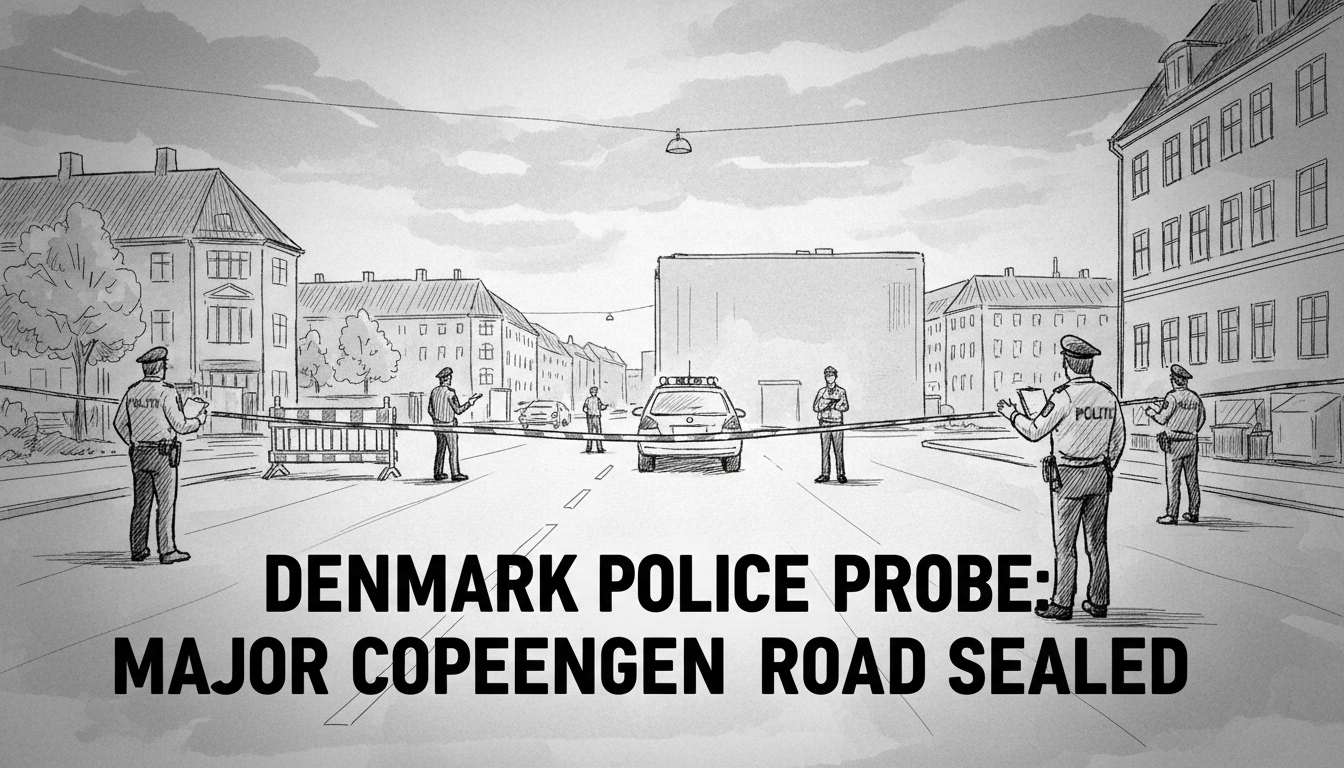
Copenhagen police have cordoned off a section of a major city road for several hours to investigate a suspicious incident. The operation on Frederiksborgvej began at 9:30 AM Saturday, involving investigators, patrol units, and police dogs. Authorities have not yet provided details about the nature of the incident, which they describe only as a 'mistænkeligt forhold' or suspicious circumstance. The scene includes part of the road in front of an apartment building, with officers also examining a specific apartment within the block.
"We are still out there and cannot yet report anything," duty officer Anders Frederiksen said in a statement to news media shortly after 1 PM. His brief comment underscores the ongoing and sensitive nature of the police work. Frederiksborgvej is a significant arterial route running northwest from Copenhagen's city center, lined with a mix of residential and commercial properties. The prolonged closure of part of this road indicates a substantial police commitment to the scene.
A Community in Waiting
For residents living in the apartment blocks along Frederiksborgvej, Saturday morning transformed from ordinary to unsettling. The sudden arrival of police vehicles and the establishment of a cordon disrupted the typical weekend calm. Neighbors watched from windows as officers in uniform and plain clothes moved with deliberate focus. The presence of police dogs added another layer of gravity to the scene, signaling a search for specific evidence, possibly narcotics or explosives.
Such incidents, while not daily occurrences, test the fabric of urban Danish society. They momentarily puncture the sense of security that defines life in Copenhagen for many. The police's tight control of information, while standard procedure, leaves a vacuum filled by quiet concern and speculation among those directly affected. This balance between investigative necessity and public transparency is a constant challenge for authorities in Denmark's close-knit urban communities.
The Mechanics of a Danish Police Response
The Danish police response to a 'mistænkeligt forhold' follows a calibrated protocol. The initial call triggers a risk assessment, determining the scale and composition of the dispatched units. The involvement of multiple resources—patrol officers for securing the perimeter, investigators for evidence collection, and specialized dog units—points to a scenario deemed to have potential serious consequences. The goal is always to secure the scene, ensure public safety, and methodically gather facts without premature conclusions.
Copenhagen Police, like all Danish police districts, operate under the principle of 'politiets arbejdsmetode' or police working methods. This emphasizes systematic, evidence-based investigation. The cautious public statements are a hallmark of this approach; officials will not comment until they have verified information to avoid spreading misinformation or compromising the inquiry. This methodical pace can frustrate public curiosity but is designed to protect the integrity of any potential legal proceedings.
Urban Security in a Nordic Capital
Copenhagen consistently ranks as one of the world's safest capitals, a fact embedded in its social policy and urban planning. Incidents requiring major police cordons therefore stand out sharply against the norm. They prompt reflections on the nature of urban safety, which in Danish policy extends beyond policing to include social welfare, integration programs, and proactive community engagement. The location on Frederiksborgvej, a diverse area, brings these broader societal questions into focus, even without knowing the incident's specifics.
Danish social policy often aims to prevent crime through inclusion rather than just responding to it. Municipalities fund community centers and local initiatives to foster social cohesion. When a police operation of this scale occurs, it momentarily shifts the focus from prevention to response. It highlights the ongoing work required to maintain security in a dynamic, international city. The incident serves as a reminder that safety is an active achievement, not a passive condition, even in societies with strong welfare networks.
The Information Vacuum and Public Trust
By early afternoon, with details still scarce, the story existed in a space between official silence and public awareness. This gap is where public trust in institutions is either reinforced or strained. In Denmark, trust in police remains relatively high compared to many other countries, built on a tradition of transparency and community policing. However, prolonged silence during active situations can test that trust, especially for residents directly inconvenienced or alarmed by the cordon.
The police face a difficult calculation. Releasing unconfirmed information risks causing unnecessary panic, compromising an investigation, or unfairly implicating individuals. Remaining silent fuels speculation and anxiety. Navigating this requires careful communication strategy. Typically, Danish police will release more information once the immediate scene is secured and initial facts are clear, often through a press briefing or a detailed online update. The waiting period is a tense, but standard, phase of such operations.
Looking Beyond the Cordon
The true impact of Saturday's event will depend on what the investigation ultimately reveals. It could range from a resolved false alarm to the discovery of a serious criminal plot. Each outcome carries different implications for the community and for policy. A minor conclusion might be a brief news item; a serious one could spark debates on resource allocation for police, surveillance policies, or social interventions in specific Copenhagen neighborhoods.
For now, the scene on Frederiksborgvej represents a pause in the ordinary life of the city. It is a snapshot of the mechanisms that activate when the normal order is potentially threatened. The blue lights, the yellow tape, and the focused officers are visible signs of a system designed to assess and neutralize risk. They are a manifestation of the social contract, where citizens grant authority to institutions tasked with preserving safety, even when their methods are momentarily opaque.
As the afternoon progresses, residents await the all-clear and an explanation. The police, meanwhile, continue their meticulous work within the cordon, piecing together the narrative of a suspicious circumstance on a Copenhagen Saturday. The resolution will close this specific incident, but the questions it raises about security, transparency, and urban life in one of the world's most livable cities will linger longer.