
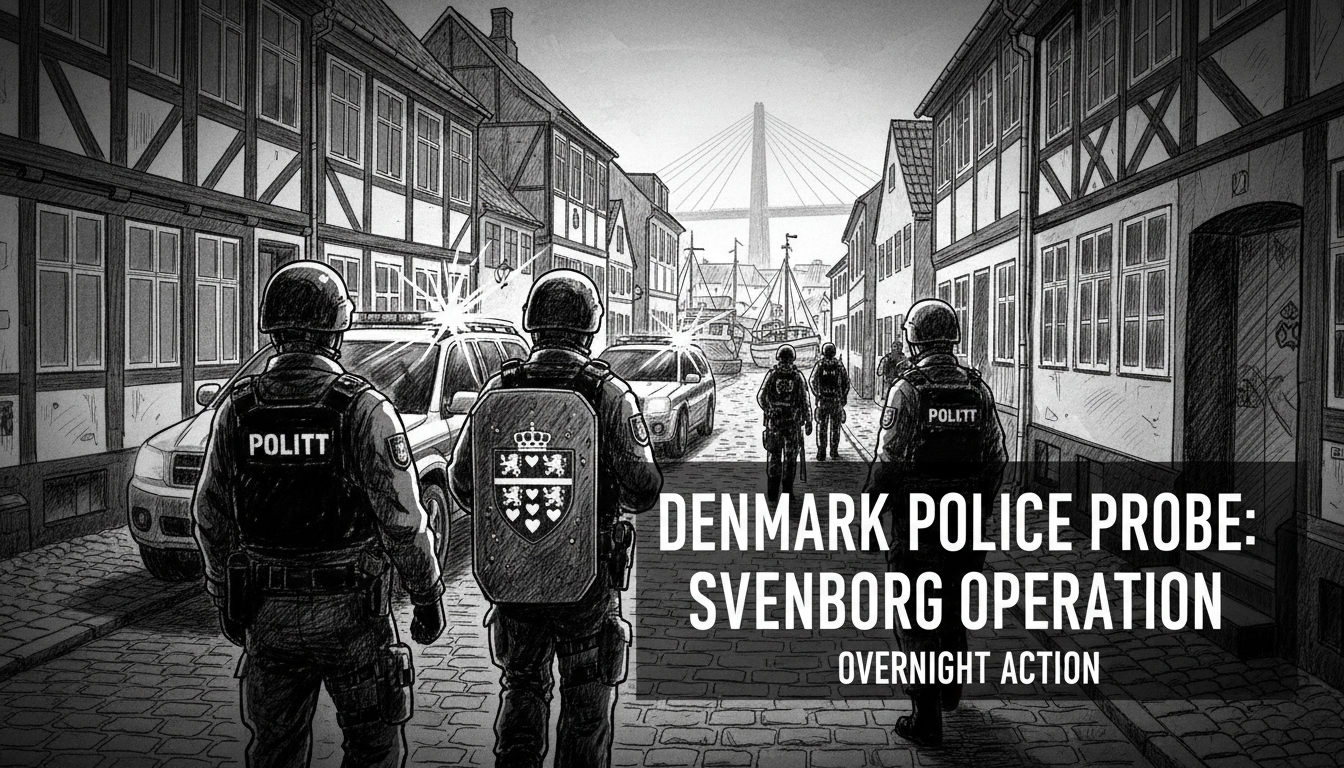
Denmark police are maintaining a significant presence on a quiet street in Svendborg, with officers stating they will remain at a Sanddalsvej address throughout the night. Fyns Politi, the regional force for Funen, confirms it is investigating a 'mistænkeligt forhold'—a suspicious circumstance—but is releasing no further details. The operation's scale and duration, announced by duty commander Henrik Strauss, suggest a serious incident requiring meticulous forensic work. This unfolding situation in a typically tranquil town highlights the unpredictable nature of police work across Danish municipalities.
A Nighttime Investigation in a Sleepy Town
Svendborg, a picturesque town on Funen's southern coast, is known for its maritime history and calm atmosphere. The police activity on Sanddalsvej presents a stark contrast to the town's usual rhythm. Residents reported seeing multiple patrol cars and officers in protective gear cordoning off an area. 'We are present at the address and will investigate the suspicious circumstance,' Henrik Strauss stated, emphasizing the ongoing nature of the probe. He assured local residents there was no need for public concern, a standard message intended to prevent panic while acknowledging unusual police activity. Such operations, while rare in smaller communities, are a core function of Denmark's decentralized police structure.
The Weight of 'Mistænkeligt Forhold'
The Danish term 'mistænkeligt forhold' carries specific legal and operational weight. It allows police to secure a scene and initiate an investigation without immediately declaring a crime. This could range from discovering evidence of a break-in at an abandoned property to responding to a welfare check that reveals unsettling signs. 'The phrase is a procedural tool,' explains a former detective with knowledge of Funen Police operations. 'It grants authority to preserve a scene and collect evidence while the initial picture is still unclear. The decision to stay overnight tells us they have found something that requires immediate, secure processing.' This approach balances investigative needs with public transparency, often leaving communities with more questions than answers in the short term.
Community Impact and Police Communication
In towns like Svendborg, where community cohesion is strong, unexplained police operations can generate significant local anxiety. The police statement directly addresses this by telling people not to be nervous. This tactic is part of a broader Danish policing strategy focused on maintaining public trust. Effective communication from local social centers and municipal authorities often follows in such situations. They work to provide context without compromising the investigation. The presence of a duty commander like Strauss giving a statement indicates a coordinated effort to manage public information. For international observers, this demonstrates a system where even localized incidents receive structured communication from senior officers.
Analyzing the Overnight Commitment
The commitment to work through the night is a key detail. It signals that evidence is time-sensitive or that the scene itself—perhaps a residential property—needs to be processed before normal life resumes. It could involve forensic specialists from the National Police's technical unit, who are dispatched for serious cases across regions. 'An overnight investigation is resource-intensive,' notes a security analyst familiar with Scandinavian police methods. 'It implies they are treating the location as a primary scene of potential significance. In Denmark, this level of response is not deployed lightly.' The operation draws on the integrated welfare model, where police, social services, and health authorities have protocols for joint response scenarios.
The Broader Context of Danish Policing
This incident offers a window into the daily work of Denmark's police beyond major cities. Fyns Politi handles everything from traffic violations to serious crime across Funen. Their work is guided by the same principles of proportionality and thoroughness applied in Copenhagen. Denmark's overall crime rates are relatively low, which makes a sustained, cryptic operation more noticeable. The police system relies on high public confidence, which can be strained during opaque investigations. However, the restraint in releasing information is typically justified by the need to ensure investigative integrity and protect the rights of all involved, including potential victims or suspects.
What Happens Next in Svendborg
The coming hours and days will determine the direction of this case. Police may release a statement clarifying the nature of the incident, or details may emerge through local media reporting. The investigation could follow several paths: it may conclude rapidly if the 'suspicious circumstance' is resolved, or it may evolve into a larger criminal inquiry. The community's response will also be telling. Danish society often shows resilience and cooperation during police investigations, reflecting a general trust in public institutions. This trust is a cornerstone of the social policy that underpins daily life, even when its protective mechanisms, like a nighttime police presence, become highly visible.
A Reflection on Security and Society
An overnight police operation in a small Danish town ultimately reflects the balance between security and normalcy. Denmark's social model promises safety and order, delivered through professional institutions. That model is tested when those institutions must act in secrecy to uphold their duties. For the residents of Sanddalsvej, the sight of police tape and flashing lights is a disruption. For the officers involved, it is a meticulous process of evidence collection and assessment. The story, while currently defined by an absence of facts, is a reminder that the work of maintaining a peaceful society is often complex, deliberate, and conducted out of plain sight. The full story of what happened on Sanddalsvej will be defined by the evidence gathered in the darkness, long before the sun rises on Svendborg.