
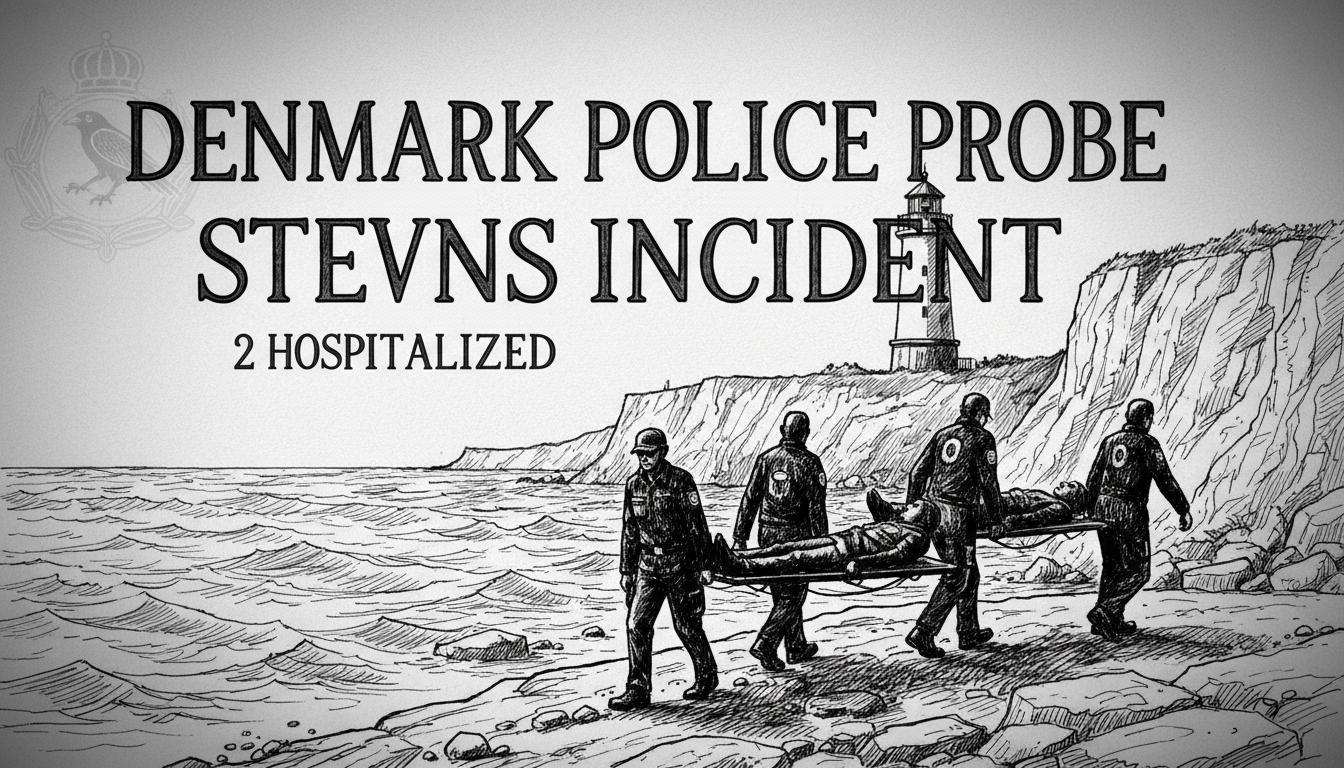
Denmark police are investigating a possible criminal offense after two people were hospitalized following an incident in a coastal town. Sydsjællands Politi responded to Brombærvej in Faxe Ladeplads late Sunday night. The regional police force confirmed the two injured individuals were taken for hospital treatment. Forensic technicians were also dispatched to conduct a detailed scene investigation. The police communications department has declined to provide further details, stating only that the case remains under active investigation. This event has unsettled the quiet community on the Stevns peninsula, an area better known for its dramatic UNESCO-listed cliffs than for violent crime.
A Quiet Coastal Community Reacts
Faxe Ladeplads is a small harbor town within the Stevns municipality, situated roughly 80 kilometers south of Copenhagen. The region is characterized by its rural landscapes, summer tourism, and the geological significance of Stevns Klint. Incidents requiring forensic technicians and hospitalizations are rare in such locales. Local residents often express a strong sense of safety and community cohesion. The police presence and the nature of the investigation have therefore generated significant local concern and speculation. Community leaders have urged calm while authorities complete their work. The limited official information has created a vacuum often filled with rumor, a challenge familiar to police in close-knit areas.
The Deliberate Pace of a Police Investigation
The restrained communication from Sydsjællands Politi is a standard, deliberate strategy in ongoing investigations. Releasing minimal details helps preserve the integrity of the inquiry and prevents the contamination of witness testimonies. It also allows investigators to verify facts before making public statements. "When police describe an event as a 'possible criminal offense' and withhold specifics, it typically indicates they are treating the scene as a crime scene but are still determining the exact circumstances," explains a former detective with experience in regional Danish police forces. This approach prioritizes procedural correctness over immediate public disclosure, especially in sensitive cases potentially involving serious harm.
Forensic technicians play a critical role in this phase. Their work involves documenting the scene, collecting physical evidence, and analyzing details not visible to the naked eye. Their involvement, as confirmed by images from the scene, signals that police are building a forensic case. This could range from analyzing potential weapons to reconstructing events through blood pattern analysis or ballistic evidence. The time between the Sunday night response and the Monday morning statement was likely consumed by securing the area and initiating this meticulous forensic process.
Contextualizing Crime in Rural Denmark
While Denmark consistently ranks as one of the world's safest countries, no region is immune to isolated violent events. Statistics from the Danish National Police show that the vast majority of serious violent crimes occur in larger urban areas. The South Zealand and Lolland-Falster region, policed by Sydsjællands Politi, generally reports lower rates of violence against the person compared to Copenhagen or Aarhus. However, localized incidents can dramatically impact the perceived safety in small communities where everyone knows each other. A single serious event can reshape a community's self-image for years.
This incident also highlights the operational structure of Danish policing. Denmark is divided into 12 police districts, with Sydsjællands and Lolland-Falsters Politi covering a large, partly rural area. Resources like forensic teams and specialized investigators are centralized but deployed across the district as needed. An event in a small town like Faxe Ladeplads draws on this pooled regional expertise. The response demonstrates the system's capacity to mobilize investigative resources to any location, regardless of its size or usual crime levels.
The Human Impact Beyond the Headline
Behind the police terminology of "possible criminal offense" and "two persons injured" are individuals, families, and a community in distress. The human impact of such an event radiates far beyond the immediate victims. Neighbors on Brombærvej and throughout Faxe Ladeplads are confronted with uncertainty and fear. Local shop owners, school administrators, and municipal workers in Stevns Kommune must navigate the aftermath while maintaining daily routines. For a municipality whose identity is tied to natural heritage and tranquility, managing the social and psychological fallout is as important as the police investigation.
Danish social policy and the welfare system have frameworks for supporting victims of crime and traumatized communities. Municipal social services and victim support organizations can be activated. The role of the local community center or 'borgerhus' often becomes crucial in such times, providing a neutral space for residents to gather and access information. The Stevns municipal administration, in coordination with police, faces the task of communicating effectively to reassure citizens without compromising the investigation—a delicate balance between transparency and necessity.
Awaiting Answers in the Shadow of the Cliffs
As the investigation continues, the community of Stevns waits. The white cliffs of Stevns Klint, which have stood for millions of years, are a silent backdrop to a very current human drama. The coming days will determine whether this was a tragic but isolated conflict, an accident with criminal negligence, or something more systemic. The police's next update will be scrutinized for clues about the victims' conditions, the nature of the suspected offense, and whether any arrests are imminent.
The case serves as a reminder that safety is a fragile construct, even in Denmark's picturesque rural corners. It tests the responsiveness of regional police and the resilience of local social bonds. For now, the official line remains one of cautious investigation. The full story of what happened on Brombærvej in the dark hours before Monday remains, like the details of the police case, undisclosed. The hope in Faxe Ladeplads is for a swift resolution that restores peace to the coastal town and provides clarity to all affected.