
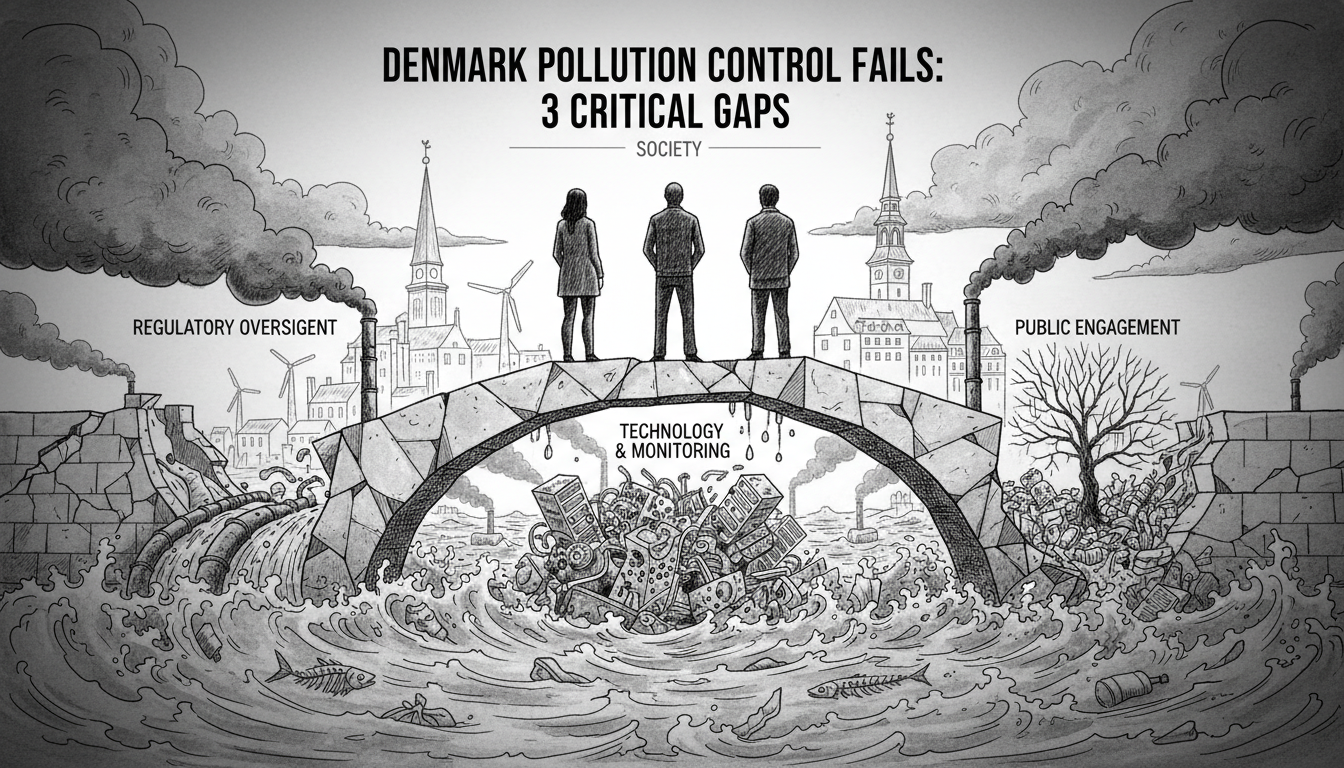
Denmark's environmental regulation system is failing to control the country's most polluting companies, according to a damning new report from the State Auditors. The report, presented at Christiansborg, delivers sharp criticism of the Ministry of Environment and the Environmental Protection Agency (Miljøstyrelsen) for inadequate oversight in the approval and re-evaluation of high-impact industrial sites. "It is ultimately Danes and Danish nature that pay the price for the deficient pollution control," said the chairman of the State Auditors, framing the findings as a direct threat to public health and Denmark's green reputation.
This systemic failure strikes at the heart of Denmark's international image as a sustainability leader. For a nation that champions ambitious carbon neutrality goals and exports green technology worldwide, the auditors' conclusion that authorities are not complying with their own legal mandates for industrial oversight represents a significant credibility gap. The report suggests the foundational controls meant to protect water, soil, and air from industrial contaminants are not functioning as intended.
A System Under Scrutiny
The State Auditors' investigation focused on the processes governing "particularly polluting" companies—a classification for industrial operations with the highest potential environmental impact. These include large waste treatment facilities, chemical plants, and major manufacturing sites. The report identifies critical weaknesses in both the initial approval of these facilities and the legally required periodic re-evaluations of their environmental permits.
According to the findings, the Environmental Protection Agency has not established a systematic, risk-based approach for this oversight. This leads to inconsistent enforcement and potentially allows violations to go unchecked for extended periods. The ministry's role in setting clear guidelines and ensuring adequate resources for the agency also came under fire. In essence, the regulatory framework exists on paper, but the operational execution is lacking, creating enforcement gaps that companies may exploit.
The Economic and Reputational Cost
The implications extend far beyond environmental damage. Experts point to substantial long-term economic costs. "Insufficient environmental control directly leads to increased public healthcare costs and expensive remediation projects that taxpayers ultimately fund," noted a senior environmental economist at the University of Copenhagen, who reviewed the report's summary. Contaminated soil and water are notoriously costly to clean, and the burden often falls on the public sector long after the responsible company has ceased operations.
For Danish businesses, especially in the thriving clean-tech sector, this regulatory failure poses a reputational risk. Denmark's brand as a green pioneer is a key competitive advantage in global markets. "When the home country's enforcement is seen as weak, it undermines the message of our green exporters," said the CEO of a prominent Copenhagen-based renewable energy firm. "Our partners abroad expect our domestic practices to match our international advocacy." This dissonance could affect trade relations and investor confidence, particularly from funds with strict environmental, social, and governance (ESG) criteria.
Structural Flaws and Missing Data
A core issue highlighted is the lack of a comprehensive, centralized data system to track compliance and inspections. The auditors found that the Environmental Protection Agency cannot reliably document whether all mandated re-evaluations of polluting companies have been carried out. This data gap makes it impossible for the agency—or the public—to assess the overall effectiveness of the control regime or to prioritize resources based on actual risk.
Furthermore, the report suggests that the ministry has not provided sufficient political steering or allocated adequate resources to address these known shortcomings. The problem appears to be one of both management and capacity. Without a clear directive from the top and the tools to execute it, the agency's inspectors are left navigating a complex landscape with incomplete information. This operational environment makes proactive, preventative regulation nearly impossible, shifting the model to reactive responses after pollution events occur.
The Path to Remediation
The State Auditors do not merely catalog failures; they implicitly call for a significant overhaul. The necessary steps are clear, if challenging: implement a unified digital management system for all environmental permits and inspections, establish a transparent risk-assessment model to guide oversight activities, and ensure the Environmental Protection Agency has the legal mandate and budgetary support to fulfill its duties.
Accountability must also be strengthened. The report indicates that the consequences for companies found in violation are often insufficient to deter non-compliance. Strengthening penalty structures and ensuring their consistent application would be a logical component of any reform. The Ministry of Environment now faces pressure to present a concrete action plan with timelines to address every criticism in the report. Parliamentary committees are expected to summon the Environment Minister for questioning in the coming weeks.
A Test for Green Ambitions
This episode serves as a stark reminder that ambitious climate targets and a history of environmentalism are not enough. Effective on-the-ground regulation is the unglamorous, essential backbone of any green transition. Denmark's goal of reducing greenhouse gas emissions by 70% by 2030 and achieving climate neutrality relies heavily on curbing industrial pollution. If the state cannot monitor and enforce rules for today's pollution, confidence in its ability to manage tomorrow's complex transition evaporates.
The report from the State Auditors is more than a bureaucratic critique; it is a warning about the erosion of a fundamental social contract. Danes pay taxes and support green policies with the expectation that their government will safeguard their environment. The current system, as described, is breaking that trust. The question now is whether Denmark's political system can muster the will to fix the very machinery designed to protect its land, water, and people—and by extension, its cherished green identity. The world is watching, not just for announcements of future goals, but for competence in present-day governance.