
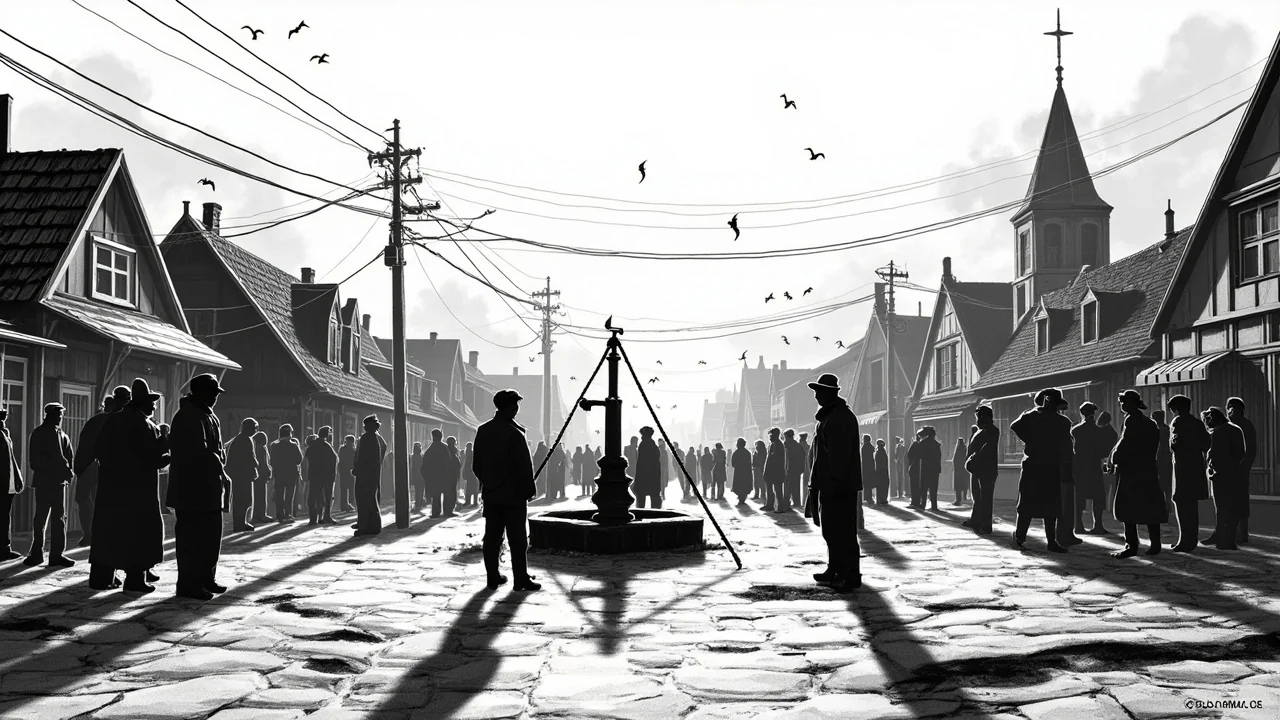
Denmark's much-vaunted infrastructure reliability faced a critical test when a power cut in North Jutland left an entire town without running water for hours. The failure in Grindsted on Sunday morning exposed a surprising vulnerability when emergency generators at the local waterworks unexpectedly failed. This disruption to a fundamental service has raised immediate questions about backup system preparedness across Danish municipalities.
Residents of Grindsted woke to dry taps, a jarring experience in a nation where uninterrupted access to clean water is considered a basic welfare guarantee. The local utility company, GEV, confirmed the outage was caused by a failure in the power supply to the town's waterworks. Director René Heiselberg Gier expressed clear concern over the generator failure, noting they had been tested recently. "Normally, our emergency generators would take over, and they have not done so in this case, which puzzles me," he stated. Water service was restored only when the generators suddenly, and inexplicably, began working again.
A System Failure in the Welfare State
The incident strikes at the heart of the Danish social contract, where high taxation funds a comprehensive and reliable public infrastructure. For citizens, the sudden loss of water represents more than an inconvenience; it is a breach of trust in the system's foundational layers. Danish welfare relies on the seamless operation of utilities managed by professional municipal companies like GEV. When these systems falter, it prompts a broader societal examination of maintenance protocols and contingency planning. This is not merely a technical fault but a social policy issue, affecting every resident's daily life and sense of security.
Experts point out that such failures, while rare, test the resilience built into Denmark's decentralized municipal model. Each municipality operates its own critical utilities, meaning standards and preparedness can vary. The director's public puzzlement indicates a gap between scheduled testing and real-world performance, a concern for other towns relying on similar backup systems. Three electricians were deployed to diagnose the root cause, with investigations ongoing into whether the local fault was linked to wider power disruptions reported across North Jylland that day.
The Human Impact of Infrastructure Gaps
Beyond the technical details, the story is about disrupted routines and awakened anxieties. Imagine being unable to flush a toilet, prepare coffee, or wash hands—basic acts taken for granted in a modern European society. For families with young children, the elderly, or those with health conditions, the lack of water creates immediate hardship. Such events reveal how deeply our social stability is woven into the constant, quiet functioning of pipes and power grids. They remind us that the welfare state is not an abstract concept but a complex machine requiring constant, vigilant upkeep.
This incident serves as a case study for municipal planners nationwide. It highlights the difference between theoretical preparedness and operational reality. A tested generator that fails during an actual crisis provides no safety net. The social policy implication is clear: public investment in infrastructure must encompass not only the primary systems but also the depth and reliability of backup solutions. Regular testing under realistic load conditions, rather than simple mechanical checks, becomes a critical public duty.
Municipal Responsibility and Public Trust
The response from GEV's director was transparent, a positive sign in maintaining public trust. However, his admitted confusion underscores a need for more resilient design. Danish social policy often focuses on human services—education, healthcare, integration—but this event is a stark reminder that physical infrastructure is the bedrock upon which all other services depend. A successful integration program, for instance, means little if a new Danish family cannot access clean water in their home. All aspects of social cohesion rely on these basic functions.
Communities expect their municipal companies to have answers and solutions. The speed of the technical investigation and the subsequent public report will be closely watched. Will the cause be a singular component failure, a procedural error, or a design flaw? The answer will influence how other Danish utility companies review their own contingency plans. This proactive review is essential to prevent similar failures elsewhere, from Copenhagen to smaller rural communities.
A Look at the Broader Grid
While the focus is on Grindsted, the event coincides with broader reports of power instability in the region. This raises a second-order question about the interdependency of Denmark's national grid and local municipal services. Is the central power supply becoming less stable, thereby stressing local backup systems more frequently? Denmark's ambitious transition to renewable energy sources is reshaping its national grid, requiring new balances between supply, demand, and storage. Local utilities must adapt their emergency preparedness to this evolving energy landscape.
The situation in Grindsted may be a localized malfunction, but it occurs within this context of national energy transition. It presents a crucial lesson: as Denmark innovates at the macro level with wind and solar power, the micro-level infrastructure—the pumps, filters, and generators that deliver water—must be upgraded in parallel. The welfare state's resilience depends on synchronizing large-scale policy with granular, local technical integrity.
Moving Forward: Reliability as a Social Good
Ultimately, the Grindsted water outage is a story about expectations. Danes pay for and expect a system that works. The social compact demands it. The hours without water will fade from memory, but the imperative for municipal utilities and regulators is to ensure the lesson does not. It calls for a renewed focus on what engineers call "redundancy"—having multiple, independently failing backup systems. In human terms, it is about ensuring that no family is left questioning this most basic guarantee of daily life.
As the electricians complete their diagnosis, the broader task begins. Other municipal waterworks will be checking their generators today. Politicians on local councils will be asking for briefings. This is how the Danish welfare system self-corrects: through transparent failure analysis and a shared commitment to collective security. The true test is not that a system failed, but how thoroughly its guardians diagnose the flaw and prevent its repetition for every citizen, in every town. The water is back, but the work to restore unwavering confidence has just begun.