
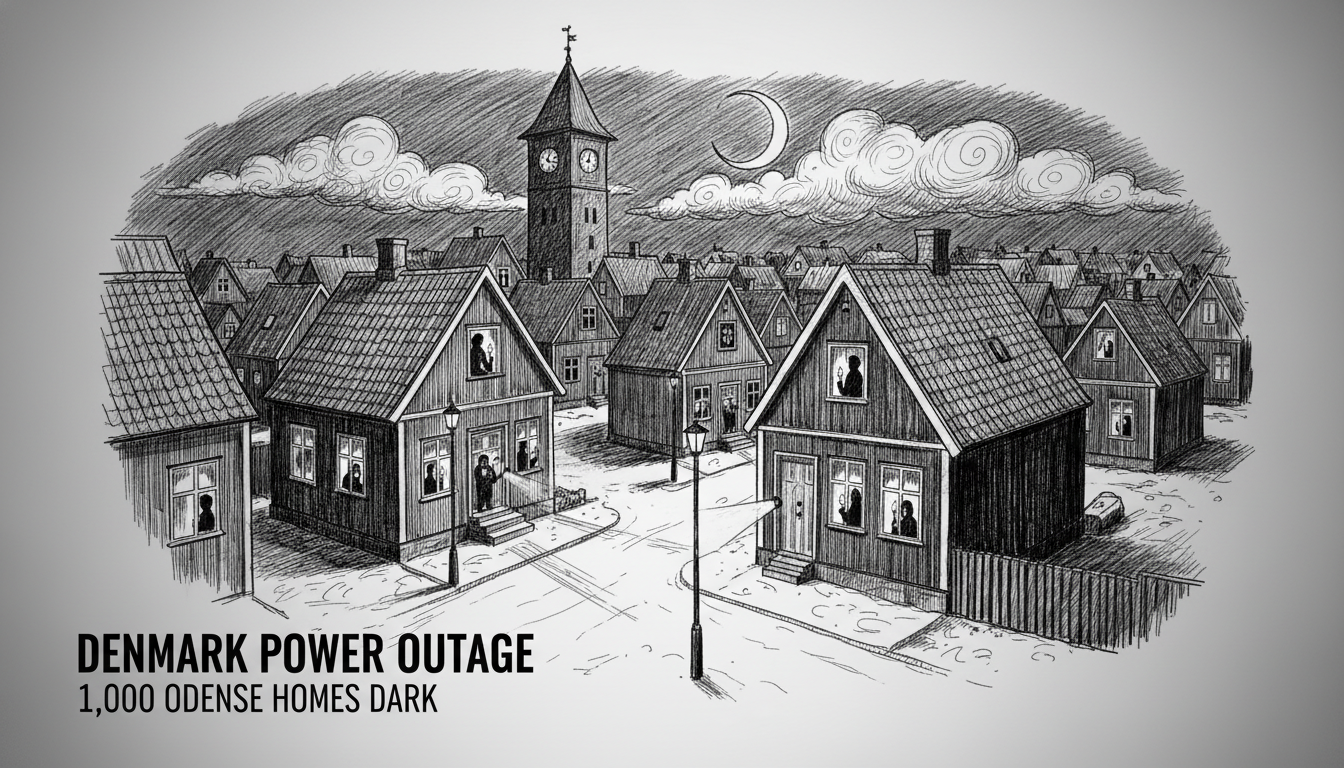
Denmark's third-largest city faced a significant disruption as a power outage left 1,000 households in Odense without electricity on Saturday afternoon. The blackout, reported shortly after 2:00 PM, impacted residential areas across central, southern, and southwestern districts of the city. Regional energy provider Energi Fyn confirmed its grid operator, Elnet, had identified the fault and was working urgently on restoration. Company officials estimated power would return by approximately 4:00 PM, aiming to limit the inconvenience for affected families on a weekend.
For residents in Odense C, M, S, and SV, the sudden silence of appliances and flickering off of lights marked the start of an unexpected challenge. Weekend routines were interrupted, with concerns quickly turning to food in refrigerators, disrupted remote work, and the well-being of vulnerable individuals reliant on electrical medical equipment. The incident, while localized, serves as a stark reminder of our collective dependence on a seamless flow of energy. It tests the resilience of both infrastructure and community preparedness in an increasingly digital age.
The Immediate Impact on a Saturday Afternoon
Power outages strip away the normalcy of daily life with startling speed. In Odense, what began as a typical Saturday transformed for a thousand families. The failure occurred during peak weekend hours when households are active, with children home from school and parents managing chores and leisure. The immediate effect was a halt to countless domestic activities. Cooking with electric stoves became impossible, home entertainment systems went dark, and internet routers shut down, severing digital connections. For those working from home or studying online, the blackout meant lost productivity and potential deadline stress.
The human impact extends beyond simple inconvenience. Modern Danish homes are deeply integrated with technology for security, climate control, and communication. An outage disrupts all these systems simultaneously. Elderly residents or individuals with health conditions who depend on powered medical devices face acute anxiety. Parents of young children must manage without the electronic comforts that often aid in care. The timing, on a weekend, also complicates the community response, as many public service offices and support centers operate on reduced hours.
Energi Fyn's Response and Grid Reliability
Energi Fyn's public communication followed a standard crisis protocol, announcing the fault identification and providing a restoration timeline. The company's Elnet division is responsible for the physical grid maintenance and repair across the island of Funen. Their stated goal of a two-hour restoration window is indicative of the high reliability standards expected in Denmark's energy sector. The Danish electricity grid is renowned as one of the world's most stable and interconnected, with a very high security of supply. Nationwide, the average Danish customer experiences less than 24 minutes of power interruption per year, a figure that leads Europe.
Localized faults, however, are an inevitable aspect of any complex mechanical and electrical system. Causes can range from equipment failure at a substation and cable damage from construction work to animal interference or even extreme weather. The rapid identification of the problem point suggests robust monitoring systems are in place. "The key metric for any distribution system operator is not just preventing faults, but minimizing the duration of interruptions when they occur," notes a Copenhagen-based energy infrastructure consultant. "A two-hour target for restoring one thousand connections shows a system designed for swift diagnosis and repair."
The Broader Context of Danish Energy Security
This incident in Odense occurs against a backdrop of heightened focus on energy security across Denmark and Europe. While this outage appears to be a routine technical fault, it subtly underscores a national conversation. Denmark is a pioneer in renewable energy, with wind power frequently supplying more than 100% of the nation's electricity demand. This transition towards a decentralized, weather-dependent generation mix introduces new challenges for grid management and stability. The grid must balance variable supply with constant demand, a task requiring advanced technology and resilient infrastructure.
The Danish welfare model is fundamentally built upon reliable public utilities. Consistent electricity powers not just homes but the entire social ecosystem: hospitals, schools, public transportation, and digital citizen services. Any prolonged disruption has cascading effects. Therefore, substantial public and private investment continues to flow into modernizing the transmission and distribution network. This includes digitalizing substations, burying cables, and creating smarter grids that can isolate faults to ever-smaller areas, preventing the kind of widespread outage seen in past decades.
Community Resilience and Personal Preparedness
Events like Saturday's blackout prompt a necessary public reflection on personal and community preparedness. How many households in Odense had a battery-powered radio, a stock of candles, or a power bank for their phone? National authorities, including the Danish Emergency Management Agency (Beredskabsstyrelsen), routinely advise citizens to maintain a basic preparedness kit. This is recommended for all types of emergencies, from storms to power cuts. The kit should include water, non-perishable food, a flashlight, batteries, and a first-aid kit.
In a connected society, the loss of power often means a loss of information. During the Odense outage, residents would have relied on mobile phones with limited battery life to get updates from Energi Fyn's website or social media. This highlights a critical vulnerability. Community resilience is also tested through local support networks. Checking on neighbors, especially those living alone or with health issues, becomes a vital informal safety net when official systems are stressed. The incident, though brief, acts as an unplanned drill for both the utility and the populace.
Looking Ahead: A More Decentralized Future
The future of Denmark's electricity system points toward greater decentralization. The growth of residential solar panels, community wind turbines, and even home battery storage could change how local outages are experienced. A household with solar panels and a battery might ride through a grid outage with minimal disruption. This concept of 'energy islands' or self-sufficient micro-grids is part of long-term planning, particularly for enhancing security in remote areas. For urban centers like Odense, the focus remains on reinforcing the central grid's robustness while integrating these distributed resources.
Saturday's outage in Odense was resolved within the estimated timeframe, with power restored to the affected households. For Energi Fyn, the work continues with a post-incident analysis to determine the root cause and prevent recurrence. For the residents, life quickly returned to normal, the brief interruption fading into a weekend anecdote. Yet, the event remains a useful case study. It demonstrates the effectiveness of current response protocols while quietly asking if we, as a society, are prepared for a disruption that lasts longer than two hours. As Denmark charges toward its ambitious green future, ensuring the lights stay on in Odense and every other city remains the most fundamental promise of the welfare state.