
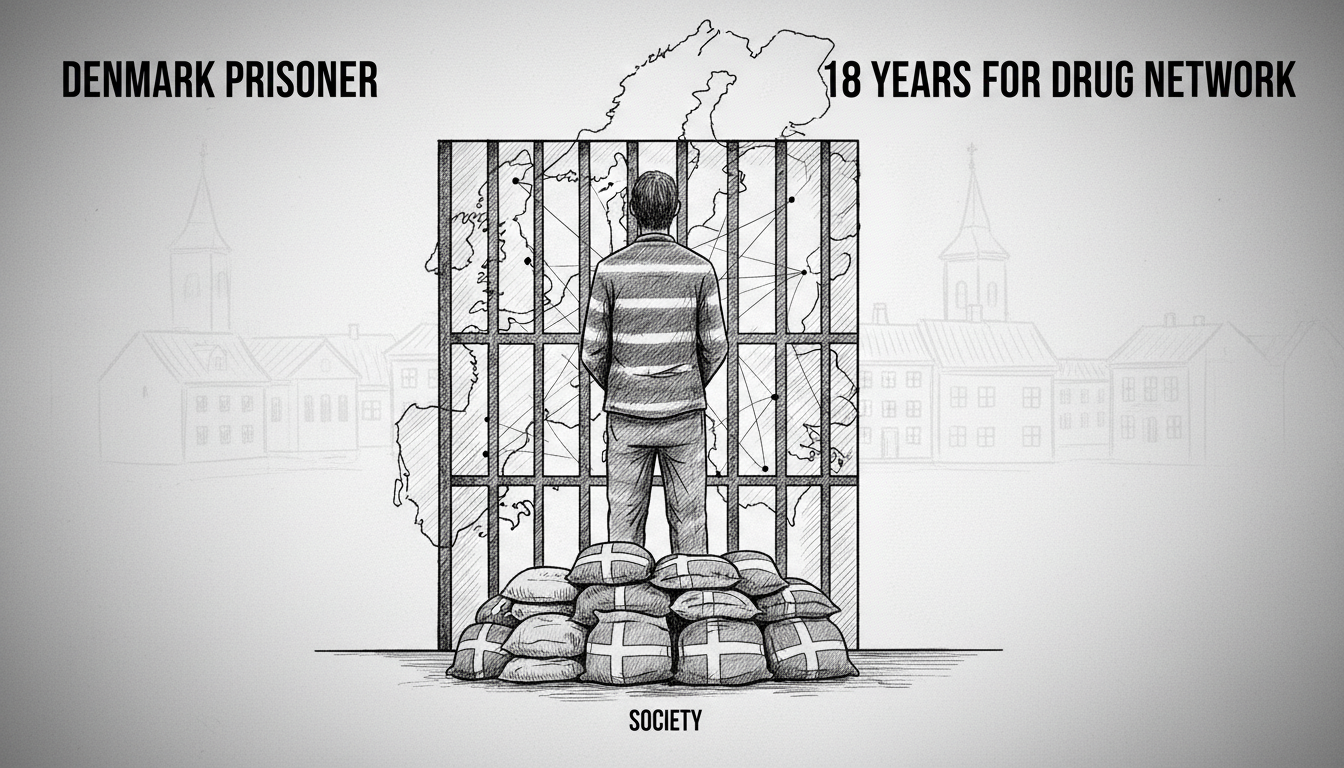
A Danish prisoner has been sentenced to 18 years in prison for running a major drug trafficking network from inside his cell. The Roskilde Court delivered the verdict on Wednesday, breaking the usual 16-year maximum sentence. While serving time at Sdr. Omme Prison, the 27-year-old man organized the import of approximately 300 kilograms of amphetamine. He coordinated the operation using a hidden mobile phone and the encrypted messaging service Signal.
This case exposes a startling failure in Denmark's correctional system. A man already detained for serious crimes managed to direct a vast criminal enterprise from behind bars. His phone was concealed behind a refrigerator within the prison walls. The National Unit for Special Crime (NSK) investigated the network under the codename 'Operation Crazy Horse'. Two other defendants in the case received sentences of 12 and nine years.
The court's decision to exceed the standard sentencing framework sends a strong message. It happened even though the defendant was acquitted on several charges. The prosecution had alleged the total drug amount exceeded half a ton. The judge's ruling underscores the severity of crimes that undermine the justice system itself.
A Phone Behind the Fridge
The mechanics of the operation read like a crime thriller plot. Authorities discovered a mobile phone hidden behind a refrigerator in the prison. The inmate used this device to access the encrypted platform Signal. From there, he communicated with associates on the outside to manage the logistics of importing hundreds of kilos of drugs. This was not a small-scale operation for personal use. It was a sophisticated, profit-driven business run from a state institution designed to isolate criminals from society.
Encrypted messaging apps present a significant challenge for law enforcement worldwide. Services like Signal offer end-to-end encryption, making message interception extremely difficult. For criminal networks, especially those coordinating across borders and through prison walls, these tools are invaluable. They allow for secure planning away from the ears of police monitors. The Sdr. Omme case shows how effectively these technologies can be exploited, even within a controlled environment.
The Systemic Challenge for Danish Prisons
Drug trafficking within prisons is a persistent, global problem that Denmark is not immune to. Danish correctional services generally emphasize rehabilitation and reintegration. Yet, the infiltration of organized crime into these facilities threatens those core principles. It creates a climate of fear and corruption. It also provides inmates with a continued criminal income and influence, directly counteracting rehabilitation goals.
Preventing such crimes requires constant adaptation. Prison staff must combat smuggling of contraband like phones, drugs, and SIM cards. They use scanners, targeted searches, and intelligence gathering. However, as criminals develop more creative concealment methods, authorities must stay ahead. This case suggests current measures at Sdr. Omme Prison were insufficient. It raises questions about resource allocation and the effectiveness of routine security protocols in high-security sections.
“This verdict highlights a critical vulnerability,” says a Copenhagen-based criminologist who studies organized crime. “When incarcerated leaders can maintain operational control, it mocks the purpose of imprisonment. It shows these networks are not reliant on any single individual. They are structured to survive. The Danish system must invest not just in blocking phones, but in deeper intelligence to dismantle the entire chain of command.” The expert requested anonymity due to their ongoing work with justice agencies.
Operation Crazy Horse and National Response
The investigation, dubbed Operation Crazy Horse, was led by the National Unit for Special Crime (NSK). This specialized police unit tackles serious, organized, and complex cross-border crime. Their involvement indicates the scale and sophistication attributed to this prison-based network. Taking down such an operation requires extensive surveillance, communication analysis, and coordination across police districts.
The successful prosecution relies on piecing together digital evidence. This includes forensic data from the hidden phone and mapping the network's contacts. It also involves tracing financial flows and coordinating with international partners if the drugs were sourced from abroad. The 18-year sentence for the main defendant is a significant result for the NSK. It demonstrates their capacity to untangle complex criminal webs, even those extending into prisons.
Yet, a conviction also prompts introspection. How did the network operate for long enough to move 300 kilos? Were there signs of increased corruption or intimidation within the prison? The Danish Prison and Probation Service faces tough questions about internal controls. They have stated previously that fighting contraband is a constant priority. This case will likely lead to reviews of procedures at Sdr. Omme and other facilities.
The Human and Social Cost
Beyond the legal drama, this story has a profound human cost. Amphetamine is a destructive, addictive stimulant. 300 kilograms represents a massive quantity destined for streets across Denmark and possibly beyond. Its distribution fuels addiction, damages public health, and generates violence within the drug trade. The profits from such a haul reinforce criminal structures, enabling further violence and corruption.
The case also erodes public trust. Citizens expect prisons to be places where criminals are separated from society and criminal activity is halted. When a prisoner orchestrates a major drug import, it shatters that basic expectation. It creates a perception of a justice system that is not fully in control. For a society like Denmark's, which values safety and rule of law, this is a disturbing revelation.
Community leaders in areas affected by drug crime express frustration. “Every kilo that gets through means more addiction, more broken families, and more danger in our neighborhoods,” says a social worker in Copenhagen’s Nørrebro district. “When it comes from inside a prison, it feels like a double betrayal. The system meant to protect us is being used against us.” This sentiment underscores the broader societal impact of institutional failures.
A Look Ahead: Securing the System
The 18-year sentence is a conclusion, but also a beginning. It marks the start of a period of scrutiny for Denmark's prison security protocols. The Danish Prison and Probation Service will be under pressure to explain the lapses and outline corrective measures. Potential responses could include increased investment in signal-jamming technology within prisons, more frequent and unpredictable cell searches, and enhanced staff training to detect subtle signs of coordination.
There is also a policy dimension. Some may argue for stricter sentencing for crimes committed from within prison, a factor the Roskilde Court already considered. Others might call for greater isolation of inmates known to lead criminal networks, though this must be balanced against human rights regulations. The debate will center on finding the right mix of technology, intelligence, and physical security to restore integrity to the prison environment.
This case serves as a stark reminder. Criminal networks are adaptable and resilient. They will exploit any weakness, including the walls meant to contain them. Denmark's justice system has won a battle with Operation Crazy Horse. The 18-year sentence is a tangible victory. But the war for secure prisons continues. The key question remains: How do you isolate a criminal from their network when their network is just a hidden phone away?