
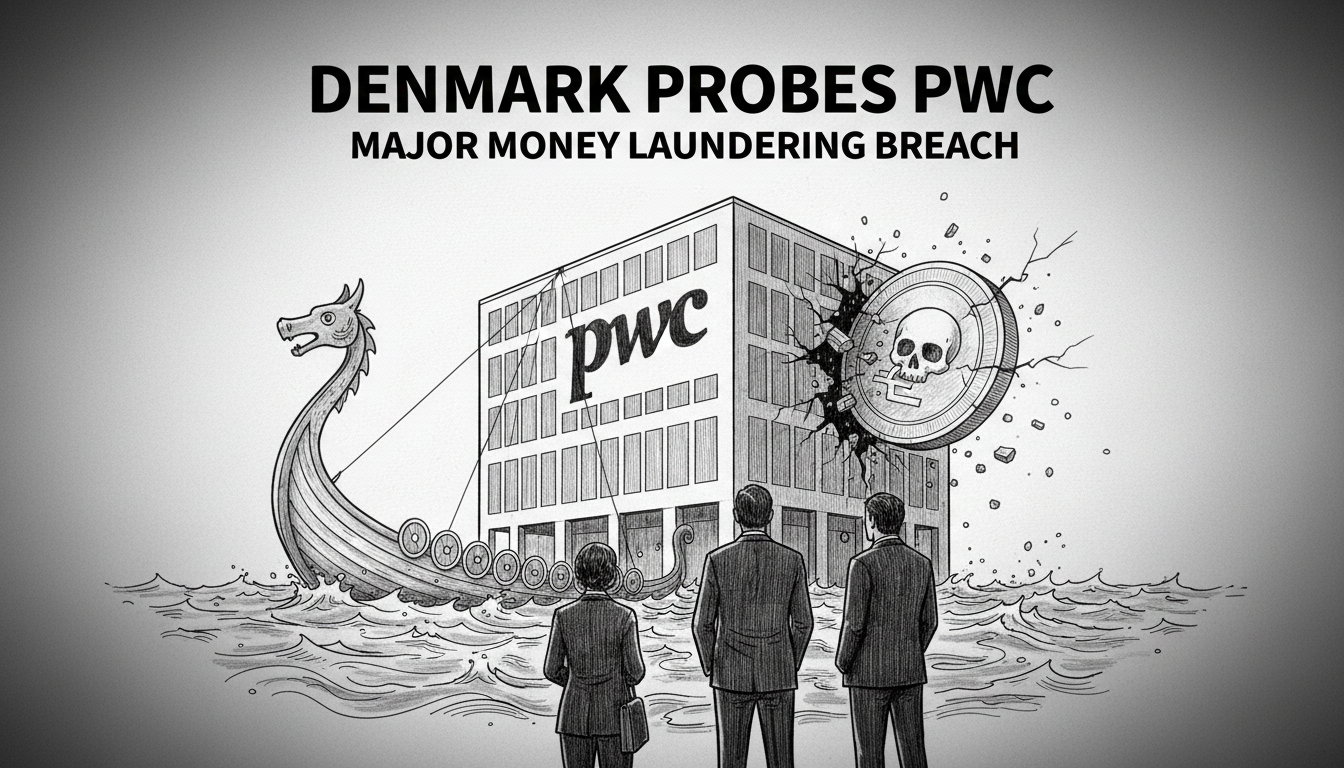
Denmark's financial oversight agency has reported auditing giant PwC to police over a significant failure in its anti-money laundering controls. The Danish Business Authority, Erhvervsstyrelsen, alleges PwC Denmark did not investigate an "unusually large transaction" in a timely manner, a serious breach of the country's stringent anti-money laundering law. This move signals a tougher enforcement stance against even the largest professional service firms in the Nordic financial hub.
Earlier this year, inspectors from Erhvervsstyrelsen arrived at PwC's headquarters in Hellerup. Their mission was to assess whether the firm, with nearly 3,000 employees across nine Danish offices, complies with the Anti-Money Laundering Act. The investigation concluded with a police report centered on one critical failure: the firm's handling of a single, conspicuous financial transaction. For a firm of PwC's stature, such a regulatory misstep carries substantial reputational and legal risk.
A Spotlight on the Gatekeepers
The case underscores the pivotal role auditors play as financial gatekeepers. In Denmark's robust welfare state, maintaining the integrity of the financial system is paramount to public trust. Auditors are legally mandated to be the first line of defense, identifying and reporting suspicious activity that could indicate money laundering or terrorist financing. When a leading firm like PwC is accused of faltering in this duty, it raises questions about systemic vigilance.
"This is not a minor administrative error," says a Copenhagen-based financial compliance consultant who requested anonymity due to client relationships. "An 'unusually large transaction' is a fundamental red flag. The law requires immediate scrutiny. Failure to do so punctures the very foundation of the preventative system." The consultant notes that enforcement has intensified across the EU, with Danish authorities aligning closely with directives from Brussels.
The Mechanics of Danish Financial Oversight
Erhvervsstyrelsen operates as the primary supervisor for a wide range of businesses under Denmark's anti-money laundering framework. Its powers include unannounced inspections, mandatory audits, and, as seen here, referrals to the police for potential criminal investigation. The agency has steadily increased its resources and focus on compliance following several high-profile international money laundering scandals that touched Nordic banks.
The reported breach involves PwC's obligation under Section 27 of the Danish Anti-Money Laundering Act. This section requires obligated entities, including auditors, to examine the background and purpose of any transaction that is unusually large, complex, or appears to have no economic or lawful purpose. This examination must be documented and completed without undue delay.
Implications for Trust and Practice
The police report against PwC Denmark arrives at a sensitive time for the global auditing profession. The industry faces ongoing scrutiny over its role in ensuring corporate transparency and ethical financial conduct. In Denmark, where social cohesion and institutional trust are highly valued, professional service firms are expected to exemplify rigorous standards.
"Public confidence in our financial institutions is non-negotiable," stated a senior policy advisor from the Ministry of Industry, Business and Financial Affairs. "The rules apply equally to all. Effective supervision and enforcement are how we maintain a clean business environment." The advisor emphasized that the case is a demonstration of the system working as intended, with supervisors holding even major players accountable.
For PwC Denmark, the immediate task is managing the legal and reputational fallout. The firm must now engage with police investigators while likely conducting an intensive internal review of its compliance protocols. Competitors and clients will be watching closely. Other audit firms are certainly revisiting their own procedures, ensuring their teams are prioritizing anti-money laundering checks.
A Broader Trend of Stricter Enforcement
This action fits a clear pattern across Scandinavia. Nordic regulators have moved aggressively to tighten financial controls after being stung by past vulnerabilities. Denmark has invested significantly in its Financial Intelligence Unit (FIU) and supervisory capabilities. The message is unambiguous: size and prestige are not shields against enforcement.
Financial crime experts point out that money laundering is rarely about one giant transfer. It is a process of layering and integration, often using professional enablers. Auditors, lawyers, and bankers can be unwitting conduits or, in worst cases, facilitators. The regulatory focus has therefore sharpened on these professions, demanding higher levels of due diligence and skepticism.
"The 'know your customer' principle is now deeply operational," explains a lecturer in financial law at the University of Copenhagen. "It's not a box-ticking exercise. It requires a proactive, analytical approach. When a transaction stands out, you must act. The PwC case will become a standard reference in compliance training for years to come."
What Comes Next for PwC and Danish Finance?
The police will determine whether there is evidence of criminal negligence or a breach of the anti-money laundering law serious enough to warrant charges. Potential outcomes range from a fine to more severe sanctions. Beyond the legal process, the incident may trigger reviews by other professional oversight bodies.
For Denmark's business community, the event is a stark reminder. The social contract that underpins the Danish model requires clean business practices. The welfare system depends on collected taxes, not laundered capital. As one Copenhagen business owner put it, "We all pay our share here. We expect the big firms advising us to follow the same rules, to the letter."
This probe into PwC Denmark ultimately tests a core national principle: that the rules apply to everyone equally. In a society built on high trust and low corruption, the integrity of financial gatekeepers is not merely a technicality. It is a pillar of social stability. The coming months will reveal how deeply this pillar was shaken, and what it takes to ensure it holds firm.