
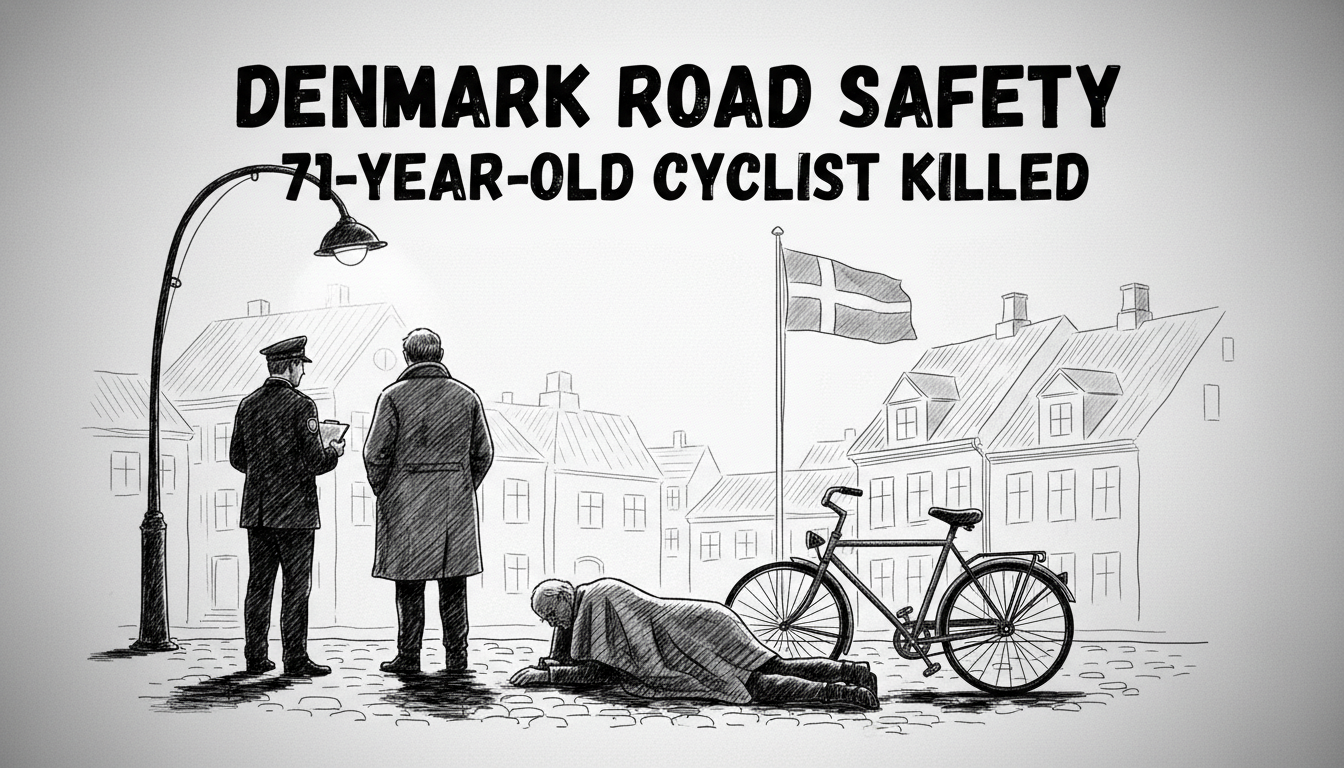
Denmark road safety data shows a persistent risk for cyclists, tragically highlighted by the death of a 71-year-old man in Svenstrup. An ordinary Tuesday afternoon on Hobrovej, the road connecting Aalborg and Hobro, turned into the scene of a fatal collision. An older female driver first struck another vehicle, then hit the elderly cyclist, before her car collided with a lamppost and came to rest in a private front yard. The man, whose identity has not been released, died at the scene. This incident casts a sobering light on the daily realities of road safety in Danish municipalities, where cyclists and drivers must constantly navigate shared spaces.
A Quiet Afternoon Shattered
The accident occurred in the early afternoon, a time typically filled with the routines of daily life in North Jutland communities. Emergency services responded swiftly, with police describing a "significant presence" on Hobrovej shortly before 2 PM. Initial reports indicate the female driver sustained no serious injuries, and the first collision resulted only in material damage. Yet, for the family of the 71-year-old cyclist, the outcome was devastating. The specific cause remains under investigation by North Jutland Police, who have not yet released details on speed, visibility, or potential driver error. The image of a small white car lodged in a front garden, far from the roadway, tells a silent story of a trajectory violently interrupted.
The Cyclist's Vulnerability in Danish Traffic
This tragedy underscores a critical and ongoing discussion in Danish society news: the vulnerability of cyclists, particularly older individuals, within the nation's traffic ecosystem. Denmark is globally renowned for its cycling culture, with extensive infrastructure designed to protect riders. However, accidents like this one reveal the system's fragility when intersections between cars and bikes go wrong. Traffic safety experts consistently stress that while segregated cycle lanes are effective, shared-road environments and junctions remain high-risk zones. "Every fatal accident demands a thorough analysis," states a Copenhagen-based traffic planner familiar with regional safety audits. "We must look at sight lines, signage, road surface conditions, and driver behavior. The goal is not blame, but prevention."
Data from the Danish Road Directorate shows a general downward trend in serious traffic accidents over the past decade, a testament to focused safety campaigns and infrastructure investment. Yet, cyclists still represent a disproportionate number of serious injuries and fatalities. For older cyclists, the risks compound; reaction times may be slower, and physical resilience is reduced. The loss of a 71-year-old life is not just a statistic. It represents the erosion of a community member who likely relied on his bicycle for independence, health, and connection—a common story in towns across Denmark.
Local Impact and Municipal Responsibility
The accident happened near Svenstrup, just south of Aalborg's Skalborg district. In such communities, news travels fast, and the impact is deeply personal. Local social centers and community groups often become informal support networks in the aftermath of sudden loss. While the national police handle the investigation, the municipal authority will inevitably review the accident site on Hobrovej. Danish municipalities bear significant responsibility for local road planning and maintenance. A fatal accident typically triggers a safety assessment to determine if changes—like improved lighting, adjusted speed limits, or modified road markings—are warranted. This process embodies the Danish welfare system's proactive, if sometimes bureaucratic, approach to public safety.
Conversations about Denmark's immigration policy and integration often focus on social cohesion. Events like this traffic accident present a different, unifying form of integration—a shared vulnerability on the roads that affects every resident, regardless of background. The grief experienced by the cyclist's family is a universal language. It also raises questions about an aging population's mobility and how infrastructure serves all citizens. Ensuring older adults can move safely, whether by bike, foot, or car, is a growing challenge for Danish social policy as demographics shift.
A Broader Look at North Jutland's Roads
North Jutland, with its mix of bustling cities like Aalborg and sprawling rural landscapes, presents unique traffic challenges. Roads like Hobrovej serve as vital arteries, carrying a mix of local and through traffic. They must accommodate high-speed vehicles, agricultural machinery, cyclists, and pedestrians. Balancing these competing needs is a constant engineering and policy dilemma. Regional authorities regularly analyze accident clusters to identify dangerous stretches, applying for national funds for targeted upgrades. The outcome of the police investigation into this Svenstrup accident will feed directly into that ongoing analytical work.
For now, the community is left with unanswered questions and a profound sense of loss. The female driver involved must reckon with the grave consequences of the collision, regardless of the legal findings. There are no simple narratives in such tragedies, only fractured lives and a renewed urgency for vigilance. Denmark's ambition to have zero traffic fatalities and serious injuries requires confronting each failure head-on. It demands honesty about where protected bike lanes end, where driver attention can waver, and how the design of a seemingly ordinary road can have life-or-death implications.
The Path Forward from Tragedy
The death of the cyclist on Hobrovej is a somber reminder that safety is a daily practice, not a guaranteed condition. It will likely be cited in future municipal debates about road budgets and design priorities. For Denmark's traffic planners, the hard work involves translating this specific grief into systemic improvements that protect others. This means investing in physical infrastructure but also fostering a culture of mutual responsibility among all road users. Could more prominent signage alert drivers to common cycling routes? Are speed limits on connector roads appropriate for their mixed use? These are the practical, painful questions that follow a fatal accident.
As the investigation continues, the memory of the 71-year-old man on his bicycle lingers. His story is a stark data point in Denmark's road safety record, but it is foremost a human tragedy. It challenges the comforting notion that Denmark has completely solved the puzzle of safe coexistence between cars and bicycles. The incident invites a difficult but necessary reflection: in a society built on trust and collective welfare, how do we better safeguard the most vulnerable among us during the most ordinary acts of daily life? The answer will determine how many more families receive the worst possible news on an otherwise quiet afternoon.