
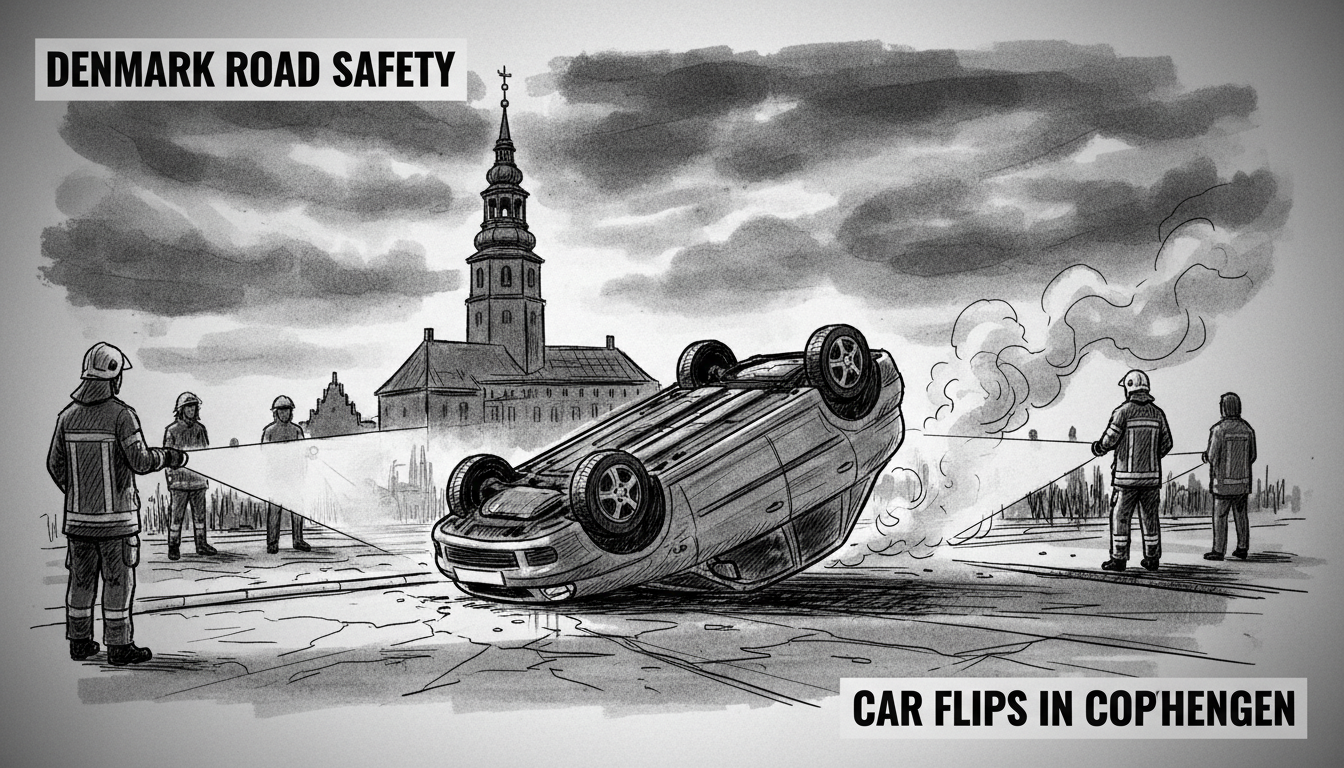
Copenhagen traffic police responded to a dramatic car accident on one of the city's oldest streets Tuesday afternoon. A vehicle ended up on its roof on Gammel Kongevej at the intersection with Prinsesse Maries Allé, forcing a complete closure of the major Frederiksberg thoroughfare in both directions. Remarkably, despite the severity of the crash, authorities reported no serious injuries.
"The driver of the car that is flipped over is being examined by medical personnel on site," said Anders Frederiksen, duty officer with Copenhagen Police. The incident was reported to authorities at 4:19 PM. Police have not yet determined how the accident occurred and are considering whether to file charges in the case. The scene required a significant emergency response, with investigators working to clear the wreckage and restore normal traffic flow.
This single incident on a crisp autumn afternoon opens a window into Denmark's broader relationship with road safety, urban design, and the constant tension between historical infrastructure and modern traffic demands. As a journalist who navigates these streets daily, I see these moments not just as news items, but as pressure points in our social fabric.
A Historic Street Meets Modern Traffic
Gammel Kongevej, or "Old King's Road," is a central artery in the affluent enclave of Frederiksberg. This independent municipality is an island within Copenhagen, known for its stately apartments, boutique shops, and dense urban life. The street itself is a historic route, once the main road connecting Copenhagen's city center to the royal palace at Frederiksberg Have. Today, it carries a steady stream of cars, buses, bicycles, and pedestrians through a vibrant commercial district.
The accident's location at Prinsesse Maries Allé places it at a busy junction. Such intersections in dense urban areas are typical flashpoints. According to the Danish Road Directorate, approximately 30% of all personal injury accidents in urban areas occur at intersections. While Denmark boasts one of the world's lowest road mortality rates—with 2.7 road deaths per 100,000 inhabitants in 2022 according to the OECD—its dense cities present unique challenges. The focus has increasingly shifted from fatal accidents to reducing serious injuries in urban environments.
The Investigation and Urban Safety Priorities
Following the crash, traffic accident investigators began their standard procedure. They examine skid marks, vehicle damage, road surface conditions, and gather witness statements. They will also likely check for any technical malfunctions in the vehicle and assess the driver's actions. "It is still unclear how the accident happened," Frederiksen noted, highlighting the careful, evidence-based approach Danish authorities take.
This methodical process is part of a larger safety ecosystem. Denmark's "Vision Zero" policy, adopted from Swedish models, aims to eliminate fatal and serious traffic injuries. This philosophy influences everything from road design—favoring traffic calming measures like raised crossings and narrower lanes—to strict enforcement of speed limits, which are often as low as 40 km/h or 30 km/h on streets like Gammel Kongevej. The fact that the driver in this case walked away is a testament to modern vehicle safety standards, but also raises questions about the causes of such violent collisions in a controlled environment.
The Human and Community Impact
Beyond the police report, an accident like this sends ripples through the community. Local businesses face disrupted access. Commuters are rerouted, adding time to their journeys. Residents hear the sirens and are reminded of the vulnerability that exists just outside their doors. For the driver involved, the psychological impact of a rollover accident can be significant, even without physical injury.
In my reporting on Danish society, I often observe how such events are processed. There is a collective sigh of relief when no one is seriously hurt, followed by a pragmatic focus on clearing the scene and learning lessons. Public debate might briefly turn to traffic safety, the design of that specific intersection, or driver behavior. This reflects a societal trust in systems—the police will investigate, the municipality will review the site if needed, and the rules are generally seen as fair and designed for collective protection.
A Look at Denmark's Road Safety Landscape
To understand this single event, one must view it within Denmark's national context. The country is consistently ranked among the safest in the world for road users. This is achieved through a combination of rigorous driver education, high rates of seatbelt and helmet use, and a strong cultural adherence to traffic rules. Investment in bicycle infrastructure has also been profound, separating cyclists from motor vehicles and reducing conflict points.
However, challenges persist. Distracted driving, often linked to mobile phone use, remains a concern. The integration of ever-increasing numbers of electric scooters and cargo bikes into traffic flow creates new dynamics. Furthermore, historic districts like those in Frederiksberg were not designed for contemporary traffic volumes, leading to engineering compromises. The accident on Gammel Kongevej, while isolated, touches on all these ongoing dialogues between preservation and safety, individual responsibility and systemic design.
The Path Forward from a Single Crash
As the tow trucks cleared the overturned vehicle and police reopened Gammel Kongevej to traffic, normalcy returned. But the data point was recorded. The investigation's findings will contribute to the national statistics analyzed by the Danish Road Directorate and organizations like TrygFonden, which campaigns for injury prevention. If a pattern emerges at that location, the Frederiksberg Municipality may consider engineering changes.
This is how Danish social policy often works: an incident occurs, it is thoroughly documented and analyzed, and its lessons are fed into a system focused on continuous, incremental improvement. The absence of serious injury is the primary success. Yet, the goal, as per Vision Zero, is to prevent the accident from happening at all. That pursuit requires constant vigilance from planners, lawmakers, and every person who gets behind the wheel.
The flipped car on a classic Copenhagen street is a stark image. It serves as a momentary rupture in the orderly flow of Danish daily life, a reminder that safety is actively maintained, not passively guaranteed. It underscores a central tenet of life here: that individual freedom to move coexists with a profound collective responsibility for one another's welfare on the shared space of the road.