
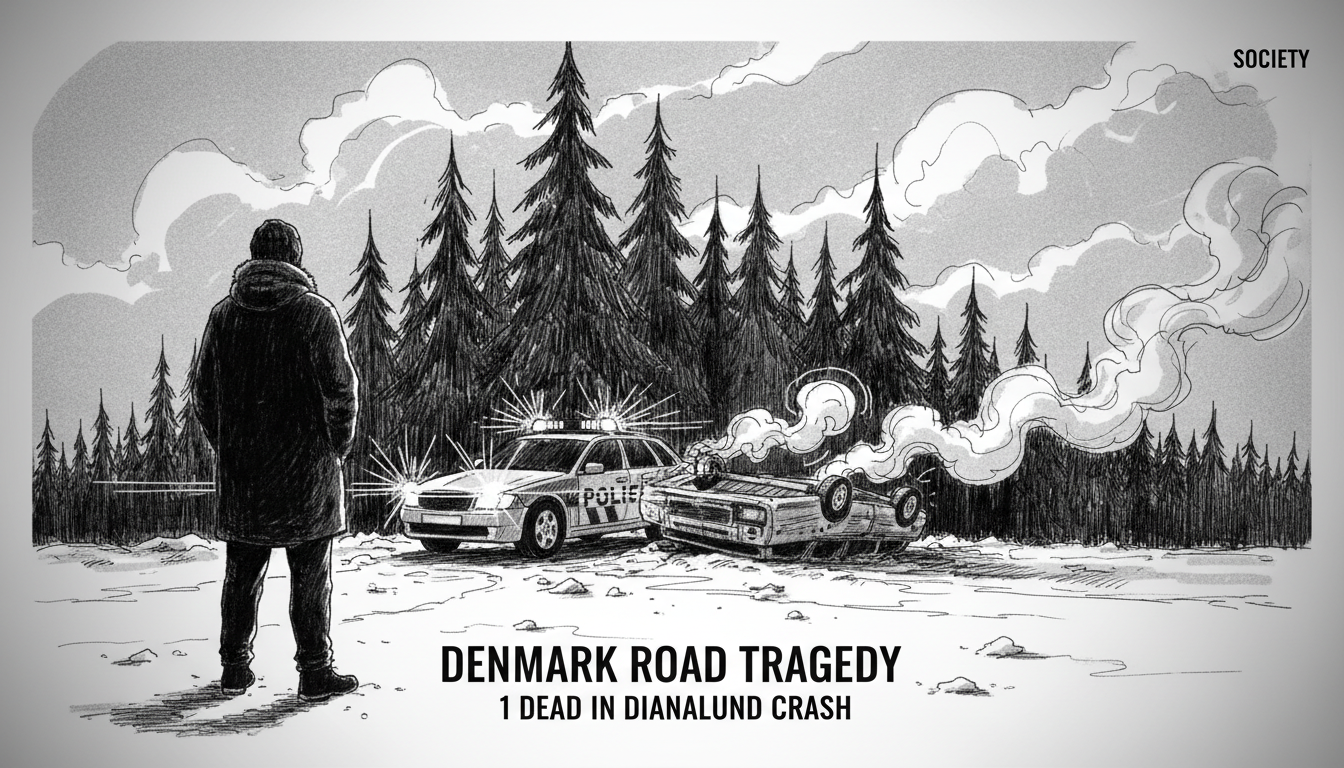
Denmark traffic accident on Skellebjergvej has left one person dead and a road completely blocked after a head-on collision between a truck and a passenger car. The Tuesday morning crash in Dianalund on West Zealand has drawn a significant emergency response, with three police patrols and an incident commander deployed to the scene. Police have confirmed the road, Route 219, is closed in both directions with no estimated time for reopening, creating major disruptions for the local community.
A Community Road Turned to Chaos
The quiet of a Tuesday morning in Dianalund was shattered by the sound of crushing metal on Skellebjergvej. This regional route, a vital artery connecting towns in West Zealand, became the site of a severe traffic accident. A truck and a car collided head-on, a type of crash known for its devastating potential due to the massive difference in vehicle mass and momentum. Police from the South Zealand and Lolland-Falster district were first to confirm the incident, stating they had just arrived on scene. The immediate priority was securing the area and assessing the casualties, with the road closure implemented swiftly to allow for investigation and recovery.
Local residents reported hearing the impact and seeing the rapid arrival of emergency services. The closure of Route 219 forces significant detours for commuters and commercial traffic, highlighting the town's reliance on this single thoroughfare. Sorø Municipality, which encompasses Dianalund, now faces the dual challenge of supporting the investigation and managing the logistical fallout for its citizens. The human cost, however, remains the central and most tragic focus.
The Grim Mechanics of a Head-On Collision
Road safety experts consistently point to the extreme danger posed by head-on collisions, especially those involving a heavy goods vehicle and a standard passenger car. The physics are brutally simple: the combined speed of both vehicles at the point of impact creates forces that modern car safety structures are often not designed to withstand fully. Factors commonly investigated in such tragedies include driver fatigue, momentary distraction, speeding, or hazardous overtaking maneuvers on rural roads like Skellebjergvej.
“The disparity in size and weight is the critical factor,” explains a traffic safety analyst from a Danish consultancy, who wished to remain anonymous as the police investigation is active. “A truck’s cabin may have modern safety, but the rigid structure behind it offers little absorption. For the car’s occupants, the deceleration forces are catastrophic.” Danish accident statistics show that while fatalities on roads have generally decreased due to better vehicle technology and infrastructure, collisions on regional routes outside motorways remain a persistent concern. These roads often lack median barriers, which are proven to prevent cross-over head-on crashes.
Emergency Response and Investigation Protocol
The police response to the Dianalund accident follows a standardized Danish protocol for serious traffic incidents. The dispatch of three patrols and a dedicated incident commander indicates the severity with which the crash was initially reported. The incident commander’s role is to coordinate all emergency units on site—police, fire, and medical services—ensuring a cohesive effort to save lives, secure evidence, and clear the scene safely. The fact that police could not immediately provide a timeline for reopening the road suggests a complex scene requiring detailed forensic analysis.
This analysis will involve mapping skid marks, assessing vehicle deformation points, and potentially retrieving data from the vehicles’ event data recorders. Investigators will look to establish the trajectory of each vehicle leading up to the collision. They will also examine the road conditions on Skellebjergvej at the time and check for any technical faults with either vehicle. The process is meticulous, as the findings could have implications for potential criminal charges, such as causing death by negligent driving, or for vital road safety advocacy.
The Ripple Effect on a Small Town
Beyond the immediate tragedy, the closure of a main road like Skellebjergvej sends ripples through a community like Dianalund. Local businesses that rely on passing trade or timely deliveries face disruption. Parents making school runs and commuters heading to work in larger towns like Sorø must navigate lengthy alternative routes. It exposes the vulnerability of regional transport networks where a single incident can isolate communities. The psychological impact on residents, particularly those who witnessed the aftermath or know the individuals involved, is also profound and lasting.
Danish municipalities often have social services and community support networks that can be mobilized following such traumatic events. While the police handle the factual investigation, the human need for support in the aftermath is critical. Community centers and local civic leaders frequently become points of contact for those struggling in the wake of a sudden, violent death in a tight-knit area. The incident is a stark reminder that traffic safety is not just a national statistic but a hyper-local issue with deeply personal consequences.
A National Conversation on Rural Road Safety
This accident in Dianalund inevitably connects to the broader conversation about road safety in Denmark, particularly on secondary routes. Denmark has long prided itself on a progressive and safe traffic system, yet challenges remain outside the major highways. Investment in physical median barriers, improved road markings, and speed management on roads like Route 219 is a constant topic for traffic planners and local politicians. Each serious accident renews calls for accelerated investment and innovation in passive safety infrastructure.
Data from the Danish Road Directorate shows a concerted effort to reduce serious accidents, but the goal of zero fatalities remains elusive. Campaigns against distracted driving, especially mobile phone use, and for seatbelt compliance are ongoing. For professional truck drivers, strict EU regulations on driving hours and rest periods are enforced to combat fatigue. The investigation in Dianalund will scrutinize all these elements, contributing another case study to the national effort to understand and prevent such collisions.
The road will eventually reopen. Traffic on Skellebjergvej will resume its flow, and the visible scars of the crash will fade. But for the families and friends of those involved, and for the emergency responders who attended the scene, the memory of this Tuesday morning in Dianalund will persist. It underscores a sobering truth: the safety of our communities is quite literally paved on the roads we travel every day, and vigilance is a shared responsibility that never reaches its destination.