
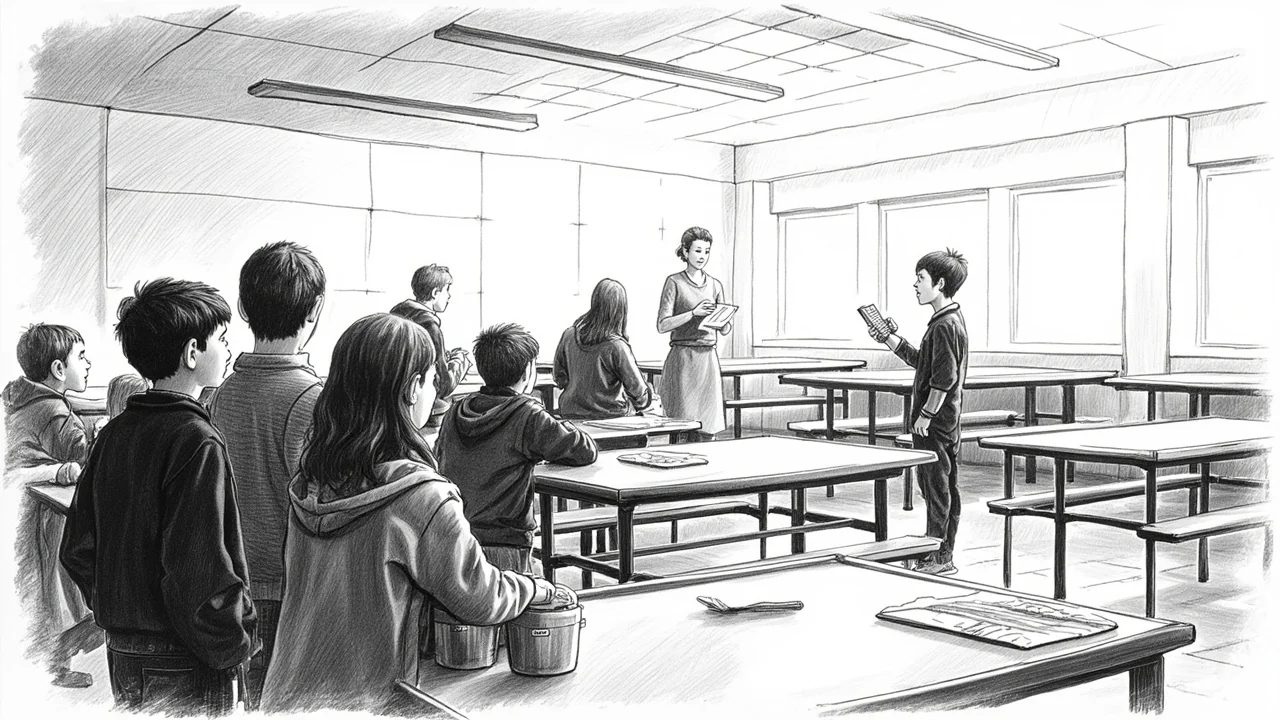
Denmark's ambitious national school lunch trial has hit its first major snag, revealing deep tensions between policy ambition and family budgets. The Sortebakkeskolen in Nørager, North Jutland, has withdrawn from the three-year pilot program because parents refused to pay the proposed 25 kroner per meal. This early dropout exposes a central fault line in Denmark's social policy experiments: the balance between collective welfare benefits and direct personal expenditure. The incident raises immediate questions about the financial model's viability and its impact on the goal of ensuring all children receive a nutritious midday meal.
School leader Gitte Rubæk expressed clear frustration. The school had everything prepared, including a supplier agreement, before the cost became an insurmountable barrier. "We assessed that 25 kroner per day was simply too much," Rubæk said. She regrets the withdrawal, as she supports the core idea of schools providing lunch. Her disappointment is compounded by the trial's structure, which assigns different payment models to participating schools. "When we signed up for the trial, we had hoped we could participate under a different arrangement," she noted, highlighting a lack of flexibility in the program's design.
The Parental Perspective on Daily Costs
For families, the arithmetic is stark and personal. Peter Nielsen, a parent of two children at Sortebakkeskolen and a member of the school board, is a proponent of school lunch in principle. However, he insists it must make financial sense for households. "When you have two children in primary school, you have to pay 50 kroner a day for school lunch. That's a lot of money when you consider it's only lunch," Nielsen explained. He pointed out a critical flaw in the perceived convenience: parents still must provide morning and afternoon snacks. "You don't even save the hassle of making a packed lunch," he said, challenging the notion that the service offers significant time savings to justify the cost.
Nielsen's comments cut to the heart of a Danish welfare dilemma. The system is famed for its high taxes and extensive public services, yet direct user fees for new services remain politically and socially sensitive. Introducing a daily charge for a fundamental need like a child's lunch tests the boundaries of what the community collectively provides and what becomes an individual family's responsibility. Nielsen hopes for a future where the school can offer lunch at a lower price, ensuring children try diverse foods and all students get a quality meal to fuel their learning. His stance represents a common Danish view: social goods are welcome, but they must be reasonably priced and efficiently delivered.
A Nationwide Experiment Under Scrutiny
The trial, orchestrated by the Ministry of Children and Education, is a significant undertaking. Running from 2025 to 2028, it involves 188 schools across Denmark, testing three distinct payment models. Some schools offer lunch completely free, funded through the trial. Others charge a reduced rate of 15 kroner per day. A third group, which included Sortebakkeskolen, operates with the highest parental co-payment of 25 kroner per meal. This tiered approach is designed to gather data on uptake, nutritional impact, and social acceptability at different price points. The early withdrawal from North Jutland, however, provides an unplanned data point on price sensitivity and local resistance.
The dropout suggests the 25-kroner model may be unsustainable in certain municipalities, particularly outside wealthier urban centers. It forces a reconsideration of what constitutes an acceptable daily charge for a public service that touches on child welfare, educational outcomes, and social equality. If the cost deters participation, it could undermine the trial's objective of studying the effects of universal school lunch. Instead, it might only prove that parents in some areas are unwilling or unable to pay a premium for a service they traditionally provide themselves for a lower cost.
Broader Implications for Danish Social Policy
This conflict reflects a larger, ongoing conversation in Danish society about the evolution of the welfare state. For decades, the model has focused on cradle-to-grave security, largely free at the point of use. New initiatives, however, increasingly explore hybrid models with user fees. The school lunch trial sits at this crossroads. Is a daily lunch a public health and educational necessity that should be universally provided, like primary education itself? Or is it an optional convenience that families should fund if they choose it? The parent rebellion in Nørager argues strongly for the former perspective, treating the fee as a barrier to a beneficial social good.
Experts in social policy often warn that small fees can create large disincentives, particularly for lower-income families. While 25 kroner may seem modest to some, it translates to over 500 kroner per month for a family with two children—a substantial line item in a household budget. This can lead to economic segregation within the school, where only children from more affluent families participate in the lunch program. Such an outcome would contradict the Danish principle of lighed, or equality, a cornerstone of the education system. The goal of ensuring all children "get something good to eat," as parent Peter Nielsen stated, is jeopardized when cost becomes a gatekeeper.
The Path Forward for School Lunches
The Ministry of Children and Education now faces its first practical test of the trial's design. Will it allow other schools to switch payment models if parents resist? Can municipalities subsidize the cost further to prevent more dropouts? The response will signal how flexible the government is willing to be. A rigid adherence to the three-model structure could see more schools follow Sortebakkeskolen's exit, skewing the trial's results and limiting its usefulness. Conversely, adaptation could save the pilot and generate more meaningful data on how to implement a nationwide program successfully.
The incident also highlights the importance of local context in national policy. A cost that seems reasonable in Copenhagen or Aarhus may be prohibitive in a smaller community in North Jutland. Danish municipalities have varying levels of economic capacity and populations with different income profiles. A successful national school lunch program may require a nuanced, municipally-sensitive funding model, not a one-size-fits-all price tag. This is a classic challenge in Danish governance: balancing national standards with local autonomy.
As the trial continues, all eyes will be on participation rates at the 25-kroner schools versus those with free or reduced-price meals. The nutritional and social benefits of school lunch are well-documented in other Scandinavian countries like Sweden and Finland. Denmark is playing catch-up, but its path must align with its unique social contract. The withdrawal of a single school is more than an administrative hiccup; it is a case study in the real-world friction that occurs when new social policies meet the realities of family economics. The hope for a shared, nutritious school lunch remains, but its price—both financial and social—is still being negotiated.