
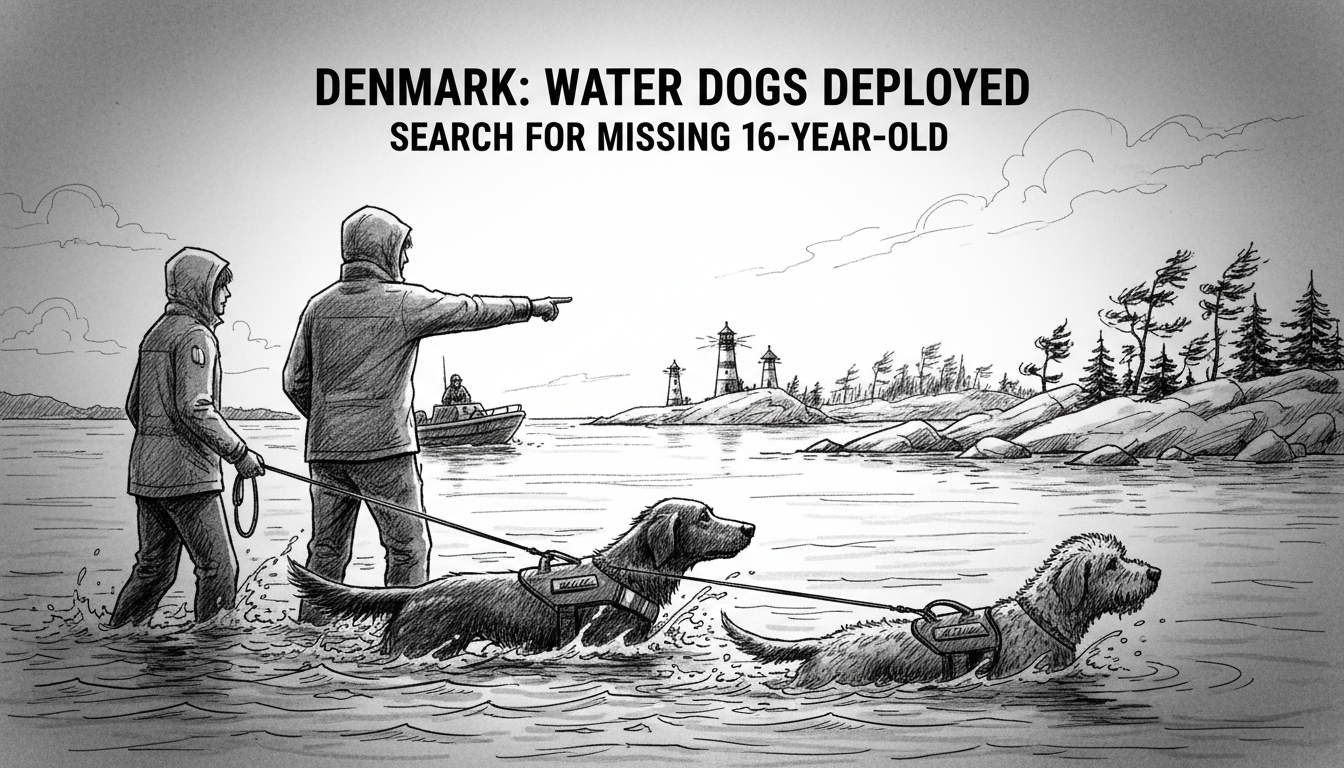
Denmark's North Zealand Police have deployed specialized water search dogs in a critical operation to find a missing 16-year-old Swedish boy. The teenager vanished after a night out with friends in Helsingør, a historic port city on the Øresund strait. His jacket was discovered floating in the harbor water on Wednesday morning, triggering an intensive search involving divers and canine units. "We are still conducting the search with divers and water search dogs in Helsingør Harbour," said duty officer David Buch from Nordsjællands Politi on Thursday afternoon. The search, paused overnight due to darkness, resumed at first light with no indication of criminal activity.
A Night Out Ends in Mystery
The incident began on Tuesday night into Wednesday when the teenager, who was visiting Helsingør from Sweden, disappeared. He had been in the city center with friends, a common social activity in the twin-city region where ferry traffic between Denmark and Sweden is constant. The discovery of his jacket in the harbor prompted immediate concern, shifting the focus of the investigation to the waterfront. Helsingør Harbour is a bustling maritime hub with strong currents from the Øresund strait, a key shipping lane connecting the Baltic and North Seas. The police response underscores the severity of the situation, mobilizing significant resources for a search-and-recovery mission.
The Specialists on the Front Line
The deployment of vandsøgningshunde, or water search dogs, represents a specialized layer of the search effort. These dogs are trained to detect the scent of human remains emanating from underwater, a crucial tool in maritime recoveries. Their work, combined with systematic dives, forms the core of the operation in challenging harbor conditions. "Search and rescue in harbor environments is among the most difficult tasks," explains Lars Mikkelsen, a former Danish emergency services coordinator. "Visibility is often near zero, currents can move objects, and the underwater landscape is cluttered with piers, pilings, and debris. Using dogs gives the teams another sensory avenue beyond what divers can see or touch." The ongoing operation highlights the procedural response to such tragedies, moving from initial search and rescue to a focused recovery mission.
A Community Connected by Water
Helsingør's identity is inextricably linked to the water that now holds such grim focus. The city is globally famous for Kronborg Castle, the UNESCO World Heritage site that forms the setting for Shakespeare's Hamlet. Its maritime history is profound, but the Øresund strait is not just a historical backdrop; it is a daily thoroughfare. Frequent ferries carry thousands of passengers and vehicles between Helsingør and Helsingborg, Sweden, every day, binding the communities closely. This incident resonates deeply on both sides of the sound, a reminder of the water's dual role as a connector and a potential danger. Local community groups and social centers in Helsingør often organize youth activities aimed at integration and safe socializing, reflecting the city's active civic engagement.
The Data Behind Disappearances
While each case is unique, missing person incidents involving young people and water have precedents in Denmark. Danish police and coastal authorities handle numerous search operations annually, though few escalate to this level of sustained, specialized resource deployment. Statistics from the Danish National Police show that the vast majority of missing persons are located within 48 hours. Operations involving harbor areas, however, present distinct statistical and practical challenges due to the environmental factors. The decision to continue the search with dogs and divers into a second day indicates the police's assessment of a high probability of recovery in the area. The lack of suspected criminal activity, as stated by police, typically steers the investigation toward accidental drowning, a leading cause of accidental death among young men in Scandinavia.
Navigating Policy and Response
The response to this tragedy operates within the framework of Denmark's well-coordinated emergency and welfare systems. Municipalities and police districts have clear protocols for missing persons, often activating joint operations centers. The Danish welfare model, with its strong social safety net, also includes youth outreach programs. Incidents like this inevitably prompt internal reviews of waterfront safety measures, public awareness campaigns about the risks of cold water and alcohol, and the effectiveness of night-time safety patrols in city centers. Community leaders in Helsingør have long emphasized creating safe social environments for youth, a challenge in any historic city with nightlife adjacent to open water.
A Personal Reflection on Loss
Reporting on these stories never becomes routine. The image of a recovered jacket is a devastating pivot point for any family, transforming worry into dread. For the Swedish family across the sound, the proximity of Denmark—a place so close and so frequently visited—makes the tragedy feel even more surreal and shattering. It underscores a universal truth in Danish and Swedish society: that safety is both a collective policy achievement and a fragile, personal reality. The comprehensive police effort, from divers braving dark, cold waters to handlers working with their dogs, represents a societal commitment to answers, however painful. It is a manifestation of a principle deeply embedded in the Nordic social contract: no one is left behind, and every effort is made, even when hope is faint.
The Search Continues
As Thursday drew to a close, the operational focus remained on the harbor. The water search dogs, trained to work from boats along specific search grids, continued their methodical task. The community of Helsingør and the boy's home community in Sweden await news, held in a painful suspension. This incident is a stark reminder of how quickly a night of youthful socializing can turn to catastrophe, and how ancient geography—a castle, a harbor, a strait—forms the stage for modern human drama. The ultimate question for authorities and the grieving family is not just where, but how and why. The answers, if they come, will be found in the meticulous work of the search teams and the difficult investigation that follows, a process where Danish procedural diligence meets profound human loss.