
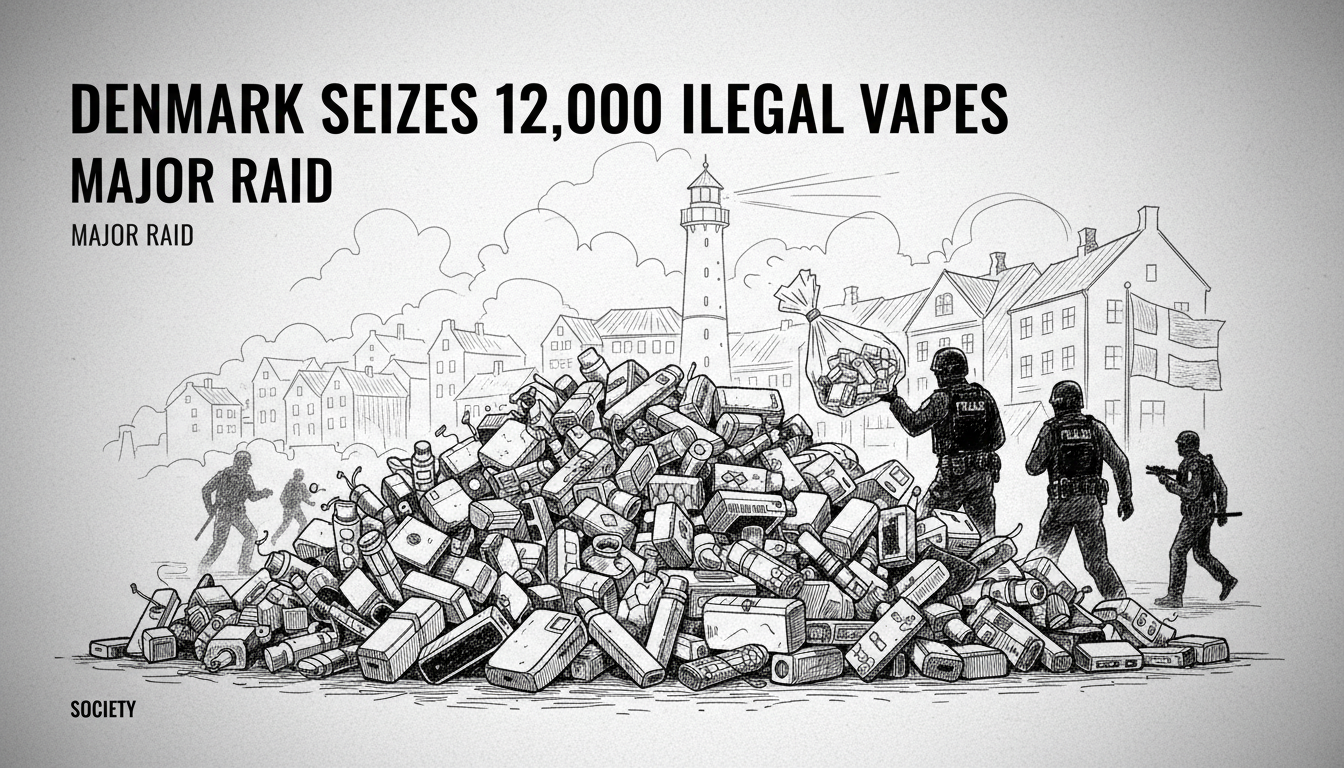
Denmark's crackdown on illegal flavored vapes escalated dramatically this week with a single massive seizure. Police in Præstø, acting on an anonymous tip, confiscated 12,000 illegal puff bars from a storage address, highlighting the ongoing black market challenge. A 33-year-old man from Søborg now faces charges, while authorities assess potential tax penalties for the significant haul of prohibited products.
This raid represents a direct enforcement action following a pivotal political decision. In the summer of 2024, the Danish parliament, Folketinget, passed a comprehensive ban on importing, purchasing, and possessing large quantities of these flavored e-cigarettes. The move targeted products specifically designed with sweet, candy-like flavors deemed attractive to young people. Despite the ban, the sheer volume of this seizure indicates a persistent and lucrative underground trade.
A Lucrative Market Meets a Firm Ban
The 12,000 puff bars found in Præstø were not merely illegal due to quantity. Their defining characteristic—flavor—places them squarely in the crosshairs of Danish health policy. Public health experts have long argued that flavors like mango, bubblegum, and cotton candy are a primary driver of vaping among adolescents. By removing these flavors from the legal market, lawmakers aimed to strip the products of their appeal to the youth demographic.
"The intention behind the ban is clear: to protect young people from nicotine addiction," says a public health researcher familiar with the policy, who requested anonymity as they were not authorized to speak publicly. "These products are a public health concern because they can act as a gateway to traditional smoking and contain high, unregulated doses of nicotine." The researcher points to international studies showing a correlation between flavored e-cigarette use and increased smoking initiation rates among teenagers.
The Enforcement Challenge for Danish Authorities
The Præstø case illustrates the practical difficulties of enforcing a flavor ban. Unlike narcotics, these products are variations of legally available nicotine devices, making detection and interdiction complex. The police operation was conducted in collaboration with the Danish Safety Agency (Sikkerhedsstyrelsen), which is responsible for product safety, and the Tax Agency (Skattestyrelsen), which will pursue any unpaid excise duties.
This multi-agency approach is crucial. The financial penalty under consideration is not just a fine for violating the ban but also the reclaiming of substantial lost tax revenue. Each puff bar sold on the black market represents a direct loss to the state treasury, funding that supports Denmark's welfare system. The involvement of the Tax Agency signals a strategy to hit illegal operators where it hurts—their profits.
For local police districts like South Zealand and Lolland-Falster, such operations drain resources but are seen as necessary. "A seizure of this scale disrupts a significant supply chain," a police spokesperson said in a statement regarding the operation. "It sends a message that the illegal trade in these products carries serious consequences." The anonymous tip that led to the raid also underscores the role of community vigilance in policing such markets.
The Social Impact of Vaping in Danish Youth Culture
Beyond the legal and economic dimensions lies a deeper social concern. Flavored puff bars had become a visible part of youth culture in Danish cities before the ban. Their discreet design and sweet flavors made them popular among teenagers, sparking anxiety among parents, teachers, and health professionals. The ban was a legislative response to a visible social phenomenon, aiming to reverse the normalization of vaping among minors.
School administrators in Copenhagen have reported a noticeable decline in vaping incidents on school grounds since the ban's discussion gained momentum. However, they caution that the underground availability, as evidenced by the Præstø seizure, means the problem is not eradicated. "The law changed the open market," one Copenhagen school principal noted. "But we still educate our students about the risks, because where there is demand, a supply often emerges." This ongoing educational effort is a key component of Denmark's holistic approach, combining strict regulation with prevention.
What the Massive Haul Reveals About the Black Market
The scale of this single seizure—12,000 units—suggests a highly organized operation. It is not the stock of a casual seller but likely a central storage point supplying a network. This indicates that the profit margins on these illegal products are significant enough to justify the risk of large-scale warehousing and distribution. The products are often manufactured abroad and smuggled into Denmark, evading all safety checks and taxation.
Public health experts warn that this unregulated nature poses additional dangers. "When you buy from the black market, you have no guarantee what is in the liquid," the public health researcher explained. "The nicotine concentration can be dangerously high, and there could be other harmful substances not found in regulated products." This creates a paradox where a policy designed to enhance public safety could inadvertently push some users toward riskier, unregulated alternatives.
The Road Ahead for Denmark's Anti-Vaping Policy
The Præstø raid is likely a sign of more enforcement to come. Danish authorities are clearly prioritizing the disruption of the flavored vape supply chain. The success of the 2024 ban will ultimately be measured not just by large seizures but by a decline in youth vaping rates over time. This requires sustained effort on three fronts: consistent enforcement against suppliers, continuous public health campaigns targeting demand, and monitoring of emerging product trends.
The international community is watching Denmark's experiment. Several other Nordic and European nations are grappling with similar surges in youth vaping and are considering their own flavor restrictions. Denmark's combination of a strict legislative ban and active police enforcement provides a case study in aggressive regulation. The coming years will reveal whether this approach successfully curbs addiction or simply drives the market further into the shadows.
The seizure of 12,000 puff bars in a quiet town is more than a police statistic. It is a tangible manifestation of a national policy collision—where public health ambition meets the enduring reality of black market economics. As the 33-year-old suspect awaits the legal and financial repercussions, the broader question remains: can a society legislate away demand, or must the focus shift more profoundly to addressing the root causes of why young people reach for these products in the first place?