
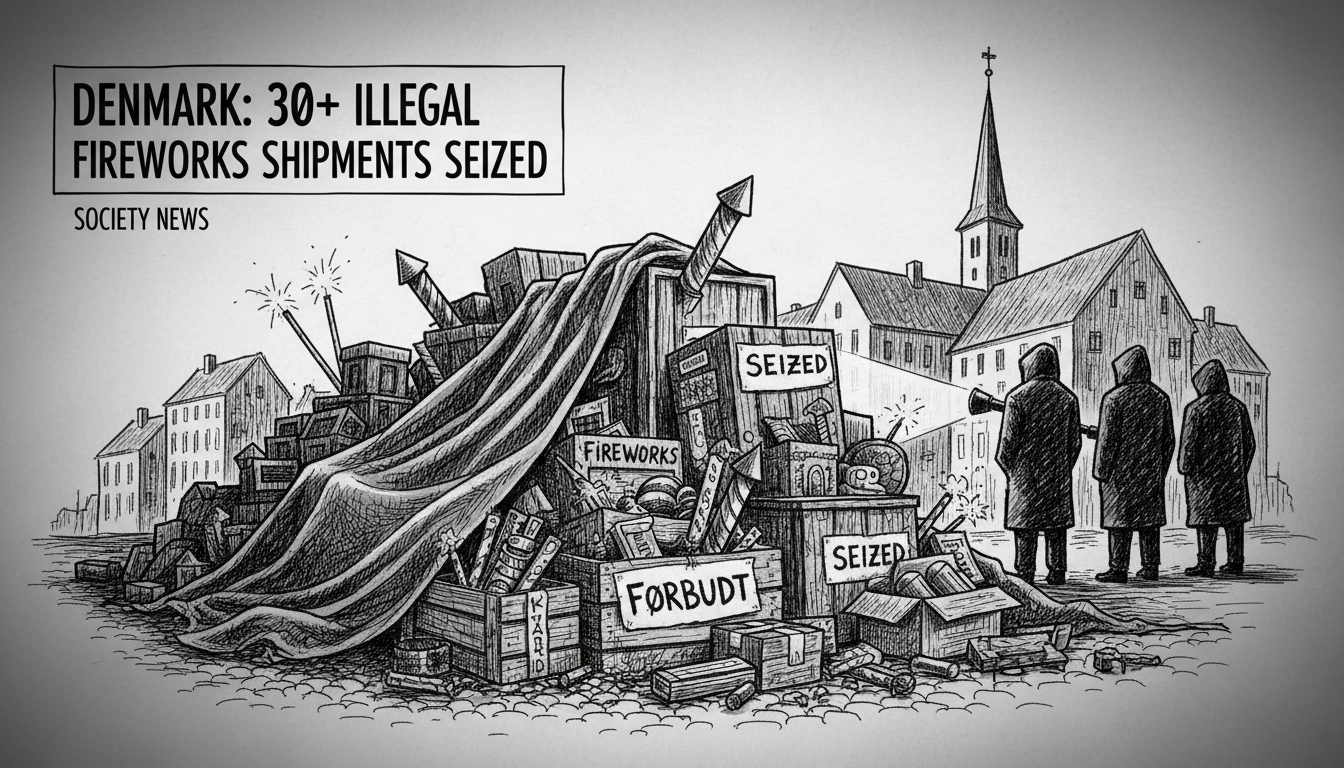
Danish border police have intercepted over thirty illegal fireworks shipments in a single day, targeting smugglers ahead of New Year’s Eve. Authorities at the Rødbyhavn crossing confiscated 28 boxes of pyrotechnics from a Swedish van and fined multiple individuals for violating strict national safety laws. This annual pre-holiday crackdown highlights the persistent conflict between Denmark’s stringent regulations and the demand for powerful, often illegal, celebratory explosives.
A Seasonal, Predictable Crackdown
Police in the South Zealand and Lolland Falster region reported multiple intercepts during routine border checks on Monday. A 33-year-old Copenhagen man was caught with a package of fireworks, receiving a 2,000 kroner fine. An 18-year-old Dutch driver faced the same penalty after officers found various fireworks in his car. In a separate incident, a 23-year-old man from Maribo was stopped with three 'bomberør' or mortar tubes in his trunk. Each faces a fixed fine of 2,000 kroner for breaches of the Danish Fireworks Act.
The most significant seizure involved a Swedish-registered van carrying two men, aged 19 and 31. A search revealed 28 full boxes of New Year's fireworks. These men were each fined 3,000 kroner for violating immigration laws, as they lacked sufficient travel identification, in addition to fireworks charges. These coordinated stops represent a standard yet intensified enforcement pattern seen each December. Danish police focus resources on key border points, knowing individuals seek cheaper or more powerful products abroad.
The Legal Framework and Its Limits
Denmark's Fyrværkeriloven (Fireworks Act) tightly controls the sale, possession, and use of pyrotechnics. The law categorizes fireworks by type and explosive content, with strict rules on who can buy them and when they can be used. Legal consumer fireworks in Denmark are generally less powerful than those found in some neighboring countries. This disparity creates a market for smuggling, primarily from Germany and Eastern Europe, where regulations differ. The Danish approach prioritizes public safety, aiming to reduce severe injuries and property damage that spike annually around December 31.
‘The goal is prevention,’ a safety official from the Danish Emergency Management Agency told Nordics Today. ‘Illegal fireworks often do not meet safety standards. They can be unstable, misfire, or cause far more powerful explosions than expected. Every year, we see life-altering injuries caused by products that should never have entered the country.’ Medical data supports this, with Danish hospitals treating dozens of serious fireworks-related injuries each New Year, many linked to illegal or misused devices.
The Price of Celebration
The fines issued at Rødbyhavn—2,000 kroner for fireworks act violations—are standard administrative penalties. They represent a significant financial deterrent for most individuals. However, authorities acknowledge that larger-scale commercial smuggling operations view such fines as a simple cost of business. Confiscation remains the primary tool, removing dangerous goods from circulation. The simultaneous charge for lacking proper ID underscores how border checks integrate multiple legal frameworks to control the flow of goods and people.
Local municipalities and police districts run annual safety campaigns urging the public to buy only legal, certified fireworks from authorized Danish retailers. ‘We want people to celebrate, but to do so safely,’ said a Copenhagen police spokesperson. ‘The illegal trade undermines that safety. It also funds other criminal activities. When you buy illegal fireworks, you are not just breaking the law; you are potentially supporting a broader criminal network.’ This messaging connects personal celebration to wider social responsibility, a common thread in Danish public safety policy.
A Border Challenge with Deep Roots
The phenomenon is not new. For decades, Danes have crossed into Germany to purchase fireworks, a practice that became illegal as Danish regulations tightened. The single European market facilitates travel but not the harmonization of national safety laws. Consequently, border towns like Rødbyhavn and Padborg become seasonal hotspots for enforcement. Police use profiling, intelligence, and random checks to identify smugglers. The recent seizures show a mix of profiles: young men in private cars and larger-scale transporters using commercial vehicles.
This enforcement comes at a high resource cost. Police must divert personnel to border control during a period already demanding high visibility in city centers. Yet, it is seen as a necessary investment. Unchecked, the influx of illegal pyrotechnics would lead to more dangerous celebrations, greater public risk, and increased strain on healthcare and emergency services. The policy reflects the Danish welfare model's proactive nature, where state intervention aims to prevent harm before it occurs, even in cultural traditions like New Year's celebrations.
Looking Ahead to New Year's Eve
With the confiscated fireworks now destroyed, police attention will shift from the border to the streets. Local ordinances in cities like Copenhagen and Aarhus designate specific public zones where fireworks are banned entirely, protecting historic buildings and crowded squares. Community patrols and emergency service readiness will peak on December 31. The success of the border operations is measured not in seizures alone, but in a quieter, safer holiday. Early indicators from hospital admissions and fire service calls in the first hours of the new year will provide the real verdict.
The annual cycle raises a persistent question for Danish society: can regulation ultimately curb the desire for ever-bigger explosions? The demand suggests a cultural element that laws alone cannot extinguish. As one fined smuggler reportedly told police, ‘It’s just for fun.’ Balancing this cultural expectation with collective safety remains a delicate, ongoing negotiation. It is a negotiation that plays out concretely at the border, in police fines, and ultimately, in the intactness of the hands and eyes of celebrants when the clock strikes midnight.