
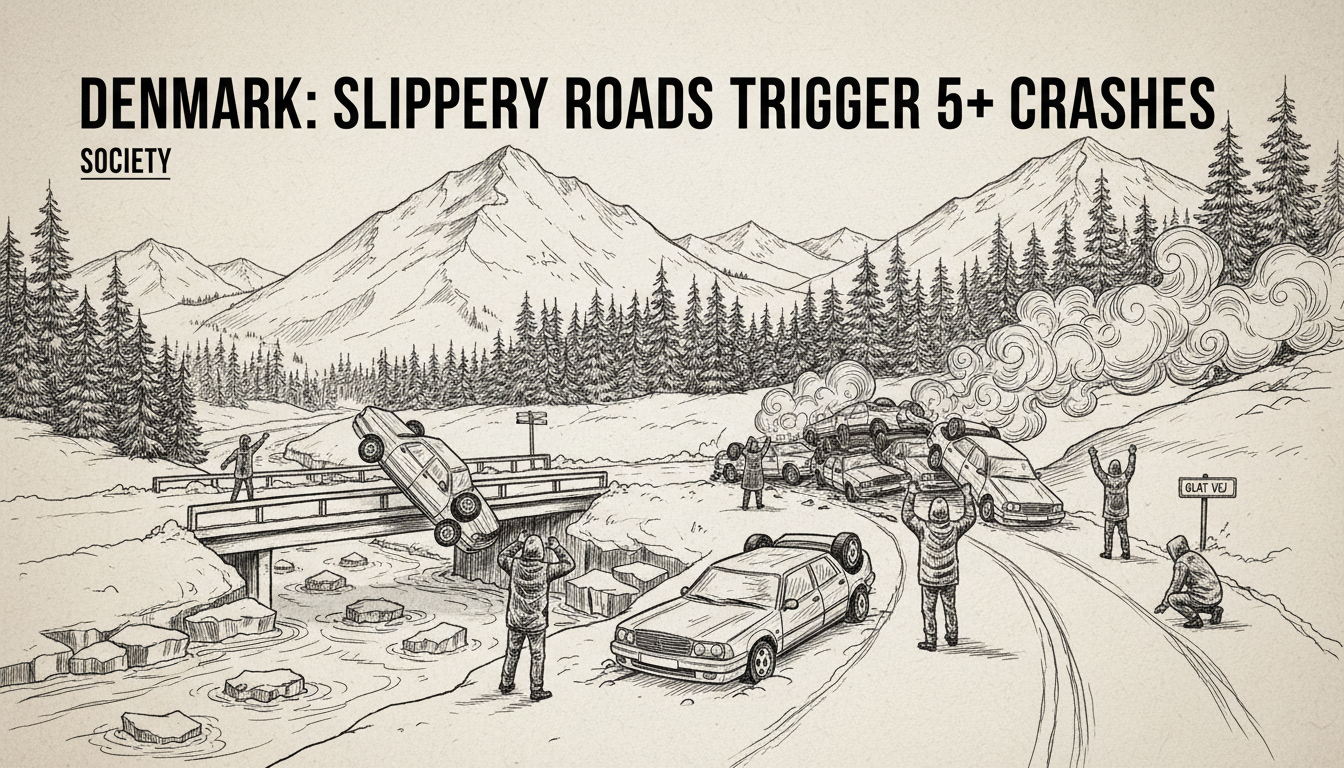
Denmark's police are warning drivers after five or more accidents occurred within hours on dangerously slick roads. Midt- and Vestsjællands Police issued an urgent alert on Thursday evening, reporting multiple crashes primarily in the Vestsjælland region as frost and ice created rapidly changing conditions. The force is urging extreme caution, lower speeds, and greater following distances to prevent further collisions.
This sudden spike in incidents highlights the perennial challenge of autumn and winter road safety in a country with variable coastal weather. The Danish Road Directorate (Vejdirektoratet) maintains the network, but local police become the frontline for real-time warnings when black ice forms. 'The road conditions can change quickly – also on stretches that otherwise seem safe,' the police stated on social media, advising drivers to pay close attention to the 'nature of the road.'
A Recurring Seasonal Hazard
Slippery conditions are a dominant cause of traffic accidents in Denmark between October and March. While national statistics on this specific incident cluster were not immediately available, similar weather patterns reliably lead to increased collisions. The warning underscores a critical period of transition, where temperatures hover around freezing, creating patches of transparent ice that are difficult to see, known as black ice.
Road safety experts consistently emphasize that technology and infrastructure alone cannot eliminate this risk. 'The most important safety feature is the driver's behavior,' says Lars Stig, a former traffic safety researcher. 'Winter tires are legally required and essential, but they are not magic. Adjusting your speed to the conditions and maintaining a safe distance are the decisive factors.' Danish authorities run annual campaigns promoting these behaviors, yet preventable accidents persist.
The Human and Systemic Response
Behind each police report is a chain of emergency response. Local fire departments and ambulance services must navigate the same hazardous roads to reach collision sites, putting first responders at additional risk. Each crash also strains healthcare resources, from emergency room staff to follow-up care for injuries that can range from whiplash to life-changing trauma.
The police warning follows a standard but vital protocol for incident prevention. By using social media platforms like X, authorities can broadcast alerts directly to the public rapidly. This approach supplements traditional media announcements and roadside variable message signs. The goal is to create a network of awareness that convinces drivers to slow down before they encounter a problem, not after.
Navigating Danish Winter Roads
For Denmark's residents, particularly new arrivals, adapting to winter driving is a necessary part of life. The law mandates the use of winter or all-season tires from November to April, a rule actively enforced. Beyond tires, experts recommend keeping a winter emergency kit in the car, including a blanket, flashlight, and reflective warning triangle.
Many Danish driving schools incorporate skid pad training, teaching corrective maneuvers for losing control on ice. However, this is not mandatory for all license holders. The consensus among safety professionals is that defensive, anticipatory driving is the best strategy. This means reducing speed well below the posted limit on bridges, shaded forest roads, and open stretches where wind can accelerate freezing.
A Look at the Broader Infrastructure
Denmark invests significantly in road maintenance to combat icy conditions. Municipalities and the Road Directorate deploy salting and graveling trucks based on detailed weather forecasts. The system is designed to be efficient, but it cannot pre-treat every road simultaneously. Rural secondary roads, like many in Vestsjælland, may see treatment later than major motorways.
This incident serves as a yearly reminder of nature's power over human systems. Even with advanced forecasting and fleets of salt trucks, a sudden temperature drop can outpace response times. The responsibility therefore shifts significantly to the individual motorist. Checking the detailed road condition service provided by the Road Directorate before travel is a habit that can prevent accidents.
The Cost of Complacency
Ignoring such warnings carries high costs. Beyond the immediate risk of injury, drivers involved in weather-related accidents may face significant insurance complications if they are found to have driven unsuitably for the conditions. The economic toll of property damage, healthcare costs, and lost productivity from even minor crashes adds up to millions of kroner annually.
The police message is simple but profound: take it easy. Slowing down is not just about legal compliance; it's about communal safety. It allows more time to react to a skidding vehicle ahead, a sudden obstacle, or an unexpected icy patch. In dense traffic, one driver's mistake can cascade into a multi-vehicle pileup.
As Denmark moves deeper into the cold season, this week's cluster of accidents in Vestsjælland is unlikely to be the last. It stands as a case study in the interplay between public warning systems, individual responsibility, and unpredictable weather. The roads may be engineered for safety, but they demand respect, especially when the frost settles silently on an evening commute. Will this warning be enough to change driving habits on the next cold night, or is a near-miss or a bent fender the only real teacher for some?