
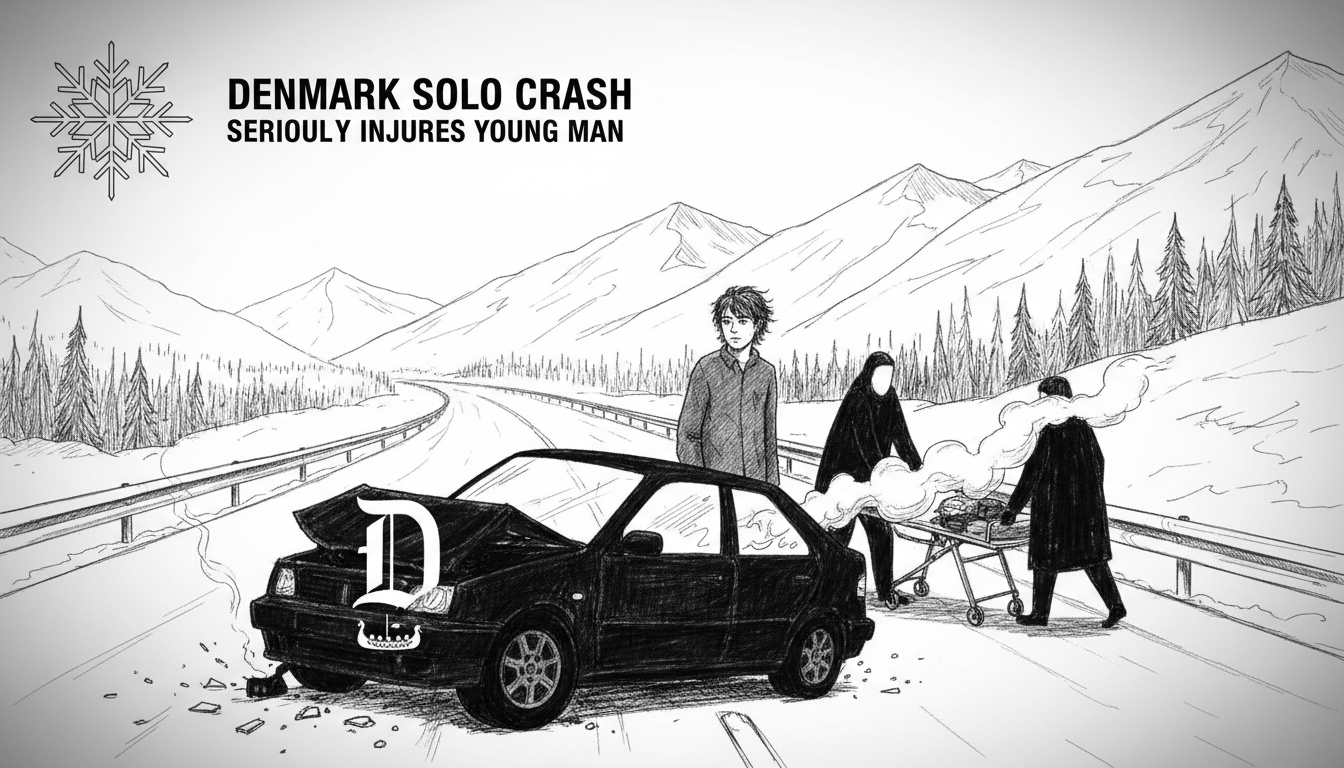
Denmark road safety concerns resurface after a young man was seriously injured in a single-vehicle accident on the island of Funen. The crash occurred in the early hours of Saturday morning on Vestergade in the town of Særslev, jolting the quiet community awake with emergency calls at 4:17 a.m. According to police, the driver’s car left the road and struck a tree in what the duty officer described as a possible slippery road accident. The scene paints a familiar and grim picture for Danish authorities who perpetually battle the human cost of traffic incidents.
Rescue services from Beredskab Fyn worked to free the trapped driver from the wreckage. Although other individuals were reportedly in the vehicle, the young man driving was the sole casualty. He was transported from the scene with serious injuries for specialized treatment at Odense University Hospital, one of Denmark's major trauma centers. Police have confirmed that next of kin have been notified, beginning the painful process for a family now facing an unexpected crisis.
A Community's Early Morning Interruption
The specific date of the Saturday morning accident was not disclosed in the initial police report, a common practice in ongoing investigations. What remains clear is the sequence of events that unfolded in the darkness. The road, Vestergade, is a local thoroughfare in Særslev. Police duty officer Christoffer Jacobsen pointed to potentially slippery conditions as a factor. Local reports described the incident as a 'curve accident' where the vehicle's rear lost traction. This detail underscores a critical aspect of winter driving hazards, where a momentary loss of control on a familiar bend can have catastrophic results.
The immediate response followed Denmark's well-coordinated emergency protocol. The call to 112 triggered a dispatch of police and the technical rescue units of Beredskab Fyn, whose crews are trained to handle complex extrications. Their work at the scene was crucial in safely removing the injured driver and facilitating rapid transport to hospital. The efficiency of this response system is a cornerstone of Denmark's welfare model, designed to deliver critical care regardless of circumstance.
The Persistent Shadow on Danish Roads
This incident is not an isolated event but part of a persistent national challenge. While Danish roads are among the safest in Europe, fatalities and serious injuries continue to occur with sobering regularity. According to the most recent comprehensive report from Statistics Denmark (published in 2024, covering 2023 data), 183 people lost their lives in traffic accidents in Denmark in 2023. This figure represents a slight increase from the 167 fatalities recorded in 2022, highlighting the fluctuating but enduring nature of the problem.
Speed, alcohol, and distraction remain the primary culprits behind serious crashes. For young drivers, the risks are often amplified. Police investigations into such solo accidents typically scrutinize these factors alongside vehicle condition and road weather. A final determination on the Særslev crash's cause will follow a technical examination. 'Every accident of this severity is investigated thoroughly to understand the sequence of events,' a police spokesperson explained. 'This helps us with prevention efforts and provides answers to the families affected.'
Winter's Invisible Threat: Black Ice and Human Error
The police suggestion of possible slippery conditions points to a seasonal danger familiar to all Danes: black ice, or 'glatføre'. This transparent ice coating on asphalt is notoriously difficult to see, especially in the low light of early morning. It can form even when air temperatures are slightly above freezing if the road surface itself is colder. Saturday mornings pose a particular risk, combining potential overnight ice formation with drivers who may be fatigued.
Road safety organizations, such as Rådet for Sikker Trafik (The Danish Road Safety Council), run annual campaigns emphasizing winter tire use and adapted driving behavior. 'The right tires are essential, but so is the right mindset,' a council expert noted. 'Reducing speed, increasing following distance, and avoiding sudden steering or braking maneuvers are the most effective defenses against slippery conditions.' Many municipalities also deploy salt and gravel on known trouble spots, but coverage can never be universal, leaving secondary roads like Vestergade vulnerable.
A Long Road to Recovery and Reflection
The injured man's journey now shifts from the acute emergency phase to treatment and recovery at Odense University Hospital. The hospital's trauma center is equipped to handle severe injuries, but the path ahead can be long and uncertain for patients with serious trauma. The psychological impact on the driver and his passengers, who escaped physical harm, can also be profound, often requiring subsequent support.
For Danish society, each serious accident triggers a moment of collective reflection. It reinforces public service announcements and policy debates about traffic safety. Discussions often turn to technology, such as advanced driver assistance systems (ADAS) becoming mandatory in new EU cars, and infrastructure improvements. Yet, at its core, the issue remains deeply human, hinging on countless individual decisions made behind the wheel every day.
The accident on Vestergade is a stark reminder that safety is fragile. It underscores the gap between statistical trends and personal tragedy—where one number in an annual report represents a life altered and a family's world upended. As the investigation continues, the community is left hoping for the young man's recovery and contemplating the thin margin for error on even the shortest of journeys.