
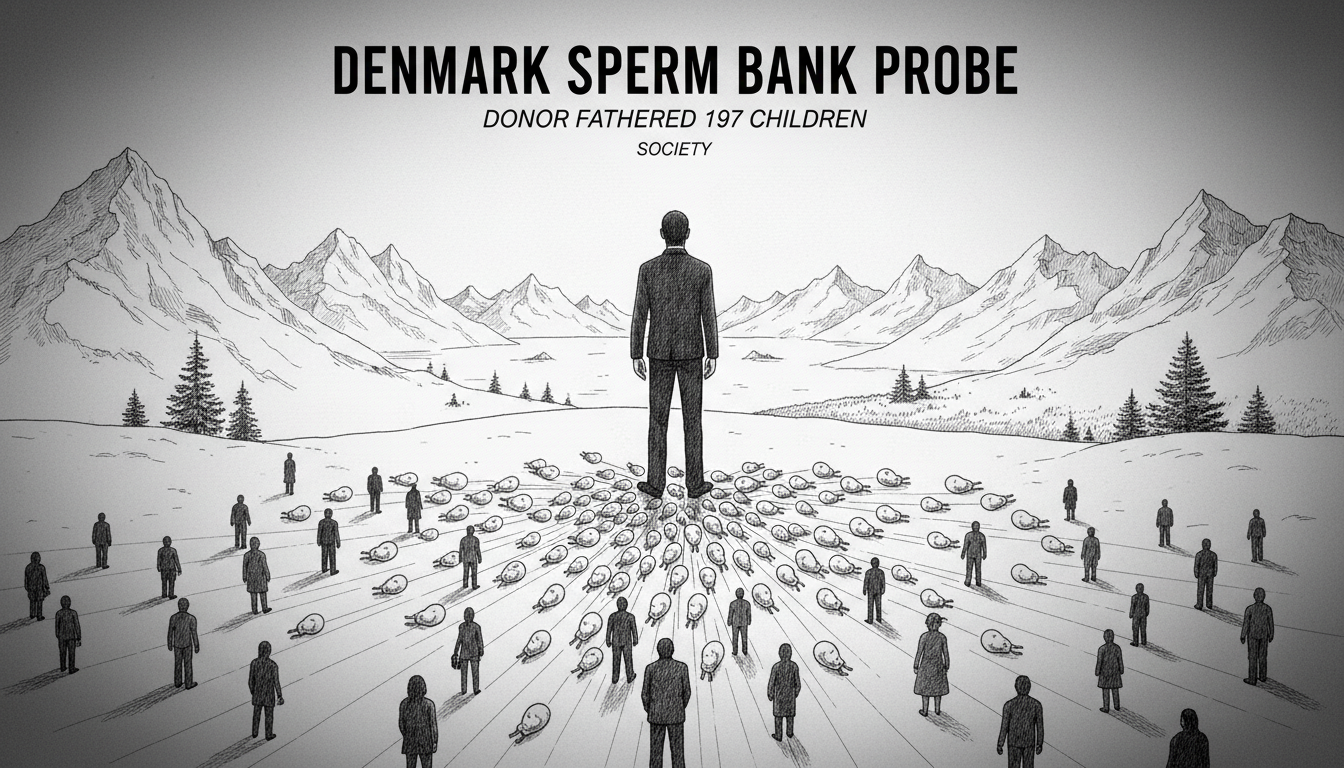
Danish sperm bank European Sperm Bank faces a police report and regulatory scrutiny after a donor was found to have fathered at least 197 children. The Copenhagen-based company, one of the world's largest, confirmed the donor's genetic material was recalled in 2023 due to a mutation, a case exposing the complex ethics and business of global fertility trade. The Danish Patient Safety Authority has filed the report, marking a significant escalation in oversight of a multi-million euro industry centered in the Øresund region.
An Industry Under the Microscope
Founded in 2004 and headquartered in Copenhagen, European Sperm Bank has grown into a major global player, facilitating over 60,000 births across 100 countries. The company was acquired by Nordic capital fund Axcel in 2019 and later by European fund Perwyn in 2022, reflecting the sector's lucrative potential. It offers sperm from a catalog of more than 1,000 donors, operating in a market where Danish regulatory standards have been a key selling point. This latest case, however, strikes at the heart of that reputation for safety and control.
The core of the investigation revolves around a donor identified by the alias 'Kjeld.' His sperm was distributed internationally before being recalled last year when the bank identified a genetic mutation in a portion of his cells. While the donor is healthy and unaware of the mutation, the scale of his offspring has raised alarm. He is the biological father to at least 197 donor-conceived children, with 49 born in Denmark alone. This Danish figure exceeds the previous national guideline of a maximum of 25 children per donor, a guideline that only became a legally binding limit in 2013.
Regulatory Response and Business Implications
The Danish Patient Safety Authority has confirmed the police report. Unit manager Bente Møller stated they are following the case closely to ensure safety for families using Danish donor services. In recent months, the authority has requested detailed information from the sperm bank, including comprehensive data on child counts from all its donors. This suggests a broader audit of practices is underway. "To the families, I would like to say: We are of course following this case all the way," Møller said. "It must be safe for families to use a Danish sperm donor and to receive fertility treatment in Denmark."
Legal experts have long criticized the high number of children linked to single donors, especially in countries with weaker regulations than Denmark's. The case highlights a tension between commercial scalability and ethical responsibility. A single donor's samples can be distributed across dozens of countries, each with different legal limits, creating a challenge for centralized oversight. The company controls the distribution, leaving donors with no say in where or in what quantities their sperm is sold.
The Ethical Quagmire and Market Trust
This incident opens a difficult discussion about the rights of donor-conceived individuals. Bioethicists argue for the right to know one's genetic origins and warn of the potential psychological and social complexities of discovering one has dozens, or even hundreds, of half-siblings. The concentration of a single donor's genetics in a population, known as "genetic bottlenecking," is also a concern for long-term public health. For the fertility industry, trust is the primary currency. Scandals like this risk undermining the confidence of intended parents who rely on rigorous screening and ethical adherence.
The business model of international sperm export is profitable but fraught with these ethical pitfalls. Denmark has positioned itself as a leader in assisted reproduction, with clinics in Copenhagen and across the country serving an international clientele. The sector contributes significantly to the Danish economy, blending healthcare services with export revenue. However, maintaining that leadership requires demonstrable compliance and transparency. A police investigation introduces reputational risk that could impact the entire Danish fertility sector's standing.
A Look Ahead for Fertility Commerce
The unfolding case presents immediate challenges for European Sperm Bank's operations and ownership. Private equity firms like Axcel and Perwyn invest in stable, scalable businesses with manageable regulatory risk. A high-profile police investigation and potential regulatory actions represent a material risk that they must now navigate. It may prompt tighter internal controls and a review of international distribution protocols to prevent future breaches.
For regulators, the case is likely to accelerate calls for harmonized international standards or more stringent export controls. The Danish Patient Safety Authority's actions signal a move toward more aggressive supervision. The outcome will set a precedent for how Denmark governs its commercially successful but ethically sensitive health export industries. Will the focus be on stricter enforcement of existing rules, or will it lead to a legislative overhaul? The industry, and the families it serves, await answers.
Ultimately, this is more than a singular case of a donor exceeding limits. It is a stress test for the entire framework of commercial fertility services. It questions whether national regulations can effectively govern a globalized biological trade and if the drive for growth can be balanced with fundamental ethical safeguards. The coming weeks, as police assess the report, will determine the next phase for one of Denmark's most distinctive and controversial export sectors.