
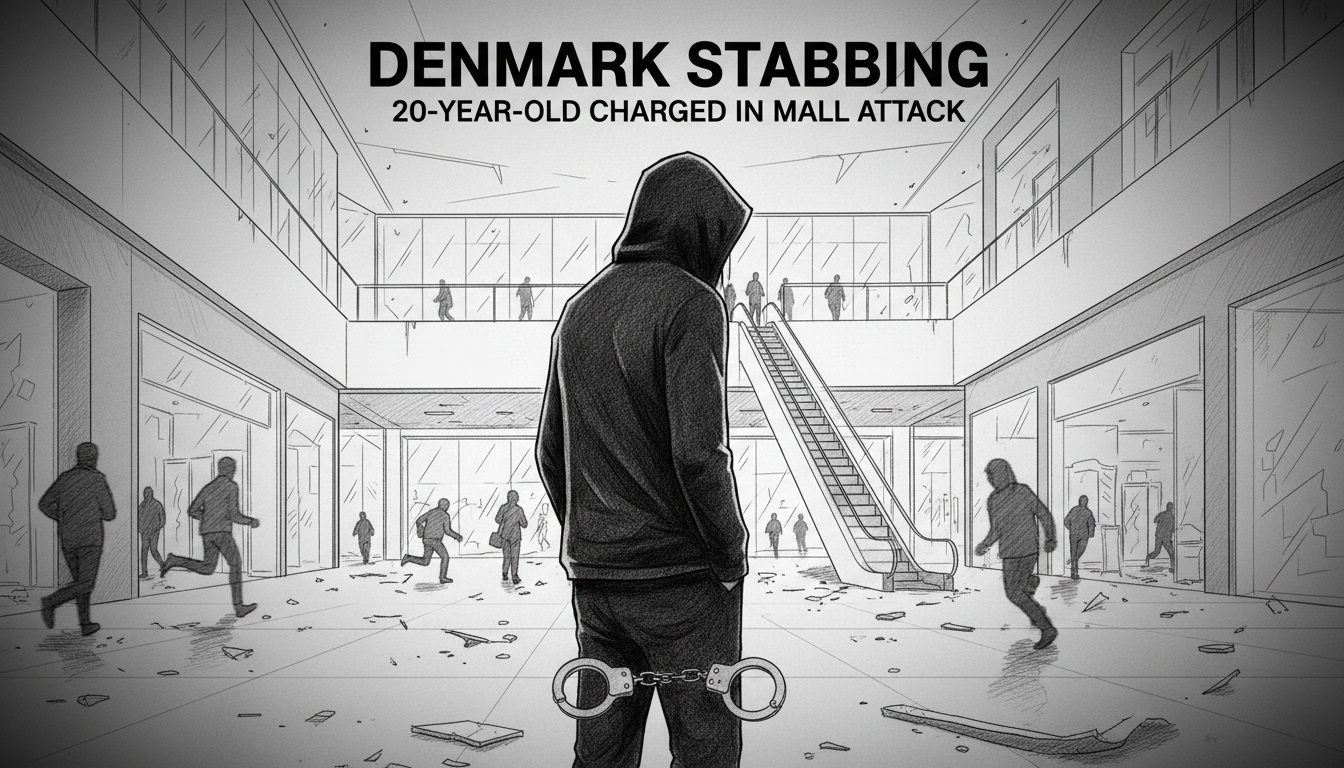
Denmark police have charged a 20-year-old man with attempted murder after a 19-year-old woman was stabbed Friday evening in Copenhagen’s Amager Centret shopping mall. The Copenhagen Police investigation is working on the hypothesis that the victim and the suspected perpetrator knew each other. This violent incident in a public space has sparked conversations about safety, domestic violence, and the complex reality behind Denmark's low overall crime statistics.
"There is nothing that makes us stop working with that hypothesis," said Mads Vestermark, the officer in charge at Copenhagen Police. He stressed that nothing indicates the stabbing was related to gang or biker activity. Authorities have reassured the public that the mall remains safe to visit. Amager Centret management expressed deep regret over the serious incident in a Facebook post, stating their thoughts were with the victim, her relatives, and all customers who were nearby.
A Violent Breach in a Community Space
The attack occurred in a location familiar to thousands of Copenhagen residents. Amager Centret is not just a retail hub; it functions as a social center for the diverse Amager borough. Such spaces are integral to daily life and community cohesion in Danish cities. A violent crime here feels like a violation of shared public trust, even if police confirm it was likely an isolated, targeted incident between acquaintances. The immediate police response and swift charge reflect the seriousness with which Danish authorities treat violent crimes, especially those involving knives.
Denmark maintains a homicide rate significantly below the global average, at approximately 0.8 per 100,000 people in recent years. This statistic is a point of national pride and a benchmark for the welfare state's success. However, isolated violent acts, particularly those potentially rooted in personal relationships, present a different kind of challenge. They are less about broad societal crime waves and more about the hidden tensions that can erupt tragically into public view.
The Domestic Violence Hypothesis
The police's focus on a potential prior relationship shifts the narrative. If confirmed, this stabbing moves from a random act of public violence into the category of potentially gender-based or domestic violence. This distinction is critical for both public understanding and policy response. In Denmark, as in other Nordic countries, there is an ongoing effort to improve intervention in domestic abuse cases, which often occur behind closed doors before escalating into public crises.
"When police quickly indicate a possible relationship, it guides the investigation toward motives like jealousy, control, or escalation of a private conflict," says a Copenhagen-based criminologist who focuses on violent crime. "The setting—a busy mall—suggests a lack of premeditation to conceal the act, or a deliberate choice to create a public spectacle. Understanding this dynamic is key to prevention and supporting the victim." The expert, who requested anonymity as the investigation is ongoing, notes that Danish social services and police have integrated protocols for handling domestic disputes, but preventing every escalation remains immensely difficult.
Security and Perception in Public Life
Despite the shocking nature of the event, Danish police were quick to reassure the public about general safety. This balance is delicate. Authorities must address public concern without inducing unnecessary fear that could harm community spaces. Amager Centret's statement reflects this dual need: acknowledging the trauma while affirming the mall's role as a safe public venue. Shopping centers across Denmark have security protocols and often collaborate closely with local police districts, but they are designed for openness, not fortification.
This incident invites reflection on what safety means in an open society. Denmark's model relies on high social trust and a visible, approachable police force. Major security barriers are uncommon. The response to this stabbing will likely focus on ensuring existing cooperation between mall security and police is effective, rather than on dramatic new security measures. The social contract in Danish cities depends on people feeling secure in shared spaces like Amager Centret.
A Look at the Broader Context of Violence
While Denmark's violent crime rate is low, each case is scrutinized. Statistics Denmark data shows fluctuations in assault rates over the past decade, with no clear upward trend. Most violent crimes in Denmark are not random; they occur between people who know each other, often in private settings. This pattern makes the public location of this stabbing particularly jarring. It forces a normally private type of violence into the communal sphere.
The judicial process for the charged 20-year-old will now begin. Attempted murder (drabsforsøg) is a grave charge under Danish law, carrying the potential for a lengthy prison sentence. The court will examine the evidence, the intent behind the act, and the circumstances. The victim's condition and testimony will be central to the case. This legal proceeding will unfold in a system known for its efficiency and thoroughness, but it cannot erase the physical and psychological trauma caused.
The Human Impact Beyond the Headline
Behind the police statements and legal charges lies a profound human story. A 19-year-old woman is recovering from a violent assault. Her family and friends are coping with shock and fear. The accused, a young man of 20, faces life-altering legal consequences. These are the raw, personal realities that crime statistics can never fully capture. For the local community on Amager, the mall may temporarily feel different—a place where a normal Friday night turned dangerous.
Danish society is built on a foundation of security and mutual care, managed through a robust welfare system and integrated social policies. Incidents like this test that foundation. They prompt questions about whether enough is being done to identify and support individuals—both potential victims and perpetrators—in crisis before violence occurs. Social services in Copenhagen municipalities often work on early intervention, but resources are finite and predicting human behavior is imperfect.
Moving Forward from a Friday Night Stabbing
The Amager Centret stabbing is a reminder that safety is complex. It involves not just policing, but also social support, community trust, and addressing the roots of interpersonal violence. Denmark's low crime rate is a significant achievement, but it is not a guarantee against tragedy. As this case moves through the legal system, it will serve as a somber point of analysis for criminologists, social workers, and policymakers alike.
Can a society with strong social safeguards prevent such intimate violence from spilling into public spaces? There are no simple answers. The response from authorities—swift charges, transparent communication about the likely nature of the crime, and reassurance to the public—follows a well-established Danish protocol. It aims to contain fear, uphold the rule of law, and allow the community to heal. The true measure of resilience for the local community will be how life gradually returns to normal at Amager Centret, with a renewed but not paralyzing awareness of vulnerability.