
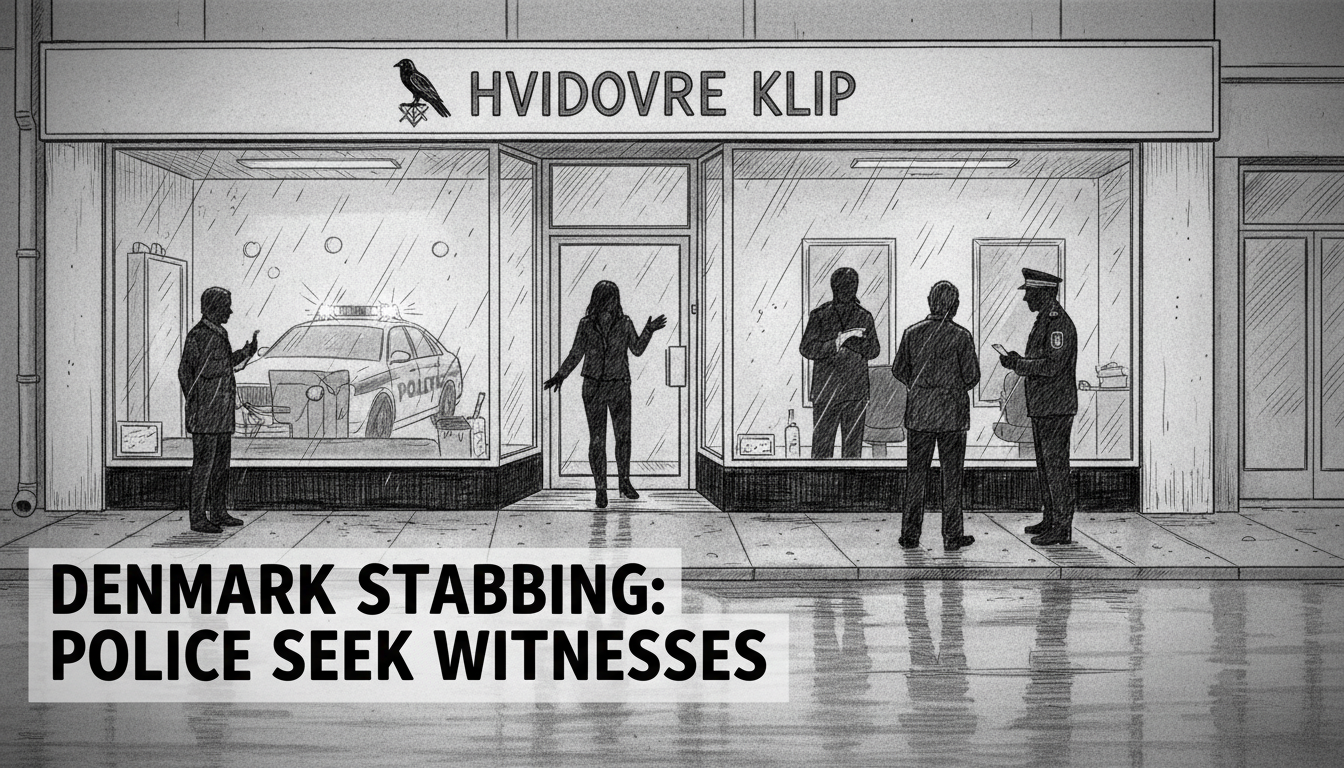
Denmark police are urgently seeking witnesses after a man was stabbed near a hair salon on Gammel Køge Landevej in Hvidovre Friday evening. The Copenhagen West Police District confirmed a massive response to the address at 314B, where the victim was found with serious injuries. Authorities later reported the man was out of life-threatening danger, though his condition remains serious. No arrests have been confirmed as the investigation continues, with officers set to maintain a presence at the scene throughout Saturday.
This violent incident on a busy commercial street has shaken the local community in Hvidovre, a municipality integrated into the greater Copenhagen area. The attack occurred in a public space typically associated with routine daily life, not violent crime. Such events, while statistically rare in Denmark, resonate deeply precisely because they disrupt a fundamental sense of public safety. The police appeal for witnesses is a standard but critical procedure, highlighting the community's role in solving crimes that occur in their midst.
A Friday Evening Shattered by Violence
The stabbing took place on Friday evening along Gammel Køge Landevej, a major arterial road connecting Copenhagen to southern Zealand. This thoroughfare is lined with shops, cafes, and services like the hair salon near where the attack happened. The timing suggests the area would have been active with people finishing work, shopping, or socializing. The transition from a normal evening to a crime scene with a massive police deployment would have been sudden and alarming for residents and bystanders.
Police first reported their presence at the address at 5:48 PM, stating one person was severely injured. The swift medical response likely played a key role in stabilizing the victim. The upgrade from 'critical' to 'out of life-threatening danger' is a positive development, but the physical and psychological trauma for the victim remains significant. For witnesses, the experience can be deeply unsettling, creating a barrier to coming forward that police must work to overcome through public appeals.
The Ripple Effect on Community Trust
Incidents like this have an impact that extends far beyond the immediate victim. They test the social fabric of a neighborhood. Hvidovre, like many Copenhagen suburbs, is a diverse community where feelings of security are paramount for social cohesion. A violent attack in a public, commercial space can make people question their safety in everyday environments. It can temporarily alter behavior, making individuals more cautious in spaces they previously considered entirely safe.
From a policy perspective, Danish municipalities and police districts closely monitor these events not just as isolated crimes, but as indicators of broader social well-being. The Danish welfare model is built on a high degree of trust and a low tolerance for public violence. When that trust is punctured, the response from authorities is typically visible and sustained, aiming to reassure the public and demonstrate control. The continued police presence on Saturday is part of that strategy, serving as both an investigative tool and a symbol of authority.
Contextualizing Violence in Danish Society
It is crucial to analyze this event within the wider context of crime in Denmark. Overall rates of violent crime are low by international standards, a point often emphasized in social policy discussions about the benefits of the Nordic model. However, when serious violent incidents do occur, especially in residential or commercial areas, they receive intense media and public scrutiny. This reflects the high expectations Danes have for public safety, an expectation woven into the social contract.
Statistics from the Danish National Police show that the vast majority of violent crimes are solved, with witness testimony being a cornerstone of many investigations. The public appeal for information in Hvidovre is a standard and effective component of this process. The lack of immediate arrests is not unusual in the early hours of such an inquiry, which often involves securing forensic evidence, collecting CCTV footage from surrounding businesses, and building a timeline from those who came forward initially.
The Path Forward for Hvidovre
The coming days will be critical for the investigation and for the community. Police will be piecing together the sequence of events and the relationship, if any, between the victim and the perpetrator. Motive remains unknown, which is often the most agonizing part for a community seeking understanding. Local social centers and community organizations in Hvidovre may play a role in providing support if residents, particularly direct witnesses, are struggling with what they saw.
For the victim, recovery will be a long road. The Danish healthcare and social support systems will be engaged, but the personal impact is profound. For the police, the work shifts from emergency response to meticulous investigation. Every piece of information, no matter how small it seems to a witness, could be the key to identifying a suspect. Their call for public assistance is a reminder that community safety is a shared responsibility.
A Test of the Social Fabric
This stabbing in Hvidovre is more than a police blotter entry. It is a sudden tear in the ordinary life of a Copenhagen suburb. It challenges the innate sense of security that is a prized feature of Danish society. The effectiveness of the police response and the willingness of the community to assist will now be tested. The resolution of this case will influence how safe residents feel walking down Gammel Køge Landevej in the future.
Ultimately, the strength of a society is often measured not by the absence of crime, but by its response to it. The mobilization of police resources, the medical care provided, and the collective hope for the victim's recovery demonstrate one layer of that response. The next layer depends on the community itself. Will witnesses step forward to help sew that tear in the social fabric? The answer will shape Hvidovre's path from being the scene of a crime back to being simply a neighborhood.