
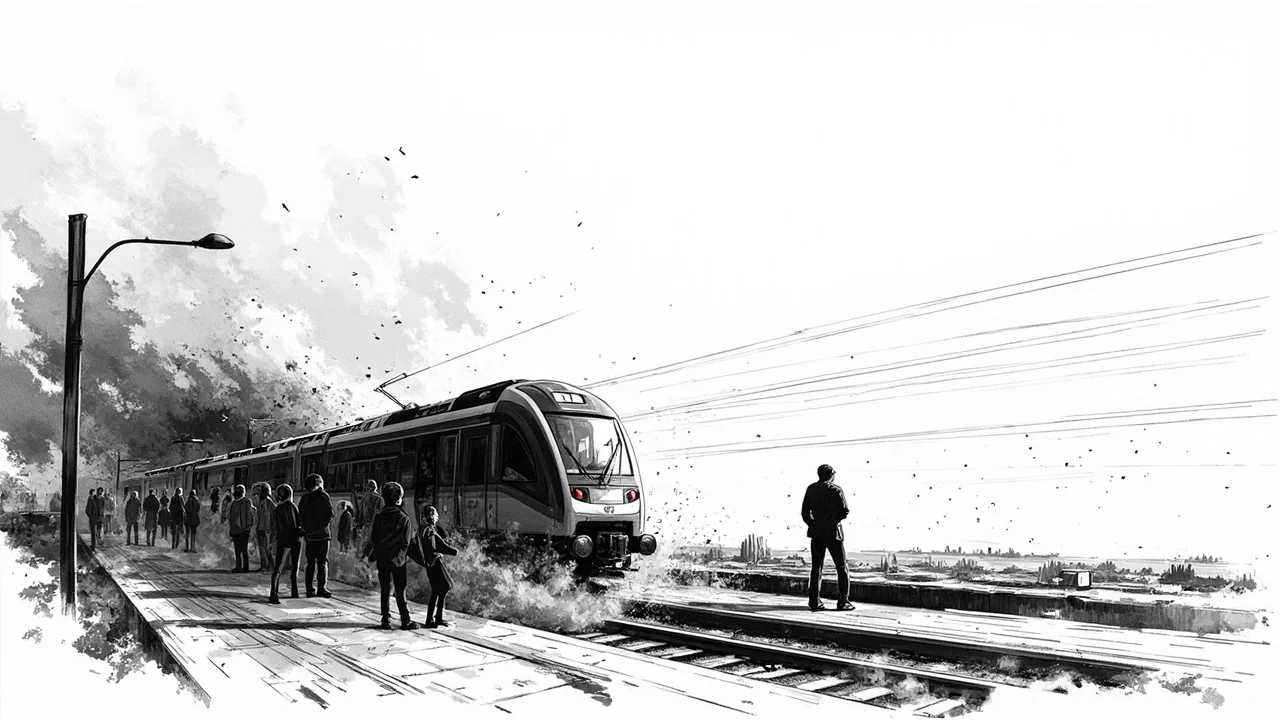
Denmark's transport police are investigating a suspected assault after a man was pushed into the path of a freight train traveling 100 to 120 kilometers per hour. The shocking incident occurred Thursday evening at Middelfart Station on Funen, plunging a routine platform into chaos and leaving one man hospitalized. Police have now charged a suspect in connection with what they describe as a life-threatening act of violence.
A Violent Shove on the Platform
According to police reports, a disturbance involving three individuals erupted on the platform. During the altercation, a freight train passed through the station. One of the men allegedly pushed another with significant force. The victim collided with the side of a freight wagon and was flung back onto the platform. The suspect fled the scene before officers arrived. The injured man was rushed to the hospital. By Friday, Fyns Police confirmed his condition was stable and he was no longer in life-threatening danger.
Vagtchef Steen Nyland described the push as 'ordentligt' or substantial. The speed of freight trains passing through stations makes such an action exceptionally dangerous. Police indicate the involved parties knew each other, though the exact nature of their relationship remains unclear during the early investigative stage. The charged suspect has been identified and questioned. Officials have not disclosed his age or background.
The Investigation Unfolds
The case has been handed to the police investigation department. Their immediate tasks include interviewing all parties and potential witnesses. A critical component will be reviewing station CCTV footage to reconstruct the event's precise sequence. Because the investigation is in its preliminary phase, police are withholding specific details about the charge and the suspect's statements. The case has not yet warranted a constitutional hearing, a formal court procedure for serious crimes.
Vagtchef Johni Müller emphasized the standard procedural steps. He noted the limited information available while the fact-finding continues. The police received the emergency call at 10:39 PM on Thursday. The rapid identification and charging of a suspect suggests witnesses or video evidence provided clear leads. Community safety at transit hubs is now under scrutiny.
Safety in Public Spaces
This incident strikes at the heart of public trust in Denmark's famously safe and orderly public spaces. Train stations are central to daily life, seen as secure transit points. A violent attack in such a setting disrupts that fundamental social contract. It prompts urgent questions about conflict resolution and safety protocols in crowded areas.
As a reporter focused on integration and social policy, I see layers here beyond the immediate crime. Public spaces are our shared commons. Their safety is a barometer of social cohesion. When violence erupts, it damages the communal trust that allows diverse societies to function smoothly. The fact the men were acquainted points to a personal conflict that spilled catastrophically into public view.
Danish municipalities and social services often work to de-escalate community tensions before they reach a crisis point. Incidents like this, while rare, test the systems designed to maintain public order. They also test the emergency response of police and medical services, which in this case appears to have been effective.
A Look at Broader Implications
The legal consequences for the charged man could be severe. Pushing someone into the path of a moving train typically leads to prosecution for attempted manslaughter or grievous bodily harm. The court will consider the perpetrator's intent and the victim's miraculous survival. The high speed of the train makes the outcome a matter of centimeters and chance.
For the local community in Middelfart, the event is a disturbing anomaly. It will likely spark discussions about security presence and lighting at smaller stations, especially during evening hours. While major hubs like Copenhagen Central have visible security, regional stations operate on a presumption of general safety. This presumption is now being re-examined.
Data on violent crime in Denmark shows these extreme events are uncommon. Yet their impact is profound. They create narratives of fear that can overshadow statistical reality. The police work now is not just judicial but also restorative—repairing the community's sense of security.
Moving Forward from the Platform
In the coming days, the judicial process will advance. The police investigation will conclude, and the prosecution will formalize its case. The victim continues his recovery, facing both physical and psychological trauma. The ripple effects of a few seconds of violence extend far into the future for all involved.
This case reminds us that safety is actively maintained, not passively assumed. It involves functional technology like CCTV, efficient police work, and a collective commitment to non-violence. As Denmark integrates diverse populations, reinforcing these norms in all communities remains a continuous task. The hope is that justice provides some closure and deters others from letting conflict escalate to the edge of a train track.
Will this shocking event lead to renewed focus on conflict mediation in local communities, or will it remain a tragic but isolated footnote? The answer depends on how society chooses to respond after the headlines fade.