
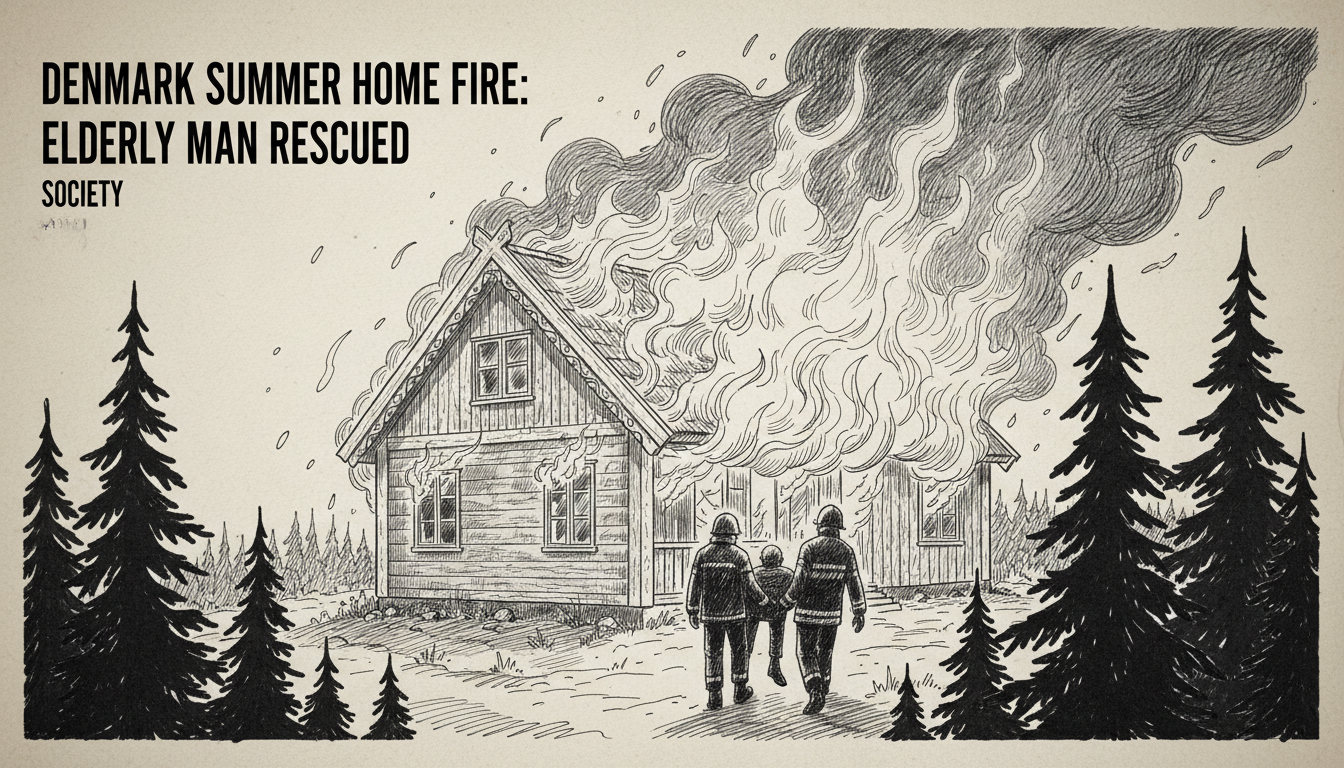
Denmark fire safety concerns resurfaced this weekend after a dramatic rescue in Juelsminde. An elderly man narrowly escaped a devastating blaze that consumed his summer home, a fire ignited by a common and often underestimated household hazard: hot ashes from a wood-burning stove. The incident, which required a significant emergency response, highlights the persistent risks in Denmark's beloved holiday home culture, especially during transitional seasons.
Neighbors became first responders on Saturday afternoon on Engbo road in the coastal town. They pulled the man to safety as flames, sparked by ashes dumped on a wooden terrace, rapidly engulfed the structure. Police reported the emergency call at 15:21. The man was checked by ambulance personnel but was unharmed, a fortunate outcome starkly contrasted by the total loss of the property. The local fire service deployed four vehicles and eleven firefighters to control the inferno and prevent its spread to neighboring houses.
A Common Catalyst for Catastrophe
The cause of this fire is frustratingly familiar to Danish emergency services. Wood-burning stoves, or 'brændeovne', are a cozy staple in many Danish summer houses and year-round homes. Their improper use, particularly the disposal of ashes, is a perennial cause of destructive fires. Experts consistently warn that ashes can retain intense heat for days, posing a severe ignition risk when placed near combustible materials like wooden decks, trash bins, or dry vegetation. This incident in Juelsminde is a textbook example of that danger realized.
Fire safety professionals stress that ashes should never be disposed of immediately after use. "The rule is simple: ashes must be cold," explains a veteran fire prevention officer from a major Danish municipality, who requested anonymity as they were not directly involved in this case. "That doesn't mean warm to the touch. It means cold. They should be stored in a dedicated, non-combustible metal container with a tight lid, placed well away from any building, for at least several days before final disposal. What seems like a harmless bucket of grey powder can hide enough heat to start a tragedy."
The Vulnerable Fabric of Holiday Havens
Summer houses, or 'sommerhuse', represent a core part of Danish leisure and family life. Often constructed decades ago with wood as a primary material, they can be particularly vulnerable to fast-spreading fires. Their locations in rural or coastal areas, like Juelsminde's popular marina district, sometimes mean longer response times for emergency services compared to urban centers. This places a premium on preventive measures and immediate neighborly action, which proved decisive in this weekend's event.
The seasonal nature of these properties adds another layer of risk. They may be used intermittently, with heating systems reactivated after long periods of dormancy. Chimneys might not be recently swept, and smoke detectors could have dead batteries. Owners, often elderly and enjoying a peaceful retreat, may not be as physically agile in responding to an emergency. The successful rescue in Juelsminde relied entirely on the alertness and courage of nearby residents, underscoring the community's role in safety.
Systemic Gaps in Safety Education
While Danish building codes for new constructions are stringent, the vast existing stock of older holiday homes operates under older standards. National fire safety campaigns do run periodically, but their penetration into the daily habits of every citizen, particularly regarding mundane tasks like ash disposal, is inconsistent. The message often competes with a deep-seated cultural comfort and familiarity with wood-burning heat, a comfort that can breed complacency.
Insurance data in Denmark reveals that fires originating from fireplaces, stoves, and chimneys consistently rank among the top causes of residential fire damage. The financial and emotional toll is immense, with families losing not just property but repositories of memories. For the elderly, such a loss can be especially disorienting and difficult to recover from, even when physically unharmed. The man in Juelsminde lost his summer house completely, a personal sanctuary reduced to ashes by the ashes he handled.
A Narrow Escape and a Broad Warning
The Juelsminde fire had all the ingredients for a fatality. An elderly occupant, a rapidly developing fire in a wooden structure, and a remote-ish location. That it ended without injury is a credit to the neighbors and the efficient response of the Sydøstjylland fire brigade. Police confirmed there was no risk of the fire spreading to adjacent properties, a testament to the containment efforts. The scene left behind was one of total destruction, a charred silhouette where a home once stood, serving as a silent, stark warning to the community.
Local authorities will typically conduct a basic investigation to confirm the cause, though in clear cases like this, it often concludes swiftly. The broader investigation, so to speak, falls to the public. This event asks every owner of a wood-burning stove, in a summer house or main residence, to audit their habits. It questions whether the metal ash can is truly used, if it is placed on a stone slab rather than a wooden porch, and if the allure of immediate tidiness is worth the latent risk.
Beyond the Ashes: A Call for Conscious Practice
Ultimately, Denmark's fire safety regarding household stoves relies less on high technology and more on unwavering vigilance and proper practice. It is a matter of culture and routine. Experts advocate for treating hot ashes with the same respect as live fire. The incident in Juelsminde is not an anomaly but a preventable accident that repeats itself in various forms across Denmark each year, particularly in autumn and spring when stoves are in use but awareness may be lower than in deep winter.
The story from Juelsminde is a fortunate one, a near-miss with a happy ending for the resident's personal safety. His rescue is a heartening example of community vigilance. Yet, the smoldering ruins of his summer home stand as an expensive and traumatic monument to a single, common mistake. As Denmark moves into seasons where the comforting crackle of a wood fire becomes appealing, this event serves as a critical, real-world reminder. Safety lies not just in having a fire extinguisher mounted on the wall, but in the patient, disciplined handling of what remains after the flames die down.