
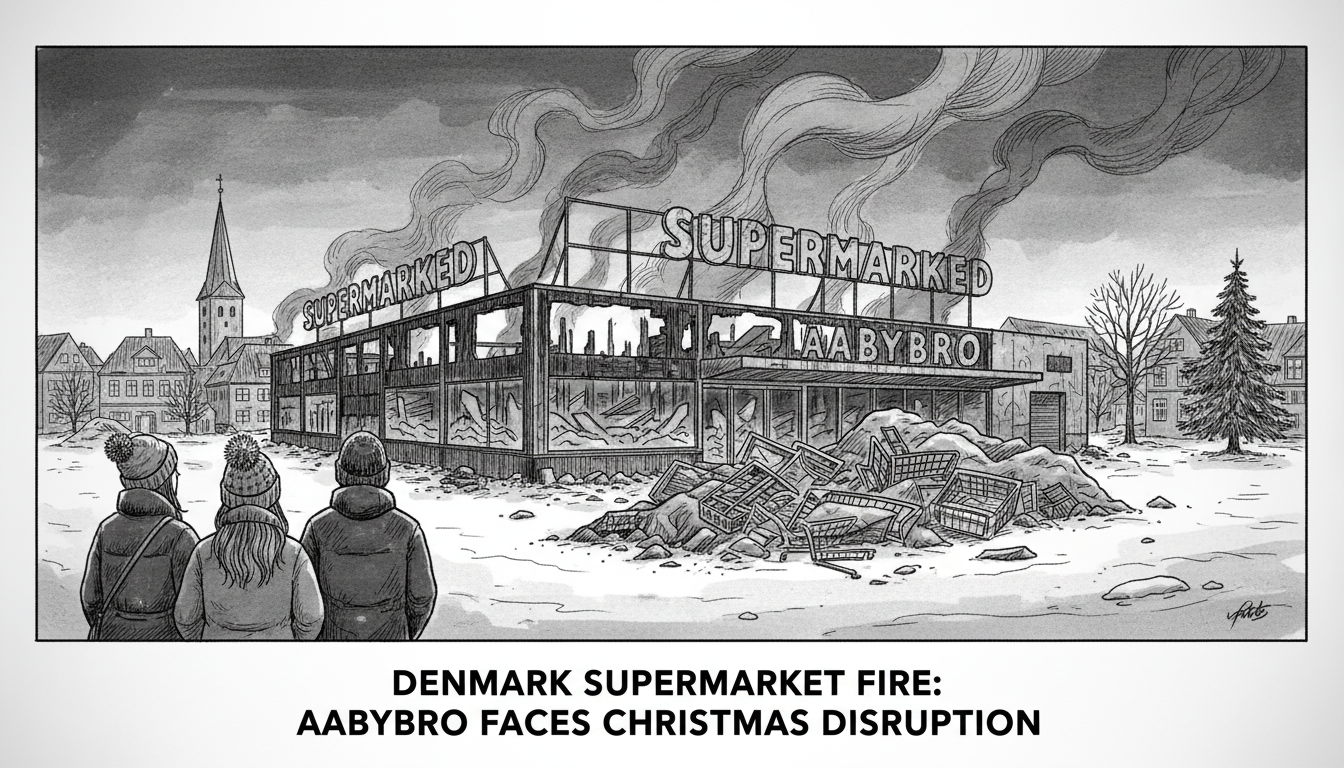
Denmark supermarket fire in Aabybro has left a community without its main grocery store and a beloved bakery just days before Christmas. The severe blaze at the Meny supermarket in Aabybro Centret has forced both the store and the adjoining Lagkagehuset bakery to close indefinitely. For residents of this North Jutland town, the timing could not be worse.
Customers who placed orders for holiday breads and cakes at Lagkagehuset Aabybro will find a temporary solution. The bakery chain announced on Facebook that all pre-ordered items, including Click & Collect orders, can be picked up on Tuesday afternoon at the local Nybolig real estate office. This quick pivot demonstrates a commitment to customer service during a disruptive event. However, the larger Meny store, a crucial hub for weekly shopping, will remain closed on the other side of the holiday, creating a significant gap in local services.
A Community Centerpiece Goes Dark
The closure of a major supermarket like Meny creates immediate logistical challenges for any community. In Aabybro, a town where local centers serve as vital social and commercial anchors, the impact is magnified. Supermarkets in Danish towns often function as more than just places to buy food. They are meeting points, employers, and guarantees of daily convenience. Losing this resource during the busy Christmas preparation period forces residents to travel farther, disrupting routines and adding stress during what is already a demanding time of year.
Local business analysts note that the economic ripple effect extends beyond the two closed stores. Aabybro Centret likely sees reduced foot traffic, potentially impacting other small businesses in the vicinity. The pre-Christmas period is typically a peak revenue time for retailers, making the lost sales particularly painful. The duration of the closure remains unknown, leaving both the business owners and the community in a state of uncertainty.
The Human Impact of a Local Crisis
While property damage and economic loss are measurable, the human inconvenience is deeply felt on a personal level. For elderly residents or those without easy access to a car, the nearest alternative supermarket may be a difficult journey. The holiday season involves planning large meals and hosting guests, tasks that become suddenly more complicated. The closure disrupts the simple, reliable patterns of daily life that people depend on.
Lagkagehuset's specific situation highlights another layer of this disruption. The bakery chain is deeply woven into Danish food culture, especially during holidays where traditional pastries and cakes are central to celebrations. A pre-order at Lagkagehuset often represents a planned centerpiece for a Christmas lunch or dinner. The company's effort to redirect these orders to Nybolig shows an understanding of this social importance. It is a pragmatic crisis response aimed at salvaging a small piece of normalcy for its customers.
Examining Denmark's Local Infrastructure Resilience
This incident in Aabybro invites a broader look at the resilience of local commercial infrastructure across Denmark. Many smaller towns and suburbs are built around a single, central shopping complex housing a supermarket, a pharmacy, and a few other essential stores. This model offers convenience but also creates a single point of failure. When a fire or other major incident strikes, the entire local service ecosystem can be crippled overnight.
Municipal crisis planning often focuses on large-scale disasters, but localized events like this fire have an outsized impact on the communities they hit directly. The speed and effectiveness of the response from both the businesses involved and local authorities become critical. The temporary use of Nybolig's premises is a good example of community-level problem-solving. It raises questions about whether other towns have similar informal networks or contingency plans to support local commerce during unexpected closures.
Looking Beyond the Immediate Aftermath
The road to recovery for Aabybro Centret will be long. Insurance assessments, safety inspections, and physical repairs must all occur before Meny and Lagkagehuset can consider reopening. For the employees of both establishments, the closure means sudden unemployment during the holidays, adding financial anxiety to the community's distress. Danish labor market schemes and union agreements will provide some support, but the interruption is significant.
The community's adaptation in the coming weeks will be telling. Will residents permanently shift some of their shopping to neighboring towns, or will they wait patiently for their local store to return? The loyalty to local businesses is strong in many Danish communities, but convenience often dictates behavior. The ultimate test will be whether the center can regain its full role as the heart of Aabybro's daily commerce once the damage is repaired.
For now, the people of Aabybro face a simplified, more complicated Christmas. They have lost a key convenience, but they have also witnessed the quick mobilization of local resources to mitigate the damage. The story of this fire is not just one of loss, but also of the practical, community-focused response that follows a crisis in Denmark. It underscores how deeply linked everyday life is to the physical spaces of commerce, and how fragile that link can be when unexpected disaster strikes.