
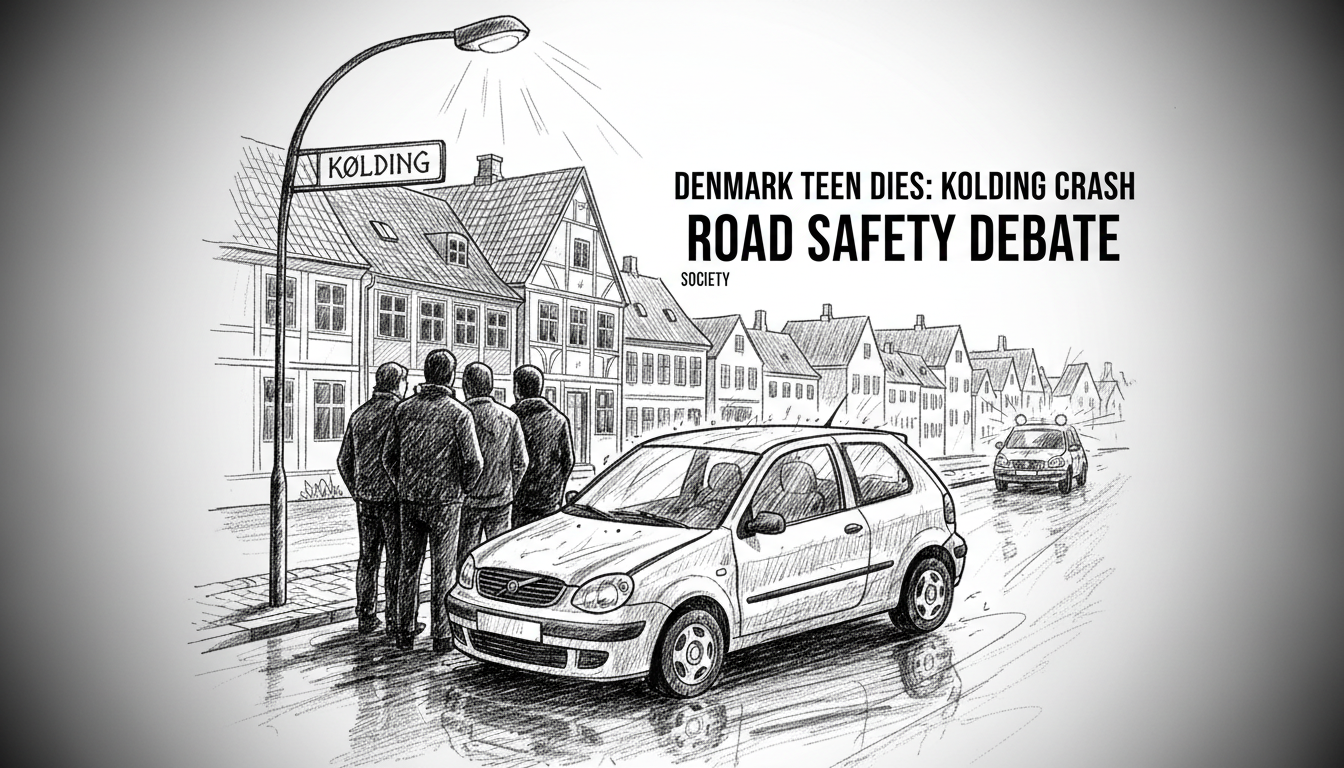
Denmark traffic accident news this week is dominated by a tragedy in Jutland that has claimed a young life. A 14-year-old boy from Odense died on Sunday evening, two days after being critically injured in a severe collision north of Kolding. The incident, which occurred on Friday on Ammitsbølvej near the Donsvej intersection, involved a head-on crash after a car inexplicably veered into oncoming traffic. The boy was a passenger in that car, driven by a 50-year-old man, also from Odense, who remains seriously injured. This single event has shattered a family and sent ripples through a community, forcing a renewed look at the persistent human cost of road incidents in one of Europe's safest countries.
A Fatal Sequence on a Friday Afternoon
According to Sydøstjyllands Police, the sequence of events was brief and violent. A car driven by the 50-year-old man was traveling on Ammitsbølvej when, for reasons still unknown, it crossed into the opposite lane. "First, the car clips another oncoming car, before it drives head-on into a third car," police duty officer Rune Nielsen explained in his initial statement on Friday. The 14-year-old boy was in the passenger seat of the first vehicle. Emergency services rushed both the driver and the teenager to the hospital, where the boy was immediately listed in critical condition. He succumbed to his injuries two days later. The police have notified the bereaved families, a formal procedure that marks the start of an unimaginable period of grief.
The location of the crash, Ammitsbølvej, is a road north of Kolding, a major city in Southern Denmark. Such regional roads, connecting towns and villages, are common scenes for serious accidents across Denmark. They often have high speed limits and varying conditions, requiring constant driver attention. The immediate aftermath saw a major police response and a detailed technical investigation launched to map the crash scene. This investigation is now paramount, not only for potential legal proceedings but to provide answers to a grieving family about why their son and brother will not be coming home.
The Statistical Paradox of Danish Road Safety
This death occurs against a backdrop of Denmark's generally exemplary road safety record. Preliminary data for 2022 shows 175 traffic fatalities in the country, one of the lowest rates per capita in Europe. Decades of policy focusing on seatbelt laws, strict drink-driving enforcement, and continuous infrastructure improvements have built a system that protects most users most of the time. For an international audience, Danish roads feel orderly and safe. Cyclists are abundant and protected, speed limits are largely respected, and the cultural attitude towards traffic rules is one of collective responsibility. This makes each fatal accident, particularly one involving a child, feel like a profound system failure.
Yet, statistics are cold comfort to the bereaved. The national number of 175 annual deaths represents 175 individual stories, 175 communities impacted, and hundreds of family members left to navigate loss. When the victim is a 14-year-old, the tragedy feels amplified. He was at an age of burgeoning independence, likely looking forward to the final years of primary school, summer holidays, and a future that has now been erased. This incident forces a difficult public conversation: how does a society that has done so much to improve road safety confront the accidents that still, inevitably, happen? The answer often lies not in broad statistics but in the granular details of each case—driver behavior, vehicle condition, road design, and sheer misfortune.
The Unanswered Questions of Cause and Responsibility
The central mystery of the Kolding crash is the cause. Why did the 50-year-old driver's car cross into the oncoming lane? Police investigations in such cases are meticulous, examining multiple potential factors. Traffic safety experts, whom I have consulted on similar stories, typically point to a triad of possibilities: medical emergency, driver impairment, or distraction. A sudden medical event like a heart attack or stroke could cause a driver to lose control. Impairment from alcohol, drugs, or prescription medication is another critical line of inquiry. In an age of smartphones, distraction is a growing and deadly concern, even on familiar roads.
The investigation will reconstruct the vehicle's trajectory, examine its mechanical condition, and await medical reports on the driver. It will also involve speaking to witnesses from the other two vehicles involved. The driver of the car that was struck head-on, in particular, has survived a traumatic event and may hold key information. Determining cause is crucial for any potential criminal charges, from negligent driving to more serious offenses. For the boy's family, however, the question of "why" transcends the legal. It becomes a central, painful part of their grieving process, a search for sense in a senseless event.
The Human Impact Beyond the Headlines
As a reporter covering Danish society, I often see how policy discussions can abstract human pain. This story is a stark reminder of the individual lives behind the headlines. The 14-year-old boy was from Odense, Denmark's third-largest city. His family, friends, and school community are now plunged into mourning. The school will likely bring in crisis counselors. His classmates will struggle to comprehend the finality of his empty chair. In Odense and in Kolding, two communities are now linked by this shared tragedy.
The 50-year-old driver, also fighting for his life in hospital, carries an immense burden. If he survives, he must face not only his own physical recovery but the psychological trauma of the crash and the death of his young passenger. The dynamics of their relationship—whether he was a family member, a friend's parent, or another trusted adult—add another layer of profound complexity to the emotional aftermath. Danish social services and the healthcare system will be tasked with supporting all those affected, a long-term process that begins in the emergency room but extends for years.
A National Conversation on Constant Vigilance
Every fatal accident in Denmark prompts a period of public reflection. Road safety authorities, such as the Danish Road Directorate (Vejdirektoratet), consistently campaign on core messages: slow down, pay attention, never drive impaired. They work with municipalities to identify dangerous stretches of road and implement engineering solutions like better lighting, rumble strips, or roundabouts. Yet, as this crash demonstrates, human error or vulnerability can override even the best infrastructure.
The debate that follows often centers on whether laws are strict enough. Could lower speed limits on roads like Ammitsbølvej prevent such cross-over collisions? Should in-car technology that prevents lane drifting become mandatory? These are valid policy questions. However, the most immediate lesson is one of collective responsibility. It is a reminder to every driver that the act of driving is one of the most dangerous daily activities we undertake, requiring our full focus and respect. The safety of our passengers, especially children, is entirely in our hands.
The death of this 14-year-old boy is a heartbreaking loss. It underscores that despite Denmark's world-leading safety standards, the road remains a place of inherent risk. The investigation in Kolding will continue, seeking answers that may prevent future tragedies. For now, a family in Odense plans a funeral, and a community is left to wonder how a routine Friday drive could end so catastrophically. Their grief is the ultimate measure of the work still to be done, not just in policy, but in the conscience of every person who gets behind the wheel.