
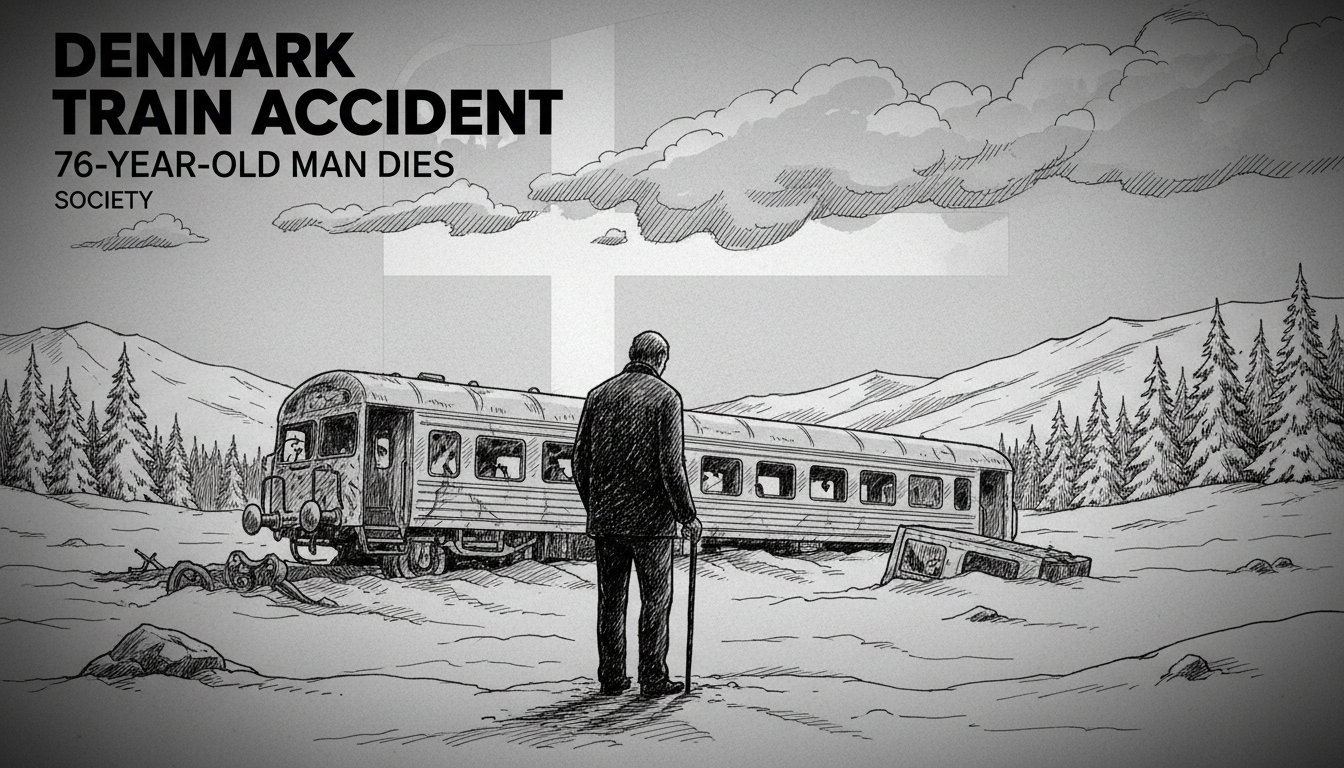
Denmark train accident investigators are piecing together a tragic sequence of events from New Year's Eve. A 76-year-old man died after being struck by a train on the Frederiksværkbanen line in North Zealand. Police confirmed the fatality and revealed the man had walked away from a local hospital in a confused state shortly before the incident. This personal tragedy opens a difficult conversation about Denmark's social safety net and the protocols for protecting its most vulnerable citizens.
A Fatal Walk from Care
Nordsjællands Politi, the North Zealand police force, is leading the investigation. They are working on the hypothesis that this was a tragic accident. The man had reportedly left a healthcare facility while disoriented. His subsequent path led him onto the railway tracks of the Frederiksværkbanen, a regional line connecting Hillerød with Frederiksværk. Train traffic was suspended for hours on December 31st as emergency services responded to the personpåkørsel, or person-on-track collision. For an international audience, such incidents are rare in Denmark due to significant national investment in railway safety and infrastructure. This makes the circumstances surrounding this death particularly jarring for the local community and for Danish society at large.
Systems Under Scrutiny
The immediate question shifts from how the accident happened to why the man was in that position. When a patient, especially an elderly one showing signs of confusion, leaves a hospital unsupervised, it suggests a potential failure in institutional duty of care. I have reported on Denmark's integration and social policies for years, often focusing on how systems designed for collective welfare handle individual crises. The Danish welfare model is built on principles of security and protection for all. A core part of its social contract is that the state and its institutions provide a safety net. This incident will inevitably trigger reviews of patient monitoring protocols and communication procedures between healthcare providers and authorities when a vulnerable person goes missing.
Experts in healthcare and public safety will likely emphasize the need for reinforced cooperation. "Cases involving individuals with cognitive impairment require seamless coordination," a Copenhagen-based social policy analyst told me, referencing standard practices. "Healthcare facilities, police, and sometimes municipal social services must have clear, actionable plans. The priority is always swift intervention to prevent harm." While Danish hospitals generally have strong protocols, this tragedy highlights how a single gap can have irreversible consequences. It raises issues familiar in discussions about elder care and mental health support—topics that are central to Denmark's ongoing social policy debates.
The Human Cost of Protocol Gaps
Beyond the policy analysis lies a profound human loss. A family is grieving a father, grandfather, or husband whose New Year's Eve ended in catastrophe. The local community in North Zealand is confronting a shocking event in their otherwise tranquil region. For the train driver and emergency responders, this is a traumatic event that leaves a lasting psychological impact. These human dimensions are sometimes overshadowed by procedural inquiries, but they are the heart of the story. The Danish approach to such tragedies often involves not just police investigation but also post-incident support for affected staff and families, a reflection of the country's broader welfare ethos.
This accident occurs within a specific Danish context. The country boasts one of the world's lowest rates of fatal railway accidents, a point of pride for Banedanmark, the national rail infrastructure manager. Their continuous investment in fencing, signaling, and public awareness campaigns aims to make such events exceedingly rare. Most incidents involve trespassing or suicide, making this case—linked to a medical episode—somewhat atypical. This distinction will focus internal reviews on the intersection of healthcare and public space safety, rather than on rail infrastructure itself.
A Broader Conversation on Vulnerability
The story transcends a single accident report. It touches on universal challenges of caring for an aging population and supporting those with cognitive or mental health issues. In Denmark, municipalities hold primary responsibility for social services and elder care, operating within a framework set by national legislation. An incident like this prompts questions about resource allocation, staff training, and the use of technology for patient location in healthcare settings. Could different procedures at the hospital have altered the outcome? What is the reasonable balance between patient autonomy and protective supervision? These are difficult questions with no easy answers, but they are the questions Danish authorities must now ask.
Statistics on integration and social care often focus on large-scale outcomes, but system strength is ultimately tested in individual, critical moments. The death of this 76-year-old man is one such moment. It tests the responsiveness of protocols and the depth of institutional accountability. My reporting on integration issues has shown that public trust in systems erodes when they fail at their core mission of protection. Restoring that trust requires transparent investigation and tangible changes to prevent recurrence.
Looking Ahead: Investigation and Implications
The police investigation will continue to establish the precise timeline and circumstances. A final report will determine whether any legal or regulatory breaches occurred. Simultaneously, the relevant hospital and regional health authorities will undoubtedly conduct their own internal review. The findings could influence guidelines across Denmark's healthcare regions, potentially leading to new standards for monitoring patients assessed as high-risk for wandering. This could involve changes to facility design, staff-to-patient ratios in certain units, or the adoption of non-restrictive tracking technologies for consenting patients.
The tragedy on the Frederiksværkbanen is a somber start to the new year. It is a reminder that even in nations with renowned social safety nets, vulnerable individuals can slip through. The measure of Denmark's society will be found not in the accident itself, but in the rigor of its response and the humanity of its reflection. Will this lead to meaningful systemic improvements that better safeguard the elderly and confused? For the family of the 76-year-old man, and for a society that prides itself on care, that is the only acceptable outcome. The tracks are now clear, but the path to ensuring such a tragedy never repeats is just beginning.