
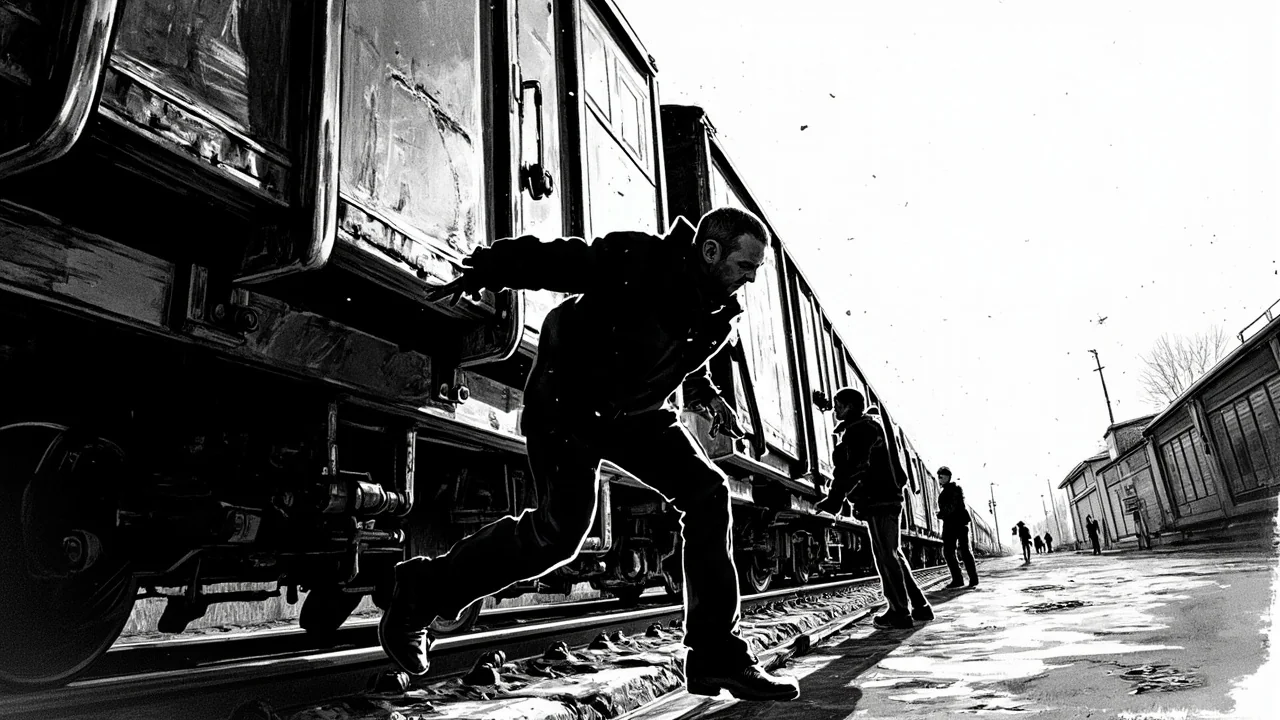
Denmark police are investigating a violent assault on a railway platform that left a man seriously injured after being pushed into a moving freight train. The incident occurred Thursday evening at Middelfart Station on the island of Funen, according to Funen Police. Authorities confirm the victim is now in stable condition and out of immediate life-threatening danger, following what they describe as a tumult between two individuals captured on station surveillance footage.
Vagtchef Steen Nyland from Funen Police stated the man was injured when he was shoved into the side of a passing freight train. These trains typically travel at speeds between 100 and 120 kilometers per hour on such stretches. The assailant fled the scene before officers arrived at 10:39 PM, but police express strong confidence in identifying and apprehending the suspect. A third young man present during the episode has been questioned but is not charged. The train driver, unaware of the incident occurring far behind the locomotive, continued until stopped at a subsequent station.
A Platform Turned Crime Scene
The quiet of a Thursday evening at Middelfart Station was shattered by an act of sudden violence. What began as an altercation between individuals escalated into a near-fatal push onto the tracks. This incident forces a uncomfortable examination of public safety in communal spaces we often take for granted. Danish railway stations, typically symbols of efficient connectivity and orderly public life, became the backdrop for a reckless assault. The visual evidence from platform cameras now forms the core of the police investigation, piecing together moments that changed a life.
Police have notified the victim's relatives but have not disclosed his age, referring only to three young men involved. The refusal to share further details, citing the ongoing investigation, underscores the seriousness with which authorities are treating the case. For the local community in Middelfart, a town of approximately 15,000 people, such a violent public incident is deeply unsettling. It breaches the social contract of security in shared infrastructure.
The Mechanics of a Near-Tragedy
The physics of the incident are horrifying. A freight train moving at 100-120 km/h generates immense force. The difference between a severe injury and a fatality in such a collision can be a matter of centimeters and angles. That the victim survived initial impact is fortunate, though his road to recovery will likely be long. The train's momentum and the driver's physical separation from the event meant there was no chance for emergency braking. This highlights a grim reality of rail safety: by the time a driver perceives an obstacle on the tracks, it is often too late to stop.
This dynamic places the onus for prevention squarely on platform safety measures and social behavior. Danish rail operator Banedanmark invests significantly in safety, but technology cannot always prevent deliberate human acts. The investigation will scrutinize whether existing barriers, signage, and surveillance at Middelfart Station are adequate or if this was a failure that could only be addressed by social intervention. The speed of the freight train, standard for non-stop services, turns any object on the tracks into a potentially lethal projectile.
Policing Public Spaces and Social Tensions
From my perspective covering Danish society, this case sits at a difficult intersection. It is a clear criminal act requiring justice, but it also prompts broader questions about conflict resolution and youth violence in public areas. Funen Police's methodical approach—reviewing video, identifying suspects, and carefully managing public information—reflects standard Danish policing protocol. Their confidence in making an arrest suggests the surveillance system functioned as intended, providing crucial evidence.
However, the incident reveals a lapse in the immediate social fabric that usually prevents such escalations. Danish society prides itself on a high level of trust and low level of public violence. When that trust is broken in a communal hub like a train station, it resonates deeply. It challenges the perception of safety and order that underpins daily life. The municipality of Middelfart, like many others, has social services and youth outreach programs. One must ask whether there are adequate resources for conflict mediation and youth engagement that could prevent such volatile situations from developing.
The Ripple Effects on Community and Infrastructure
The aftermath extends beyond the criminal investigation. Railway staff, witnesses, and first responders must process a traumatic event. DSB, the national train operator, may review procedures for responding to incidents on platforms. For regular commuters using Middelfart Station, the platform may now carry a psychological weight, a reminder of vulnerability. This is the human cost often absent from initial police bulletins.
Furthermore, the incident tests the resilience of the welfare system's support for victims of violent crime. The victim's recovery will involve not only hospital care but potentially long-term physical therapy and psychological support, all coordinated through the Danish healthcare system. His ability to reintegrate into work and community life will be a measure of that system's effectiveness. The assailant, once apprehended, will enter a justice system that balances punishment with rehabilitation—a core tenet of Danish penal policy.
A Search for Answers and Accountability
As the police investigation continues, key questions remain unanswered. What was the nature of the relationship between the individuals involved? Was the push a moment of uncontrolled rage or a premeditated act? The answers will determine the final charges. The term 'tumult' used by police suggests a chaotic, heated struggle, but the act of pushing someone toward a moving train implies a terrifying intent.
Accountability also lies with the societal framework. Are public spaces designed to minimize such risks? Could better lighting, more visible security personnel, or emergency communication points have altered the outcome? Danish urban planning typically emphasizes creating safe, open environments, but this incident shows how quickly design can be overridden by human action. The social contract requires not just physical infrastructure but a shared commitment to de-escalation and mutual respect, even in moments of conflict.
Looking Forward: Safety Beyond the Headlines
This case will eventually move from front-page news to a court docket. The legal process will run its course. The deeper challenge for Danish society is to absorb the lessons without resorting to fear or overly restrictive measures. The solution is not to blanket stations in barriers that destroy their open, accessible character. Instead, it requires reinforcing the social and communal bonds that make public spaces function.
It involves ensuring youth have constructive outlets and support systems before conflicts turn violent. It means maintaining vigilant, community-oriented policing. And it demands a continued investment in the social welfare infrastructure that can catch individuals before they fall—or before they push. The tracks at Middelfart Station will see trains pass again, as they always have. The true test is whether the community can restore the sense of security that was shattered alongside the peace of a Thursday night.