
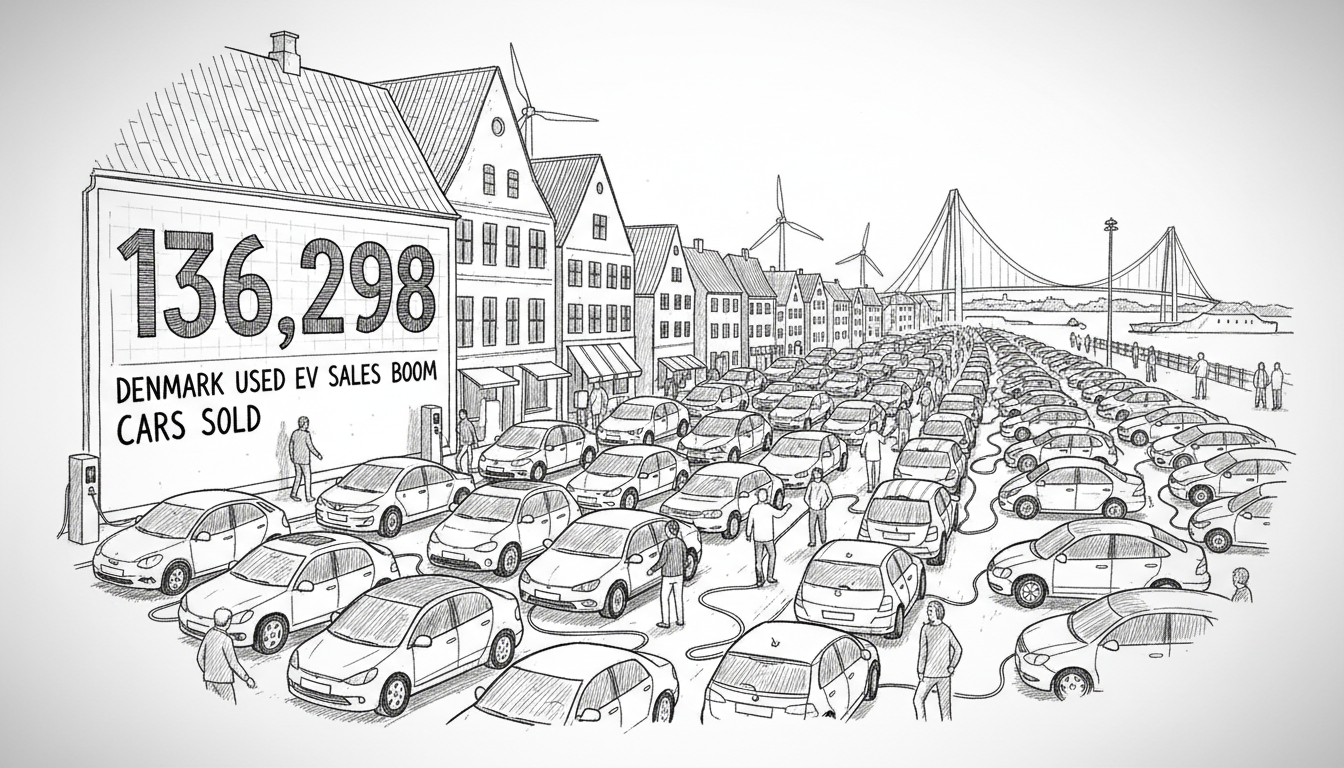
Denmark's used electric car market is accelerating at a record pace, driven by price parity with small petrol cars and a flood of imports from European neighbors. At Kvalitetsbiler, a major used car dealer in Tørring, sales chief Thor Dyhr has sold 613 used EVs this year alone, a personal record that underscores a national trend. The company expects to sell around 6,200 cars in 2025, a 25 percent increase from the previous year, with electric vehicles now constituting 95 percent of its sales.
"We call it a McDonald's booking," Dyhr says, describing the constant stream of online test-drive appointments. "On a quiet day after Christmas, we had about 80 bookings from interested customers." The surge is not confined to one dealership. National statistics for the first eleven months of 2025 show 136,298 total car sales in Denmark, with a staggering 111,496 of those being used vehicles. The data points to a fundamental shift in Danish consumer behavior, where the second-hand EV has become the default choice for a growing number of families and businesses.
The Price Parity Tipping Point
The driving force behind this boom is simple economics. According to Benjamin Madsen, owner of Kvalitetsbiler, the price of a popular used model like the Skoda Enyaq is now almost the same as a new Volkswagen Polo. "It makes much more sense to buy an electric car," Madsen states. This dramatic price compression in the used EV market, particularly for European brands like Volkswagen, Skoda, and Audi, has removed a major barrier to entry. Consumers are no longer paying a significant premium for electric technology; they are getting more car for their kroner, with the added benefit of lower running costs. The trend is fueled by a steady supply of vehicles imported from Holland, Belgium, Germany, and France, where earlier adoption cycles mean a robust inventory of used EVs is now available for the Danish market.
Analysts point to a perfect storm of factors: an expanding pool of off-lease and traded-in EVs from across Europe, consistent government policy signaling, and improved consumer confidence in battery longevity and charging infrastructure. "The increasing affordability of used EVs is the key driver," notes a Copenhagen-based automotive analyst. "We're seeing the first major wave of three-to-five-year-old electric vehicles entering the secondary market, and Danish buyers are snapping them up. The total cost of ownership calculation now decisively favors electric, even in the used segment."
Policy Winds in the Market's Favor
The sales boom at dealerships like Kvalitetsbiler comes with a political backdrop. The Danish government had originally planned to introduce a registration tax for more expensive new electric cars in 2026, a move that could have dampened the new car market and indirectly affected used values. However, that plan has been postponed by at least a year, providing a clear runway for continued growth. This policy stability, combined with existing incentives like lower registration taxes for EVs and Copenhagen's expanding network of charging stations, has given both dealers and consumers confidence.
This regulatory environment stands in stark contrast to the uncertainty facing petrol and diesel vehicles. Madsen reflects the sentiment of many in the trade when he says, "I don't think petrol and diesel cars will make a serious comeback." With Denmark's ambitious 2030 climate targets and a political consensus around decarbonizing transport, the economic signals are increasingly aligned against fossil-fuel vehicles. The used car market, often a bellwether for mainstream consumer adoption, is voting with its wallet.
A Personal Record in a National Shift
The story of Thor Dyhr's 613 sales is a microcosm of the larger economic shift. His record-breaking performance is not just about individual hustle; it's a symptom of overwhelming demand. "The total number is now up to 613 cars," Dyhr mentioned during an interview, adding, "While you were walking around taking some pictures, I just sold two more." This level of activity transforms the traditional car dealership model. The "McDonald's booking" system—high-volume, standardized, and digital-first—is tailored for a market where the product is in high demand and consumer research is often done online before a visit.
The models flying off the lot are predictable yet significant. The Volkswagen ID.3 and ID.4, along with the Skoda Enyaq, remain customer favorites. These are not niche luxury vehicles but mainstream family cars, indicating that electrification has moved squarely into the heart of the Danish automotive market. The sales are not concentrated solely in Copenhagen but are spread across the country, suggesting nationwide infrastructure and acceptance.
What Comes After the Boom?
The question facing the industry is whether this growth trajectory is sustainable. Benjamin Madsen has no doubts: "Next year will be even wilder." His optimism is based on the expectation that supply from European markets will remain strong and that prices will continue to be attractive. However, analysts caution that the market will evolve. As the used EV segment matures, differentiation will increase. Factors like battery health certification, standardized range tests for used cars, and competition from a new generation of more affordable Chinese-brand EVs could reshape the landscape.
Furthermore, the almost total dominance of EVs in some dealerships—95% at Kvalitetsbiler—raises questions about the residual value and desirability of the remaining internal combustion engine vehicles. A two-tier used market could emerge, with petrol and diesel cars becoming increasingly difficult to sell except at steep discounts. This has significant implications for the total value of the Danish vehicle fleet and for financial institutions with auto loan portfolios.
For now, the momentum is undeniable. The record sales figures from a dealership in Tørring reflect a broader Danish and Nordic commitment to sustainable transport. It demonstrates that when the economic equation works, consumers will follow. The shift to electric is no longer a future promise driven solely by policy; it is a present-day reality driven by the market. As one industry observer put it, "The conversation has changed from 'Why should I buy an electric car?' to 'Why wouldn't I?'" The hundreds of sales contracts signed at Kvalitetsbiler this year, and the thousands more across Denmark, are the tangible answer.
The Bigger Economic Picture
This surge in used EV sales has ripple effects beyond the showroom. It stimulates the import-export trade within the EU, supports financing and insurance sectors, and boosts businesses related to home charging installation and public infrastructure. For the Danish state, while there may be short-term concerns about tax revenue from vehicle registration as cheaper used cars dominate, the long-term benefits for public health, energy security, and climate goals are substantial.
The Danish experience offers a case study for other nations watching the EV transition. It shows that the used car market can act as a powerful accelerator for adoption, bringing electric mobility to a much wider demographic than the new car market alone. The success hinges on cross-border European trade, stable and supportive government policy, and, ultimately, cars that meet the practical needs and financial constraints of ordinary people. As Thor Dyhr prepares for another record year, his sales tally is more than just a number—it's a countdown to a transformed transport system.