
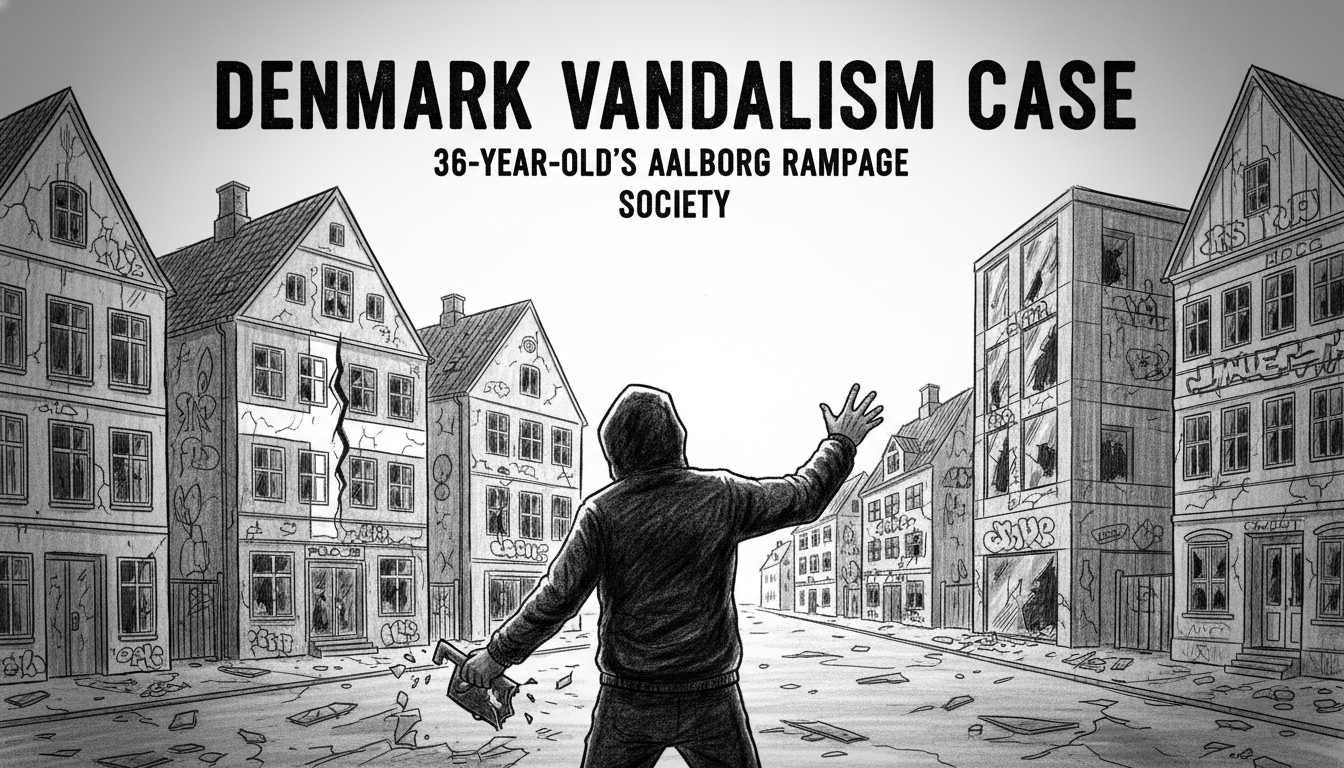
Denmark police in Nordjylland arrested a 36-year-old man in a destructive overnight incident in Aalborg. The man, who was not under the influence of alcohol or drugs, went on a rampage targeting a quiet residential street, causing significant property damage before his arrest at 2:56 AM. This case presents a complex puzzle for authorities, blending straightforward criminal acts with deeper questions about motive and mental state in Danish society.
A Night of Destruction on Schleppegrellsgade
The incident unfolded on Schleppegrellsgade in the Aalborg Vestby district, a typically calm residential area. According to police reports, the man systematically damaged door phone panels at numbers 80 and 82, rendering building security systems inoperable. He then moved to number 76, where he destroyed lamps in the building entrance. His final act was attacking a public lamppost outside the same address, shaking it violently until it broke. "He shook it so much that it broke," the police duty officer stated. "The bulb went out, and the glass at the top fell off and shattered." The sequence suggests a focused, though seemingly indiscriminate, campaign against both private and public property on a single street.
The Legal Framework for Vandalism in Denmark
Danish law treats vandalism, or hærværk, as a property crime with penalties scaled to the severity and financial cost of the damage. Simple vandalism can result in fines, while aggravated cases involving significant destruction or particular recklessness can lead to imprisonment. The classification depends on factors like the value of damaged property, whether public utilities were targeted, and the perpetrator's intent. In this Aalborg case, damaging a lamppost—a piece of public infrastructure—could potentially elevate the charge. Police must now calculate the total repair costs for the door panels, interior lighting, and the lamppost to determine the precise charge. The suspect's apparent sobriety adds another layer, as intoxication can sometimes be considered a mitigating factor in court, but that avenue appears closed.
Searching for Motive in a Sober Act
The police confirmation that the man was not intoxicated shifts the investigative focus dramatically. It rules out alcohol-fueled impulsivity, a common driver in night-time disturbance cases. This leaves authorities and criminologists examining other potential triggers. Was this a targeted act of anger towards specific residents, or a random outburst? The damage to multiple buildings suggests a broader, perhaps symbolic, target than a single individual. Mental health crises, unresolved personal conflicts, or profound psychological distress become primary lines of inquiry. "Cases like this, where the individual is sober and the destruction is methodical yet widespread on one street, point to underlying issues that go beyond simple mischief," says a Copenhagen-based criminologist who studies antisocial behavior. "The police and, later, the court will need to understand what precipitated this to determine appropriate intervention beyond punishment."
Community Impact and the Cost of Disorder
While not a violent crime against persons, this type of vandalism erodes the sense of security and order that is foundational to Danish community life. Damaged door phones compromise building security, leaving residents feeling vulnerable. A shattered lamppost creates a dark spot on the street, a tangible symbol of neglect that can encourage further petty crime. The financial cost, borne by housing associations, municipal services, and ultimately taxpayers, is direct. The social cost—the feeling that one's immediate environment is fragile—is more insidious. For residents of Schleppegrellsgade, the morning revealed a violated everyday space. Such incidents, even if isolated, trigger conversations about municipal responsiveness, police visibility, and the social fabric of neighborhoods.
Policing and Prevention in Urban Denmark
The North Jutland Police's response was swift, leading to an arrest within the same night. This efficiency is a standard expectation in Denmark's policing model, which emphasizes timely intervention. The case now moves from patrol officers to investigators and the judicial system. Prevention is a harder challenge. It involves a network of social services, mental health support, and community policing. Danish municipalities operate social service centers (kommunale socialcentre) that are often the front line for individuals in crisis. Whether this man was known to such services is a private matter, but his actions will likely trigger a review of his contact with public support systems. The goal is to connect legal accountability with social care, aiming to address root causes and prevent recurrence.
A Broader Lens on Social Wellbeing
This Aalborg vandalism case is a small but sharp data point in the wider analysis of social wellbeing in Denmark. The Nordic welfare model is designed to provide stability and support, yet incidents of unexplained, sober destructiveness hint at gaps or individual falls through the safety net. They raise uncomfortable questions about isolation, anger, and mental health in one of the world's most prosperous societies. Statistics on integration and social mobility show overall positive trends, but individual stories of distress remind us that systemic success does not eliminate personal crisis. The incident serves as a micro-study: a man, a street, and a series of broken objects that together form a puzzle about community, responsibility, and the sources of rage in a tranquil night.
What Comes Next for the Suspect and the Street
The police duty officer expected the man to be released from detention on Sunday morning, indicating the initial custody period for processing. His release does not mean the case is closed; he will likely be formally charged and summoned to court at a later date. The judicial process will determine his guilt and any sentence, which could range from fines to conditional or actual imprisonment. For the residents of Schleppegrellsgade, the path is one of repair and restoration. The damaged items will be fixed, the glass swept away, and the light restored. Yet the memory of the incident lingers, a brief crack in the ordinary peace of a Danish neighborhood. The true resolution extends beyond the courtroom, asking whether the systems designed to support individuals can engage with someone who expresses their turmoil through the destruction of a lamppost on a quiet street in Aalborg.