
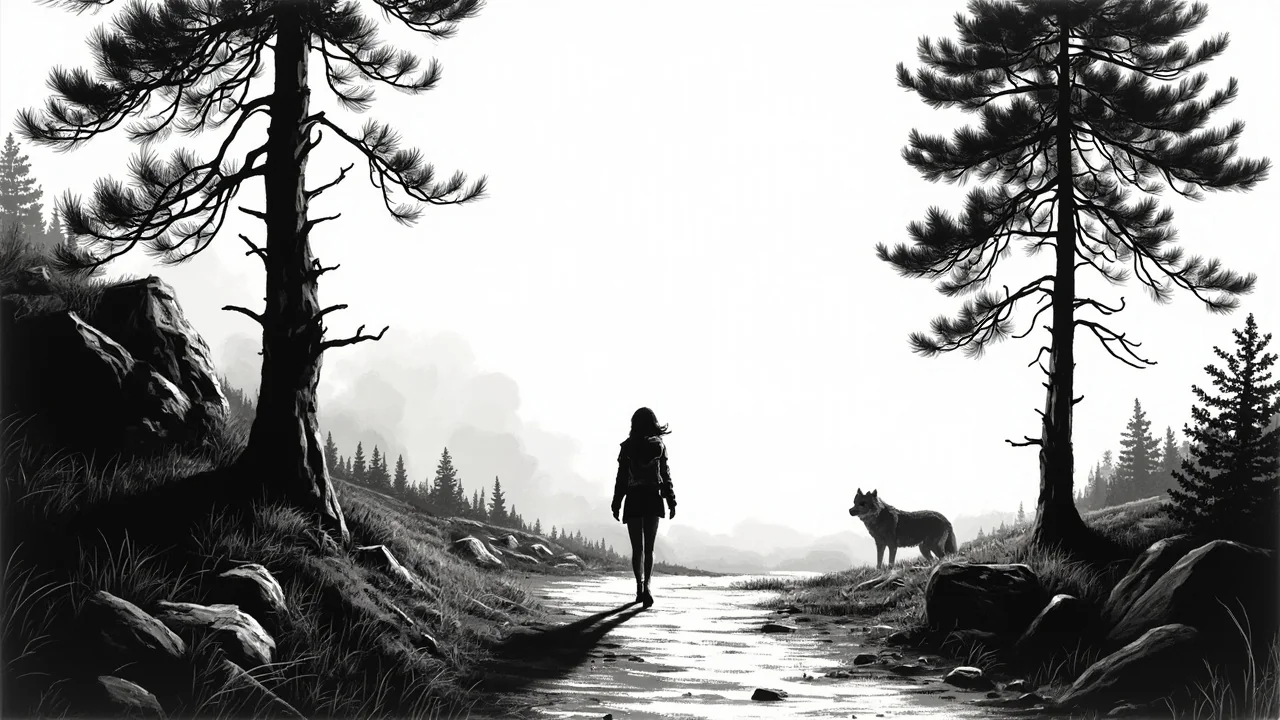
Denmark's wolf population created a moment of sheer panic for a 14-year-old girl last Friday evening in West Jutland. Anne Puggaard was walking home from her sports hall in Oksbøl when she spotted a wolf just meters away. Her ordinary walk turned into a frightening experience that has reignited a complex national debate about coexistence, fear, and the management of a protected predator now firmly re-established on Danish soil.
"I was just walking normally, and then I saw it out of the corner of my eye," Anne Puggaard recounts. "I turned around and just panicked and started filming immediately. After I stopped filming, I called home and said, 'Mom, I don't know what to do,' and that's when it came really close, maybe less than a meter." The video she captured shows the wolf trotting steadily behind her along a residential road, its gaze fixed on the teenager. The animal's persistent following is what transformed a sighting into a deeply alarming event for the local community.
Her mother, Dina Puggaard, was already in bed when the call came. "I jumped out of bed and yelled to my husband that he had to go get her," she says, the stress still audible in her voice. Fortunately, an elderly couple driving by intervened, offering Anne a safe ride home. This human response highlights the tight-knit nature of smaller Danish communities, but the incident itself exposes the raw edge of a nationwide policy challenge.
A Volunteer's Perspective on Changing Behavior
Henrik Vej Kastrupsen from the voluntary Oksbøl Wolf Watch Group has analyzed the video. His group is part of a citizen-based network that monitors wolf activity, reports sightings to the Danish Nature Agency, and attempts to haze wolves away from urban areas. "There is no doubt that it is following her," Kastrupsen states. "I can also see that it appears to be a young wolf, one that is also a little confused and a little shy at one point in the video. But it is very clear that it is following the girl."
His analysis moves beyond the immediate scare to a more significant concern: behavioral change. The core task for monitors, he explains, is identifying wolves that display altered behavior towards humans. "As a starting point, we in the Wolf Watch Group just go out and try to shout and clap and scare the wolf out of town," Kastrupsen says. "It may be that we over time must acknowledge that it takes a little more for these wolves to learn that they should not go into town." This incident suggests standard hazing techniques might be insufficient for certain individuals, pointing to a potential escalation in management strategies.
The Delicate Balance of Protection and Perception
The wolf is a strictly protected species in Denmark under both national law and the EU Habitats Directive. Their natural return to Jutland after a 200-year absence is celebrated by conservationists as a biodiversity victory. The official population estimate is small, with only a few established breeding packs primarily in West Jutland. Yet, each encounter like Anne's fuels public anxiety and tests the political consensus around their protection.
The Danish approach hinges on the principle of "fearful wolves"—wolves that naturally avoid human contact. Management actions are triggered when wolves lose that fear, exhibit habituated behavior, or pose a direct threat. The Oksbøl incident, with the wolf approaching within a meter, squarely hits this threshold. The Nature Agency, in collaboration with local wolf watchers, is now scrutinizing the video to determine why this particular animal acted as it did. The key question is whether this was a curious juvenile's one-off mistake or a sign of problematic habituation.
For residents in wolf territories, abstract policy debates feel distant. The reality is children walking home from evening activities, dog owners nervous during forest walks, and farmers concerned for livestock. The social license for wolves depends heavily on a sense of safety and control. When a 14-year-old feels pursued on a village street, that social license erodes, regardless of the statistical rarity of such events. The emotional impact outweighs the ecological data.
The Human Dimension of Wildlife Management
This story is not just about a wolf; it is about a community's sense of security. Oksbøl is not a remote wilderness area but a small town where daily life unfolds with an expectation of safety. The intrusion of a large predator into that space is profoundly disruptive. It challenges the Danish concept of tryghed, a deep-seated cultural value encompassing security, trust, and freedom from worry.
The incident also showcases the critical role of local volunteers like those in the Wolf Watch Group. They act as the eyes, ears, and first responders on the ground, bridging the gap between concerned citizens and national authorities. Their work is essential for monitoring and non-lethal intervention, but as Kastrupsen notes, its effectiveness has limits. If shouting and clapping no longer work, what comes next? The options narrow to more intensive hazing, relocation (extremely difficult), or, in the most severe cases, seeking a permit to cull a specific problem animal—a politically and legally fraught process.
Navigating a Shared Landscape
The path forward for Denmark requires navigating a complex emotional and ecological landscape. The return of wolves forces a societal conversation about what kind of nature Danes want and what level of risk is acceptable in the countryside. It pits protected species legislation against personal security concerns. For Anne Puggaard and her family, the theoretical became terrifyingly real.
Authorities must now respond with clarity. They need to assess if this wolf represents a pattern, communicate their findings transparently to a nervous public, and demonstrate that management systems can protect both people and the predator. This might involve increased monitoring, public education campaigns on how to behave during an encounter, or reviewing protocols for dealing with bold juveniles.
The lasting image from Oksbøl is not just of a wolf on a road, but of a girl filming over her shoulder, her voice filled with panic on the phone to her mother. It is a powerful human moment that will resonate far beyond one Jutland town. It tests Denmark's commitment to rewilding and asks a fundamental question: can a modern Scandinavian society make room for large carnivores not just in forests, but on the edges of the places its children call home? The answer will define Denmark's relationship with its wild nature for years to come.