
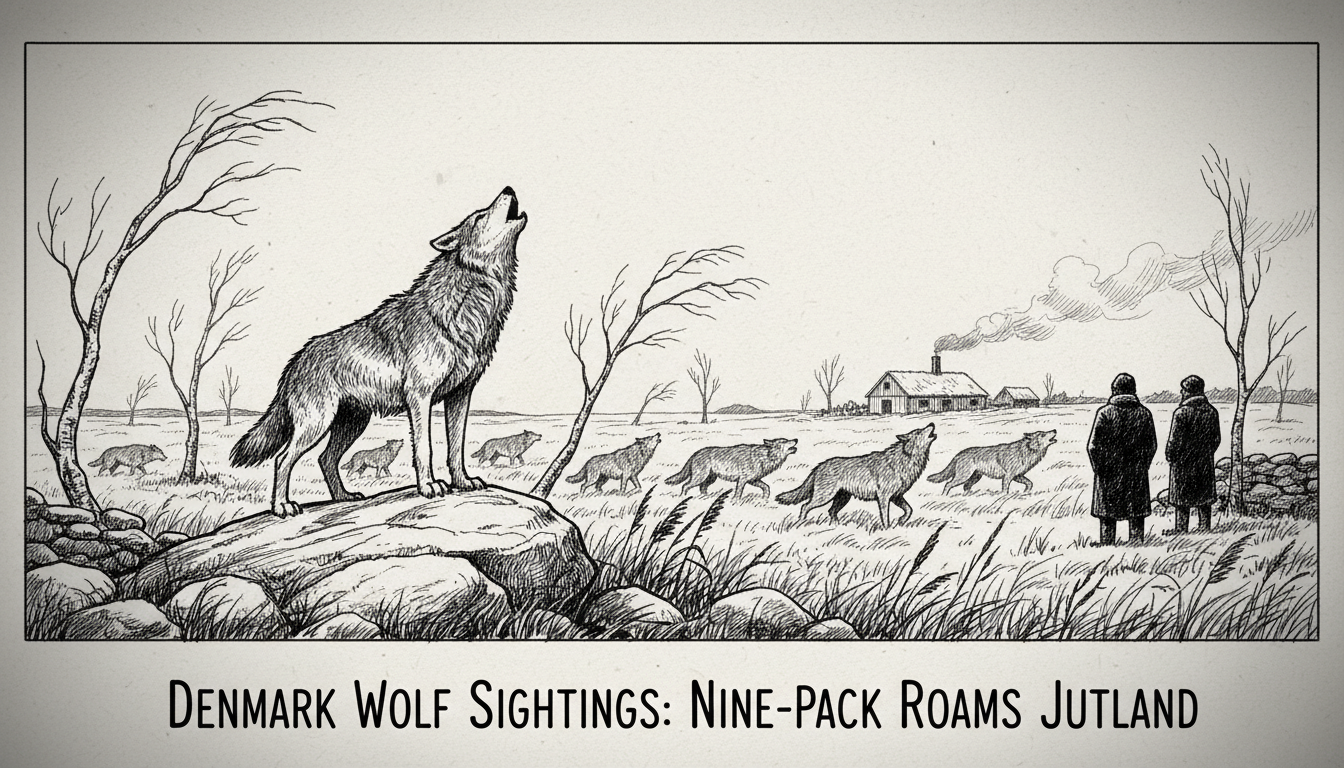
Denmark's wolf population, functionally extinct for 200 years, made a dramatic reappearance for Maria Kappel on a West Jutland road. Driving near Hoven in Ringkøbing-Skjern Municipality last Friday, she and her husband witnessed a pack of nine wolves chasing two roe deer across the road. The animals moved with startling speed, offering a rare and visceral glimpse of a predator reclaiming its historic territory. 'They were running very fast,' Maria Kappel recounted. 'It was a special experience, especially because they were quite large, and it is actually a rather beautiful animal.' She described the sight as 'wild and fascinating,' a personal wish fulfilled beyond expectation, yet she remains conflicted about their permanent presence in her community.
The Slow Return of a Native Predator
This sighting is not an isolated anomaly but a milestone in a gradual ecological shift. The last confirmed wolf in Denmark was killed in 1813, a victim of systematic persecution. Their return began in 2012, with individuals migrating north from the burgeoning populations in Germany. The first confirmed wolf pack since the 19th century established itself in West Jutland in 2017, using the same landscapes Maria Kappel drives through daily. Ringkøbing-Skjern Municipality has become a focal point for this rewilding, its sparse forests and heathlands providing suitable habitat. Researchers from Aarhus University and the Natural History Museum of Denmark track the population primarily through DNA analysis of scat, fur, and carcasses, painting a picture of a small but persistent group. Current estimates suggest a fluctuating population of a few established packs and several solitary individuals, their numbers fluid due to migration across the German border.
A Landscape of Fear and Fascination
The emotional response to wolves is deeply polarized, splitting the difference between ecological wonder and economic dread. For conservation biologists, the wolf's return signifies a successful recovery of a top predator, crucial for maintaining balanced ecosystems. They argue it is a natural process, a correction of a historical loss. 'The wolf belongs here as much as the oak tree or the red deer,' stated one researcher, who requested anonymity due to the topic's sensitivity. 'Its return is a sign of a healthier, more complete natural environment.' The state manages confirmed attacks on livestock through a compensation scheme, aiming to mitigate farmers' financial losses. Yet, for sheep farmers and rural residents, the wolf embodies a direct threat to their livelihood and sense of security. The abstract concept of biodiversity clashes with the concrete reality of a dead lamb. This tension has sparked intense debate in local councils and national media, framing the wolf as a symbol of the urban-rural divide in Danish society.
Policy in Search of Balance
Danish authorities walk a tightrope, attempting to balance European habitat directives with domestic political pressure. The wolf is a protected species under the Bern Convention and EU law, prohibiting deliberate killing. Management instead focuses on non-lethal mitigation: advising farmers on reinforced fencing, funding guard animals, and compensating verified livestock kills. According to the Ministry of Environment, compensation payouts have risen steadily, reflecting both increased wolf activity and reporting. However, many agricultural organizations argue the measures are insufficient and reactionary. They call for proactive population management, a policy currently off-limits under protection statutes. The sighting of a large pack, like the one Maria Kappel saw, fuels these calls. It transforms the wolf from a rarely-seen phantom into a tangible, pack-hunting reality, altering the psychological landscape for locals.
The Personal Within the Political
Maria Kappel's ambivalence mirrors the national conversation. Her personal fascination with seeing the animals is tempered by a pragmatic concern about their impact. This duality is common in rural communities where the theoretical benefits of predators meet practical life. Community meetings in West Jutland villages often feature heated discussions, with forest rangers and municipal officials trying to address fears with data. The Danish Environmental Protection Agency publishes maps of confirmed wolf zones, but as this sighting proves, their movements are unpredictable. Social media groups dedicated to local wildlife are flooded with both blurry photos of potential sightings and angry posts about perceived institutional neglect. The conflict is less about biology and more about autonomy, control, and changing ways of life in the Danish countryside.
An Uncertain Future for Denmark's Wolves
The path forward is fraught with biological and political uncertainty. Will the population stabilize at a sustainable level, or will continued migration from Germany lead to more packs and greater conflict? Can compensation schemes and fencing technology keep pace? The answers will depend on evolving policy, ecological factors, and, crucially, public tolerance. Sightings like Maria Kappel's become shared reference points in this debate. They are unforgettable natural spectacles that also serve as urgent reminders of a complex coexistence challenge. Denmark is now a permanent wolf country again, a fact both celebrated and contested. The journey of integration for this apex predator into modern Danish society is just beginning, testing the nation's famed consensus model against deeply rooted instincts—both human and animal. The wolves are no longer a rumor from the east; they are here, crossing our roads, reshaping our landscapes, and forcing a fundamental question: How much wildness does modern Denmark have space for?