
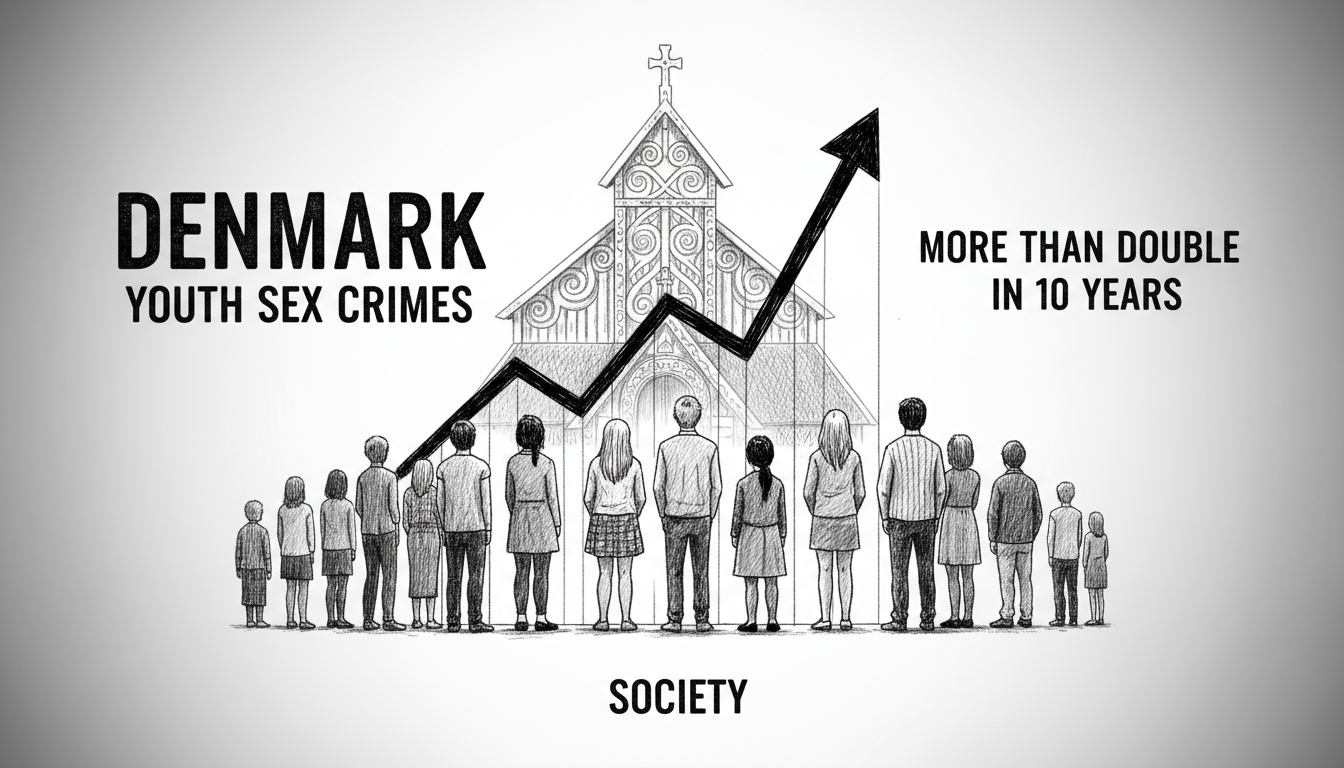
Danish youth crime involving sexual offenses against other minors has more than doubled over the past decade. New figures from the Office of the Director of Public Prosecutions show 238 criminal rulings against 15 to 17-year-olds for such acts in 2025, a stark rise from just 95 in 2015. This troubling trend spotlights the dark intersection of adolescent behavior, digital technology, and a legal system struggling to adapt.
A significant driver is the possession and distribution of illegal digital material, a category of crime that barely existed a generation ago. These are not abstract statistics but represent real young lives on both sides of the law, caught in a complex web of poor judgment, peer pressure, and digital permanence. As a reporter focused on Danish society and integration, I see this not only as a criminal justice issue but as a profound social challenge for Denmark's welfare model, which prides itself on protecting young people.
The Digital Dimension of Adolescent Crime
The data, analyzed for Berlingske by criminologist and PhD fellow Kasper Jørgensen from Aalborg University's Department of Law, reveals a clear digital fingerprint. Convictions for possessing abusive material among minors jumped by 93 percent from 2020 to 2025 alone. This surge is inextricably linked to the smartphones in every young person's pocket and the social ecosystems that thrive on them. Sharing explicit images or videos, even among peers, can quickly cross a legal line, especially when those depicted are underage.
The massive 'Umbrella case' exemplifies this. In 2018, Danish police announced plans to charge roughly 1,000 individuals, mostly young people, for sharing a video featuring two 15-year-olds. The widespread circulation turned countless teenagers into unwitting distributors of what the law classifies as child abuse material. The case resulted in hundreds of fines and convictions, creating a spike in the national statistics and a generation of young people with criminal records for an act many did not fully comprehend as a serious crime.
A Legal Framework Playing Catch-Up
Experts argue the law has failed to keep pace with teenage reality. Kasper Jørgensen describes Danish legislation in this area as 'one big jumble sale.' The framework, he notes, was largely designed with adult perpetrators in mind, lacking nuance for cases where the offender is also a child. This can lead to minors being penalized with the same severity as adults, a approach that may ignore developmental factors, intent, and possibilities for rehabilitation.
'We have not had an eye for the fact that children and young people can be perpetrators,' Jørgensen told Berlingske. He points out that Denmark possesses little concrete knowledge about the root causes behind the steep increase. Is it greater police focus and reporting? A normalization of risky digital sharing? Or a deeper shift in social norms among teenagers? The answers remain unclear, hampering effective prevention.
Beyond the Screen: Understanding the Full Picture
While digital offenses form a critical part of the story, the statistics cover all sexual offenses under the relevant penal code chapters. This includes serious in-person crimes like violation of dignity and rape committed by minors against other minors. The doubling of cases over ten years suggests a broader societal issue that cannot be blamed solely on technology. It points to potential gaps in sexual education, conversations about consent, and early intervention for troubled youth within the Danish welfare system.
Municipal social services and school counselors are often on the frontline, witnessing behavioral issues long before they escalate to police involvement. The pressure on these resources is immense. A crime statistic represents a systemic failure at multiple prior stages: in parenting, in education, in community support. For a society that invests heavily in its young people through free education and extensive social services, these numbers are a jarring indicator that something is going wrong.
Seeking Solutions in Education and Law Reform
Addressing this requires a dual approach. First, prevention through comprehensive, age-appropriate digital and sexual education is paramount. Young people must understand the legal and human consequences of their actions online and offline. Initiatives need to start early, before teenage social dynamics solidify. Second, there is a growing call for legal reform. Some experts and policymakers advocate for a differentiated system that distinguishes between malicious exploitation and adolescent foolishness, focusing on education and restorative justice for certain low-level, peer-related digital offenses.
The challenge for Danish lawmakers is to protect victims and uphold the law without needlessly criminalizing a generation of teenagers for mistakes made in a complex digital landscape they did not create. It is a balancing act between justice and proportionality, between punishment and prevention. The conversation now must move beyond shock at the numbers and toward constructive, evidence-based solutions. As these young perpetrators are also, in a sense, products of our society, their crimes reflect back on us all. The question is whether Denmark's famed social solidarity can extend to solving this intimate and digital crisis among its youth.