
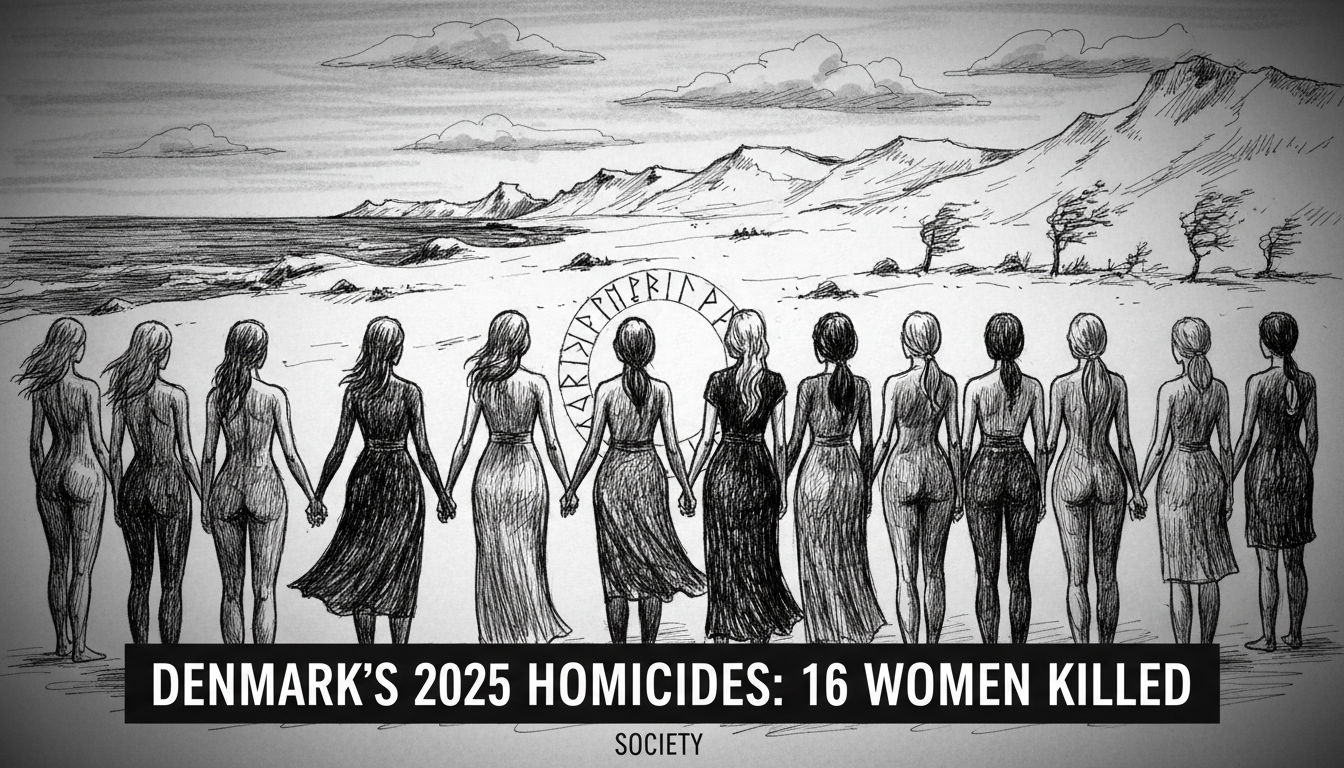
Denmark recorded 33 homicides in 2025, and 16 of the victims were women. Half of all lives taken were female, a significant and grim deviation from the nation's long-term statistical pattern. For ten of those women, police suspect the perpetrator was their current or former partner. These figures, compiled by Ritzau from police districts across the country, have placed intimate partner violence at the center of a renewed national debate on safety and prevention.
This year's numbers present a stark picture. While 16 men and two young boys also lost their lives, the equal gender split among adult victims is unusual. Historically, homicide victims in Denmark are typically one-third women and two-thirds men. The spike has triggered political action, including a parliamentary decision to establish a dedicated commission on partner homicide.
A Statistical Anomaly or a Warning Sign?
Forensic medicine expert Asser Hedegård Thomsen, who researched homicides from 1992 to 2016, cautions against reading a trend into a single year's data. He attributes the shift to natural statistical variation. "When things are rare, there will be clusters," Thomsen said. "That is why you have to look over several years before you can say whether there is a trend." His research established the baseline where roughly 12 women per year were killed by a partner, a number recent analyses suggest may have declined slightly.
The year 2014 saw a similar alignment, with 26 female homicide victims. Conversely, 2024 saw relatively few. This fluctuation underscores the challenge for policymakers seeking to address a crime that is both horrific and statistically volatile. The focus, experts argue, must be on the consistent risk factors that precede the ultimate tragedy, not just the annual tally.
The Pattern Before the Fatal Act
Sociologist Ingrid Soldal Eriksen is investigating these precise risk factors for her Ph.D. at Roskilde University. Her work, expected to yield initial results in 2026, builds on established international research. She states that partner violence almost always foreshadows a homicide. "Based on international research, we can say with great certainty that partner violence precedes the killing," Eriksen explained. "In Norway, they found that applies to about 70 percent of cases."
This violence forms a spectrum, from physical and psychological abuse to explicit threats. The fatal incident in a Brønshøj street in June 2025 tragically illustrated this continuum. A 47-year-old woman was shot in broad daylight by her ex-husband, who was under a restraining order prohibiting contact. Her death was one of six female homicides that month, a concentration that shocked the public and intensified media scrutiny.
A Political Response Takes Shape
The summer's tragedies galvanized a political response by autumn. Danish lawmakers voted to establish an official Partner Homicide Commission. Its mandate will be to analyze previous cases, identify systemic failures in protection, and recommend stronger preventative measures. This institutional approach signifies a move toward treating partner homicide as a distinct societal challenge requiring specialized understanding.
Concurrently, politicians expanded a preventative tool known as reverse electronic tagging. Starting New Year's Day 2026, the scheme will be widened. It allows authorities to monitor individuals subject to restraining orders; if they enter a prohibited zone near their victim, an alarm is triggered at a police control center. This technology aims to create a tangible barrier and provide earlier warning, potentially creating crucial minutes for intervention.
Beyond Policing: The Role of Social Services
Effective prevention extends beyond the justice system into the realm of social policy and local community support. Denmark's welfare model, with its network of municipal social centers and offering services, is a critical frontline. These centers are often the first point of contact for individuals experiencing domestic strife. Strengthening their capacity for risk assessment and coordination with police is a constant discussion point among integration and social care professionals.
"A homicide is almost never an isolated event," said a Copenhagen-based social services manager, who spoke on condition of anonymity due to the sensitivity of client cases. "It is the final point in a history of control, fear, and escalation. Our job is to see the signs earlier and connect the dots between health services, shelters, legal aid, and the police." This holistic view is essential, as risk factors can intertwine with issues like mental health, substance abuse, and economic dependency.
A Look at the Long-Term Horizon
The new commission and expanded monitoring represent proactive steps. However, experts like Ingrid Soldal Eriksen stress that sustainable solutions require deep, evidence-based understanding. Her research aims to dissect the specific circumstances—the arguments, the threats, the prior police reports—that culminate in lethal violence. The goal is to develop better assessment tools that can help social workers and police distinguish between high-conflict relationships and high-risk, potentially lethal situations.
Denmark's homicide rate remains low by global standards, a fact often cited in discussions about national safety. Yet for the families of the 16 women killed in 2025, and for the ten where a partner is suspected, that broader statistic offers little comfort. The national challenge is to reconcile that generally safe society with the persistent danger that exists behind closed doors. The policy changes for 2026 reflect a sober acknowledgment of that challenge. The ultimate test will be whether these measures can alter a tragic pattern that has proven stubbornly resistant to change.