
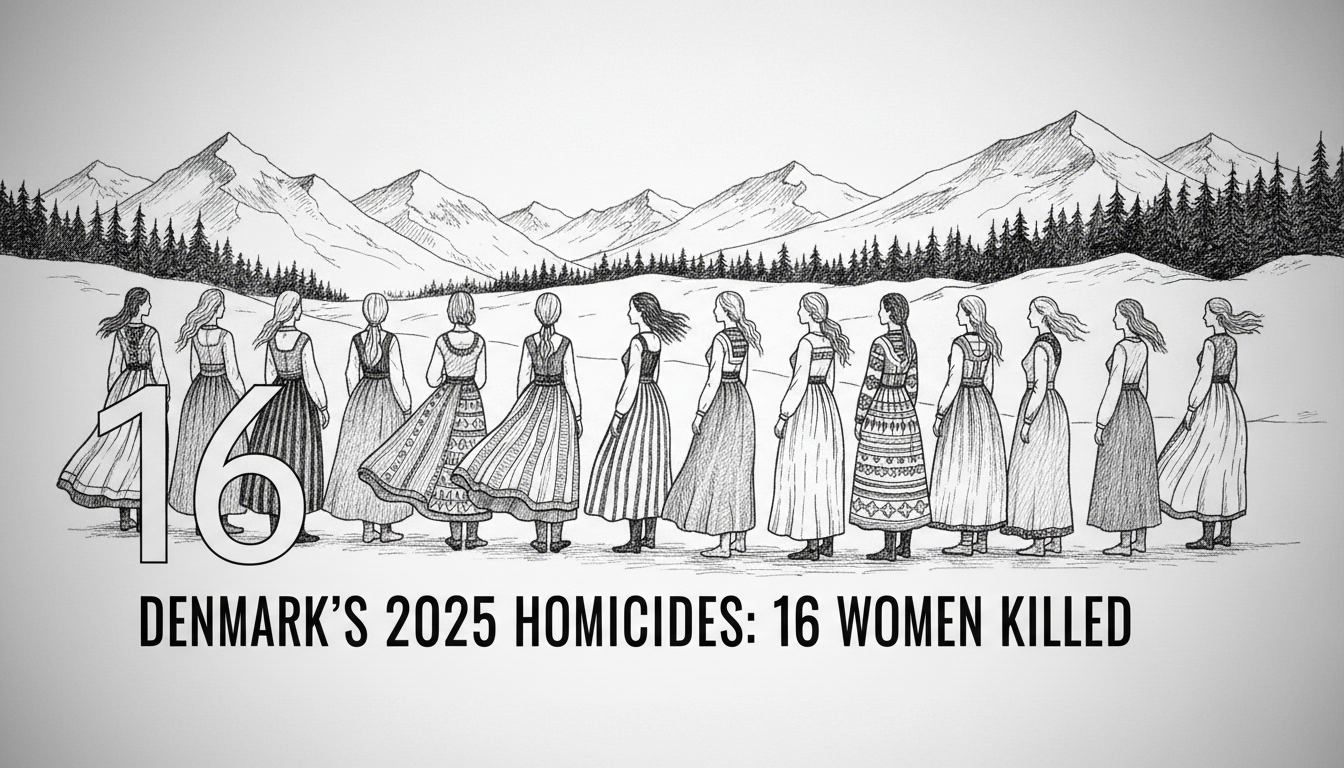
Denmark's homicide statistics for 2025 reveal an unusual and sobering pattern, with women accounting for nearly half of all victims in a country where they typically represent a third. Preliminary data compiled from police districts shows 16 women were killed or subjected to such severe violence that they died from their injuries this year. The total number of homicide victims stands at 35, comprising the 16 women, 17 men, and two young boys. This near-equal gender distribution is a significant deviation from the historical norm, where male victims consistently outnumber females two-to-one.
This statistical anomaly has drawn attention from researchers and domestic violence experts, even as they caution against drawing long-term conclusions from a single year's data. The figures have also intensified political focus on partner violence and femicide, leading to concrete legislative action. Behind each number lies a personal tragedy, a family shattered, and a community left to grapple with questions of violence and prevention in one of the world's generally safest societies.
A Statistical Outlier or Emerging Trend?
Forensic pathologist and homicide researcher Asser Hedegård Thomsen describes the 2025 figures as isolated and unusual. His research, which mapped homicides from 1992 to 2016, established the enduring pattern of one-third female victims versus two-thirds male. "I think it is an expression of statistical variation," Thomsen said. "When things are rare, there will be clusters. That is why you have to look over several years before you can say whether there is a trend." His analysis provides crucial context, reminding the public and policymakers that homicide rates naturally fluctuate. A similar year occurred in 2014, when 26 women were killed, according to data. Conversely, 2024 saw relatively few homicides of women.
The concentration of cases can feel acute. In June 2025, six women were killed within a single month, a cluster that shocked the nation and dominated news cycles. Among them was a 47-year-old woman shot in broad daylight in the Copenhagen district of Brønshøj by her ex-husband, who was under a restraining order forbidding contact. Incidents like this force the grim reality of domestic violence into the public square, moving the issue from private tragedy to national discourse.
The Stark Reality of Partner Violence
A deeply troubling constant within the variable statistics is the prevalence of partner homicide. Of the 2025 cases, ten are suspected to be partner homicides where the victim was a woman. This aligns with established research showing the most common perpetrator in female homicides is a current or former intimate partner. Sociologist Ingrid Soldal Eriksen, who is researching risk factors for partner homicide at Roskilde University, notes these crimes rarely occur without warning. "Based on international research, we can say with great certainty that partner violence precedes the homicide," Eriksen said. She points to Norwegian research indicating domestic violence is a factor in roughly 70 percent of partner homicide cases. This violence can be physical, psychological, or involve threats, creating a continuum of terror that sometimes ends in death.
Eriksen's Ph.D. project aims to identify specific risk factors within the Danish context, with preliminary results expected in 2026. Her work is part of a broader Scandinavian effort to understand and prevent these crimes by intervening earlier in the cycle of abuse. The often-cited average of 12 partner homicides of women per year stems from Thomsen's 1992-2016 study, providing a benchmark against which annual figures are measured.
Political and Policy Responses
The 2025 statistics, particularly the summer cluster, catalyzed political action. In the autumn, the Danish parliament moved to establish a commission specifically focused on investigating partner homicides. This commission's mandate will be to analyze past cases systematically, identify systemic failures in protection, and recommend preventative measures. It represents a formal, state-level commitment to treating femicide not as isolated crimes but as a societal problem requiring a coordinated response.
Concurrently, politicians voted to expand a scheme involving reverse electronic monitoring, commonly called an "ankle monitor," from the start of the new year. This technology alerts police if a person subject to a restraining order enters a forbidden zone around their victim's home, workplace, or other specified locations. The goal is to create a tangible digital barrier, providing victims with an additional layer of security and allowing for quicker police intervention before a threat escalates to violence. These policy shifts reflect a growing acknowledgment that legal restraining orders alone are insufficient without robust enforcement mechanisms.
Understanding the Broader Landscape
To interpret Denmark's 2025 homicide data accurately, one must view it within the nation's overall safety and the long-term stability of its crime rates. Denmark maintains a low homicide rate by global standards, a fact underscored by the rarity of these events that makes annual variations so pronounced. The public and media reaction to the high number of female victims also speaks to societal values and specific anxieties about violence against women. Each case triggers a necessary examination of whether the welfare state's social safety nets and judicial protections adequately shield its most vulnerable citizens.
Community centers, women's shelters, and municipal social services across Copenhagen and other cities play a frontline role in this ecosystem. They offer crisis intervention, counseling, and safe housing, often operating as the first point of contact for individuals experiencing domestic violence. Their experiences on the ground provide essential, real-world data on the gaps between policy and protection. The national conversation spurred by the 2025 statistics is as much about the effectiveness of these local support structures as it is about national laws.
A Call for Perspective and Vigilance
The central challenge for Denmark is balancing alarm with analysis. The 2025 figures are a tragic anomaly that has rightly spurred action, but they do not yet constitute a proven reversal of a decades-long trend. Researchers like Thomsen urge a measured perspective, emphasizing the need for multi-year data to distinguish signal from noise. Yet, for advocates and policymakers, every year with a double-digit death toll of women at the hands of partners is a year that demands decisive improvement.
The path forward hinges on integrating data-driven research with compassionate policy. It requires supporting ongoing academic work, like Eriksen's, to pinpoint Danish-specific risk factors. It demands ensuring that new tools like electronic monitoring are implemented effectively and accessible to those in need. Most importantly, it involves continuing to dismantle the stigma that keeps domestic violence hidden and reinforcing the message that seeking help is a strength. The legacy of 2025's disturbing statistics will be determined not by whether the number repeats next year, but by whether the response leads to a lasting reduction in fear and violence for Danish women in the years that follow.