
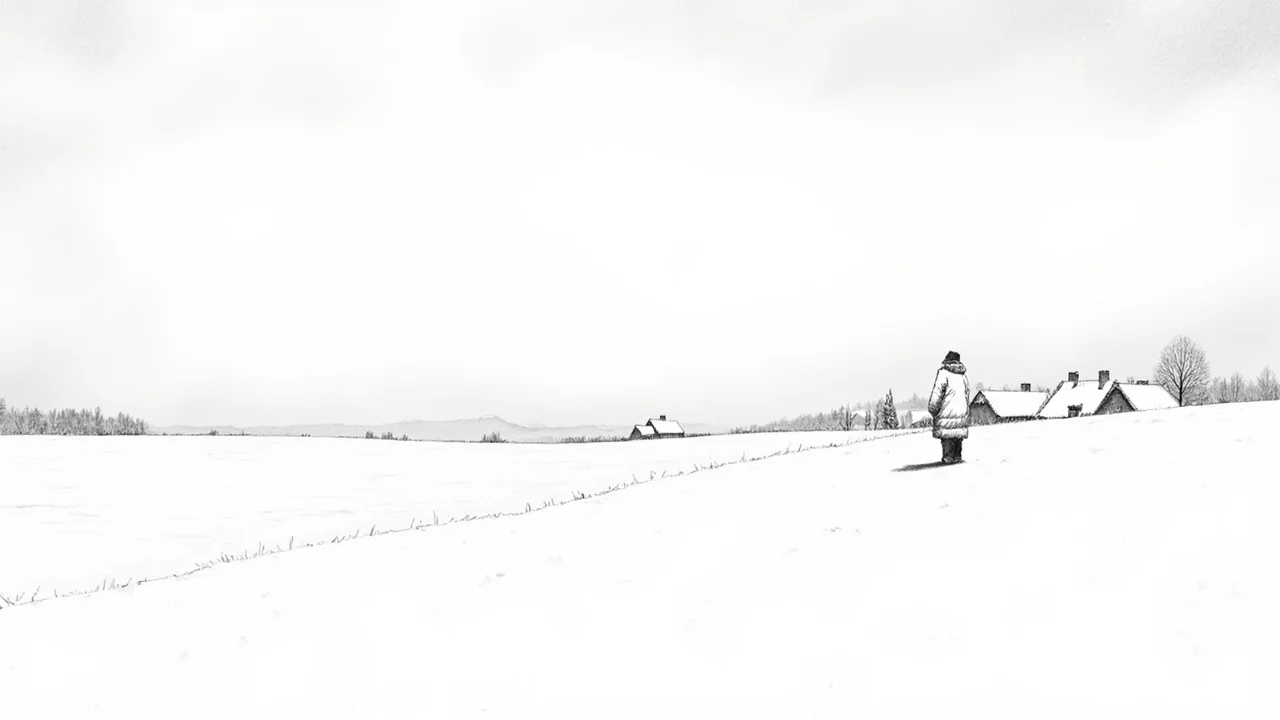
Denmark’s longest-running personal snow measurement project has recorded over 10,000 individual data points from a single backyard. Every morning at 8 AM for thirty years, Erik Thursgaard Jakobsen has stepped outside his home in central Jutland to measure snow depth. He sends the precise figure to the Danish Meteorological Institute, maintaining a flawless daily record that has become a vital thread in the fabric of Denmark’s climate history. His consistent, quiet work challenges dramatic narratives of environmental change, offering a nuanced, hyper-local perspective often lost in broader data sets. “I don’t think there has been any major deterioration,” Jakobsen states plainly, reflecting on three decades of winter watches. His story is one of unexpected civic duty, personal passion, and the subtle science of observation.
A Ritual Born of Chance
Erik Thursgaard Jakobsen’s career as a climate observer began not with a scientific application, but with a casual conversation. He was offered the role by chance through local contacts connected to the DMI’s network of volunteer observers. The institute relies on hundreds of such volunteers across Denmark to provide ground-truth data that supplements satellite imagery and automated weather stations. Jakobsen, who admits he simply loves snow, embraced the task with unexpected dedication. The requirement was straightforward: measure and report the total snow depth at the same location and same time every day it snows. What started as a simple commitment evolved into a deeply ingrained personal ritual, a quiet moment of connection with the weather that frames his day.
For thirty winters, this ritual has remained unchanged. The equipment is not complex: a simple measuring stick placed in a designated spot in his garden, away from drifts or disturbances. The reliability of the data depends entirely on the consistency of the person collecting it. Jakobsen’s unwavering commitment provides the DMI with a pristine, longitudinal data series. In climate science, the value of such a long, unbroken record from a single point is immense. It allows researchers to filter out short-term variability and identify genuine long-term trends. While automated sensors can fail or be moved, Jakobsen has been a constant, human sensor in Denmark’s environmental monitoring network.
The Science in a Single Number
Each morning measurement is a small snapshot of a specific climate moment. Over 10,000 such snapshots, however, create a moving picture of Danish winter. The data Jakobsen collects feeds directly into the DMI’s climatological databases, which are used for everything from validating weather models to planning road salt budgets for municipalities. His readings help answer practical questions about snowfall patterns in his region of central Jutland. Has the timing of the first snow changed? Are snow cover durations shorter? Is peak snow depth diminishing? According to Jakobsen’s personal analysis of his own records, the changes are less stark than public discourse might suggest.
“You have to look at it over many years,” he explains, highlighting the natural volatility of weather. He recalls winters in the early 1990s with abundant snow and others, more recently, with persistent ground cover. His observation of no “major deterioration” aligns with some official DMI analyses showing high year-to-year variability in Danish snowfall. The institute’s climate reports note that while winters have become warmer on average, a clear, linear trend in snow days for all of Denmark is complicated by geography and natural fluctuations. Jakobsen’s backyard data provides a crucial, on-the-ground reference point for these larger-scale climatic analyses. It is a reminder that global trends manifest in intensely local ways.
A Personal Archive of Winter
Beyond the numbers, Erik Thursgaard Jakobsen has compiled a personal archive of winter memories. Each significant snowfall event over three decades has a story attached. He recalls the technical challenge of measuring during a fierce blizzard, the profound silence of the garden under a thick, fresh blanket, and the specific quality of light reflected off the snow at 8 AM. His work transcends data entry; it is an act of mindful observation. This personal relationship with the phenomenon he measures adds a qualitative layer to the quantitative numbers he submits. He doesn’t just record snow depth; he witnesses winter’s character each year.
This long-term engagement fosters a deep, intuitive understanding of local weather patterns. He can sense shifts in temperature that might preserve or melt a snow cover, and he understands how wind direction affects accumulation in his garden. This embodied knowledge, gained through thousands of repetitions, is something a machine cannot replicate. It represents the human element at the heart of citizen science. Jakobsen’s motivation has never been academic acclaim or public recognition. The satisfaction comes from the routine itself, the contribution to a larger purpose, and the simple pleasure of participating in the rhythm of the seasons. His story underscores that valuable science often relies on ordinary people performing extraordinary acts of consistency.
Contextualizing a Local Record
While Jakobsen’s local record shows remarkable stability, it exists within a broader national context of climatic change. The DMI’s official climate monitoring indicates that Denmark’s average annual temperature has risen by about 1.5 degrees Celsius since 1874, with warming accelerating in recent decades. This warming influences snowfall, but the relationship is not simple. Warmer winters can lead to more precipitation, but it often falls as rain instead of snow. This can result in fewer snow-cover days even if individual snow events remain heavy. Jakobsen’s point about no “major deterioration” in his location is therefore scientifically plausible. It highlights the critical difference between weather variability and climate change, a distinction often blurred in public conversation.
Climate scientists emphasize the importance of precisely these kinds of long-term datasets to untangle that complexity. A single point of data, like Jakobsen’s, is a pixel in a vast national image. Other volunteers in different regions—coastal areas, islands, or further east—may have recorded different trends. By combining all these pixels, the DMI can create a detailed map of how climate impacts are distributed. Jakobsen’s steadfast contribution ensures his pixel is sharp and clear. His experience is a testament to the value of localized, patient observation in an era of rapid change and often alarming headlines. It provides a grounded, measured counterpoint.
The Future of Observation
As Erik Thursgaard Jakobsen looks ahead, he has no plans to retire his measuring stick. He remains passionate about his daily task and its quiet significance. His story raises important questions about the future of environmental monitoring. The DMI’s network of volunteers is an invaluable asset, but it faces challenges from an aging participant base and the allure of automated technology. Jakobsen represents a soon-to-be classic model of citizen science: deeply personal, long-term, and analog. The human connection and unwavering dedication he brings are difficult to automate. His work is a living legacy, demonstrating that rigorous science can spring from personal joy and a sense of duty.
What does thirty years of meticulous attention teach us? It teaches the value of showing up, day after day, to witness the natural world. It teaches that dramatic change is sometimes a whisper, not a shout, detectable only through decades of careful record-keeping. And for the rest of us, it offers a lesson in perspective. In a discussion often dominated by forecasts of the future, Erik Thursgaard Jakobsen’s power lies in his faithful documentation of the present, every single winter morning. His legacy is not a headline, but a column of numbers—a profound, personal testament to the patience required to truly understand our changing world.