
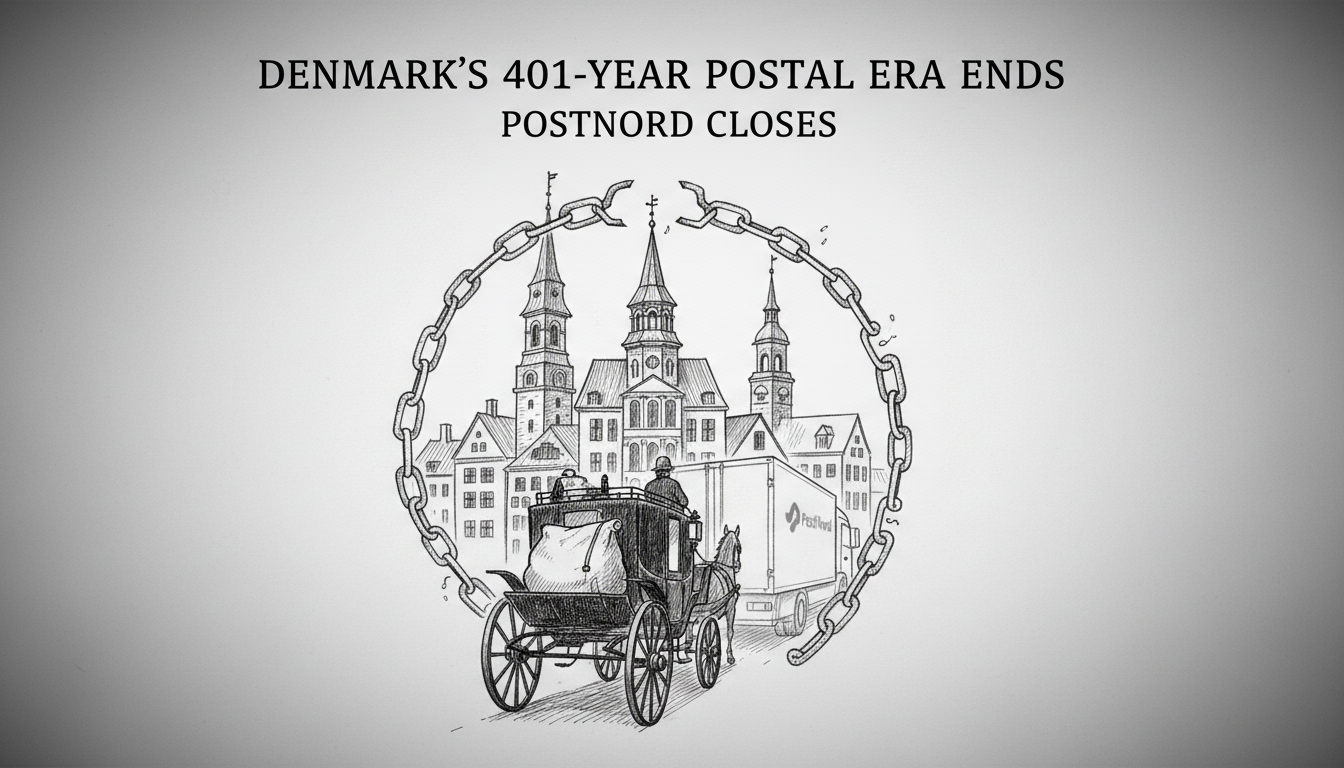
Denmark's state-owned postal service PostNord has ended its 401-year history of delivering letters. The final day for sending a traditional letter passed quietly, marked by surprise at post office counters over the cost of sending what has become a rarity. A woman stood ready with her payment card, only to be met with a screen demanding 800 kroner. This moment captured the paradox of a service rendered obsolete by the digital age, yet still holding surprising value for those who need it. The closure concludes a national institution dating to 1624 under King Christian IV, reflecting a profound societal shift.
For many Danes, the postal service was a thread woven into daily life, from birthday cards to official documents. Its gradual decline mirrored the rise of digital communication, with email and online services replacing physical mail. PostNord, formed in 2009 by merging Denmark's Post Danmark and Sweden's Posten AB, struggled with plummeting letter volumes and fierce competition. The end of letter delivery is not just a business decision but a cultural milestone, signaling the close of a chapter in Danish societal infrastructure.
The Final Day at the Post Office
The atmosphere on the last day was one of quiet resignation mixed with mild astonishment. Customers, often older generations or those with specific needs, encountered the stark reality of modern postal economics. The 800-kroner fee highlighted how sending a physical letter has transformed from a common utility to a specialized, costly service. Postal workers handled the transition, a process managed over time as digital alternatives took root. This shift was less a sudden stop and more the final step in a long, managed decline of traditional mail services.
Statistics show letter volumes in Denmark have fallen dramatically over the past two decades, driven by email and digital platforms. Postage prices consequently rose, becoming among the highest in Europe, which further reduced demand. The business model for universal letter delivery became unsustainable. PostNord's focus has shifted decisively towards parcel delivery, a booming market fueled by e-commerce. This pivot reflects a broader Nordic trend where national postal services reinvent themselves as logistics companies for the digital marketplace.
A Service Built on Centuries of Trust
The Danish postal service's history is a story of statecraft and connectivity. Established in 1624, it was a tool for royal authority and commerce, binding the kingdom together. For centuries, it was a trusted monopoly, a symbol of reliable communication. The familiar red post boxes and uniformed carriers were everyday fixtures. The creation of PostNord was itself a historic move, a cross-border merger intended to create a stronger, regionally competitive entity. It represented a modern vision of Nordic collaboration in the face of globalization and technological change.
Experts note that the end of letter delivery marks a significant point in Denmark's digital transformation. "We are witnessing the conclusion of a public service model that defined communication for generations," says a Copenhagen University sociologist specializing in infrastructure. "The state's retreat from guaranteeing universal letter service is a direct result of consumer choice moving online. It challenges our notion of essential public infrastructure." This change raises questions about accessibility for those less digitally adept and the preservation of physical communication options for official or personal needs.
The Human Impact of a Digital Shift
The closure has a distinct human dimension, particularly affecting elderly citizens and certain business sectors. While most Danes adapted years ago, a minority still rely on physical mail for bills, government correspondence, or personal contact. Municipalities and social services have worked to transition people to digital platforms, often through community centers and libraries. The Danish welfare system, renowned for its inclusivity, now faces the task of ensuring no one is left behind in this final push toward digital-first communication.
Integration policies in Denmark often emphasize digital literacy as a key to participation. The demise of a universal postal service adds urgency to these programs. For new residents and elderly citizens, losing a familiar, physical service channel can create barriers. Social policy analysts suggest this underscores a need for robust, accessible digital support services within the welfare system. The cost of sending a letter, now a luxury, highlights the growing divide between digital natives and those who struggle with the transition.
The New Logistics Landscape
PostNord's future lies in parcels and logistics, a fiercely competitive field. The company now operates in a market crowded with private giants like DAO and GLS, as well as international players. Its identity is shifting from a public service to a commercial logistics firm. This transformation is common across Europe, where traditional postal operators have sought new revenue streams. In Denmark, this means the iconic red mail vans are increasingly outnumbered by the vehicles of private parcel carriers.
The Danish consumer has gained in convenience what they lost in tradition. Next-day delivery, package tracking, and easy returns are now expected standards. The economic model is driven by volume and efficiency, not the universal service obligation that once governed letter mail. This commercial focus brings different challenges, including working conditions and environmental impact from increased delivery traffic. The closure of letter services is a trade-off, exchanging a standardized public utility for a dynamic, consumer-driven market of package delivery.
What Is Lost When Tradition Ends?
Beyond practicalities, the end of Denmark's postal service for letters severs a tangible link to history and a slower form of communication. The ritual of writing, stamping, and posting a letter carried personal weight that a quick email lacks. For Danish society, it represents another piece of shared public infrastructure receding into the past, akin to the closure of local banks or railway stations. It prompts reflection on what we value as essential common services in an increasingly digital and privatized world.
The 800-kroner letter on the last day serves as a powerful metaphor. It shows that the service still held value for someone, but at a price that reflects its new status as a niche offering. The surprise on the customer's face speaks to the disconnect between our nostalgic perception of postal services and their commercial reality. As physical mail joins telegrams and landline phones as relics, Denmark must consider how to maintain inclusivity in communication. The success of this transition will be a test of the Danish welfare model's adaptability in the digital age.
Ultimately, the story of PostNord's letter service is a microcosm of modern societal change. Technology renders old systems obsolete, markets adapt, and public institutions evolve. Denmark has managed this decline systematically, avoiding a sudden crisis. Yet the finality of the last postmark invites a moment of collective pause. It asks us to consider what we are leaving behind in our relentless march toward digital efficiency, and what enduring human needs might still require a physical touch, even at a premium.