
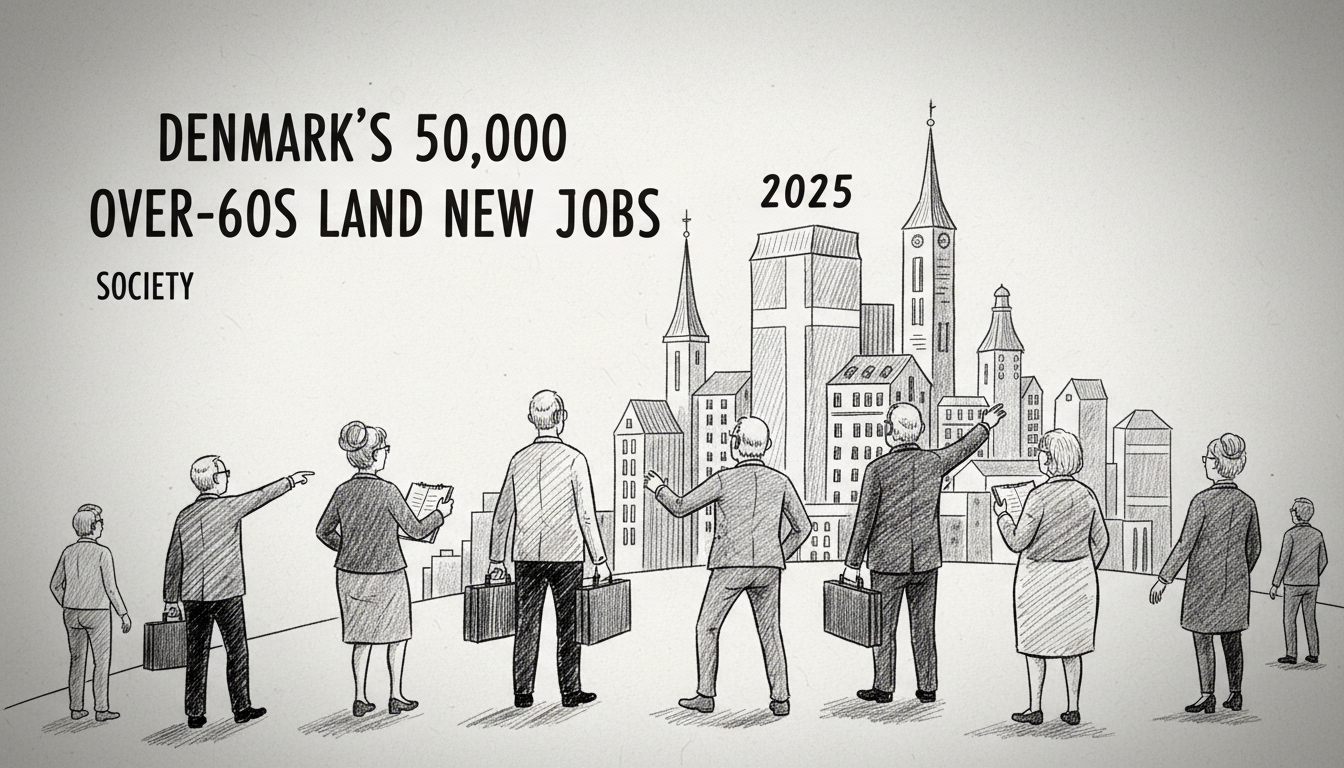
Denmark's labor market for pensioners is booming, with more than 100,000 state pensioners now working as wage earners. This surge includes a remarkable 50,000 citizens over the age of 60 who secured new employment in 2025 alone. The trend shatters long-held myths about aging and work, fundamentally reshaping Danish society and its famed welfare model. For 65-year-old Claus Jørgensen, this new reality involves reserving his favorite desk via a smartphone app each morning. "I usually have that spot," Jørgensen says, pointing to a workstation with a view toward the Øresund Bridge. His daily routine reflects a quiet revolution where flexible, app-based hot-desking coexists with decades of professional experience.
A Silent Shift in the Danish Workplace
This is not a story of financial desperation, but one of choice, policy, and demographic necessity. The employment rate for Danes aged 60-64 has climbed steadily for over a decade, placing Denmark near the top of international rankings for older adult workforce participation. The government has actively encouraged this shift through pension reforms that financially reward delayed retirement and through campaigns promoting the value of senior workers. "We are seeing a powerful confluence of factors," explains Karen Mikkelsen, a senior researcher at the Danish Center for Social Science Research (VIVE). "Longer healthy lifespans, a strong desire to remain socially engaged, and critical labor shortages in sectors like healthcare and education are pushing and pulling older Danes back into jobs."
Companies are responding by creating more age-friendly environments. Flexible hours, part-time positions, and ergonomic assessments are becoming standard as employers recognize the stability and mentorship older employees provide. "The narrative has flipped from 'problem' to 'resource,'" says Lars Bjørn, CEO of a mid-sized Copenhagen IT firm that has actively recruited over-60s. "Their experience is invaluable for onboarding young talent and managing complex client relationships. We've moved from wondering how to phase them out to asking how we can attract them."
The Personal Calculus Behind the Statistics
For individuals like Claus Jørgensen, the decision to work past retirement is multifaceted. While the extra income is welcome, it is often secondary to the sense of purpose and structure employment provides. "The pension is sufficient for a modest life," Jørgensen notes. "But my mind is sharp, and I enjoy the collaboration, the daily challenges. Sitting at home full-time was not an appealing prospect." This sentiment is echoed in community centers and job clubs across Danish municipalities, where social workers report a growing number of pensioners seeking guidance on returning to work.
Financial incentives are nonetheless significant. Danish pension reforms have gradually increased the official retirement age, linking it to life expectancy. For those who choose to defer drawing their state pension, the monthly payout increases substantially. Furthermore, special tax allowances for pensioners who earn wages make the financial arithmetic of working more attractive. A 2024 report from the Ministry of Employment calculated that a pensioner working 20 hours a week could see their net disposable income rise by over 30% compared to relying on the pension alone.
Policy Foundations and Future Challenges
The Danish welfare state's sustainability is a primary driver behind these policies. With one of the oldest populations in Europe, maintaining a high ratio of workers to pensioners is crucial for funding healthcare, eldercare, and social services. Encouraging longer working lives is a cornerstone of the government's long-term economic strategy. "It is a pragmatic and necessary adaptation," says Social Policy Minister Mette Frederiksen. "Our goal is to support individual choice while ensuring our welfare system remains robust for future generations. The success of over 100,000 pensioners in the workforce shows a new model is possible."
However, experts warn that challenges remain. Not all sectors are equally accommodating, and physical demands can bar some from continuing in their lifelong trades. There is also a risk of creating a two-tier system where well-educated, white-collar workers easily extend their careers while those with manual labor backgrounds are forced out. "Integration into the workforce must be inclusive," argues Professor Henrik Dahl from Aalborg University. "Municipal job centers need specific programs to reskill older workers for new types of roles, particularly in the green and digital transitions. Otherwise, we risk deepening existing social inequalities."
Redefining 'Retirement' in the Nordic Model
The Danish experience is redefining what retirement means within the Nordic social model. The traditional concept of a hard stop at age 65 is fading, replaced by a more fluid phase of gradual transition. This aligns with a broader cultural shift toward viewing aging as an active life stage. Community social centers, traditionally focused on leisure activities for seniors, are now partnering with job centers to host networking events and skill workshops.
This trend also impacts family dynamics and urban planning. More active seniors contribute to vibrant local economies and volunteer sectors, but also require different services from their municipalities. The conversation in city halls is shifting from solely providing care to facilitating continued contribution. Copenhagen's integration policies, for example, now explicitly mention supporting the economic and social participation of residents over 60 as a key goal.
Denmark's story of 50,000 over-60s finding new work in a single year is more than an economic statistic. It is a live experiment in social policy, a test of workplace adaptability, and a profound cultural change. It proves that with the right mix of financial incentives, flexible employers, and a shift in mindset, the later decades of life can be a period of renewed productivity. As Claus Jørgensen logs into the desk-booking app for another week, he represents the vanguard of a new, longer working life—one that is rewriting the rules for Denmark and potentially for aging societies everywhere. The ultimate question is whether this new model can be built to be equitable, ensuring that the opportunity to work longer is a genuine choice available to all, not a financial necessity or a privilege for the few.