
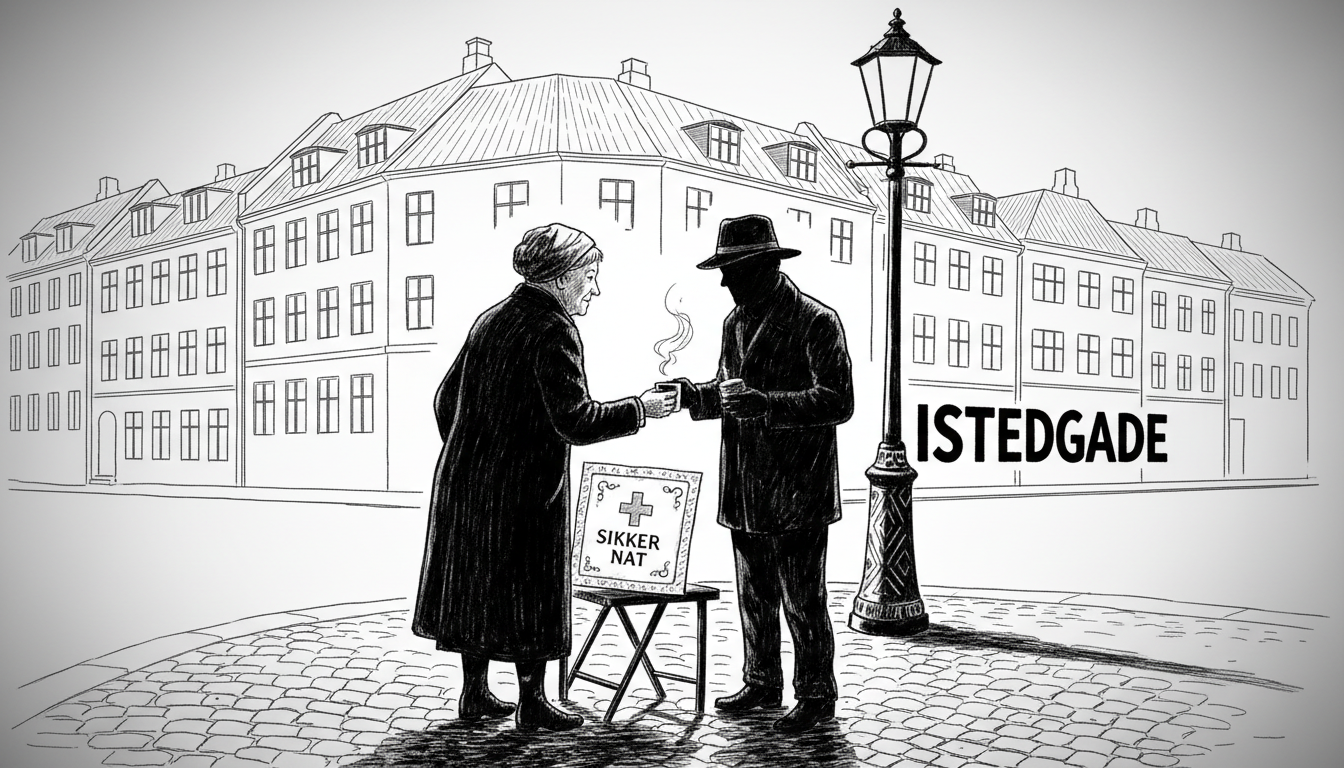
Denmark's legalized prostitution framework meets its human face every Wednesday night on a Copenhagen street corner. At 75, Karin Kjærgaard sacrifices her sleep to walk Istedgade, a historic red-light district, carrying a thermos of tea, packets of toast, and condoms. Her mission is simple: offer a moment of normalcy and a safe connection to women, predominantly from Nigeria, working the night. This quiet act of compassion unfolds against the complex backdrop of Danish social policy, where legality does not automatically erase vulnerability. "They are someone's daughter," Karin says, her voice steady amid the passing traffic. "Sometimes, they just need someone to see them as a person, not a transaction." Her weekly ritual highlights the gap between law and lived experience in one of Europe's most progressive nations.
The Wednesday Night Ritual
Around midnight, Karin arrives in Vesterbro, Copenhagen's diverse inner district. Istedgade stretches before her, a street of contrasts with trendy cafes, immigrant-run shops, and a centuries-old association with sex work. She moves with purpose, approaching small groups of women. The offering is basic: warmth, food, protection. The response, she notes, is often profound relief. "The tea is just an excuse," she explains. "It's about stopping. It's about asking 'how are you?' and meaning it." She estimates she connects with 15 to 20 women each week. While prostitution was legalized in Denmark in 1999 to improve safety and remove stigma, experts say street-based workers, especially migrants, remain acutely vulnerable. Karin's informal outreach fills a niche not covered by official municipal services, which operate more on a daytime, appointment-based model.
Legal Framework, Human Reality
Denmark's approach to sex work is often cited as pragmatic. The 1999 legalization aimed to destigmatize the profession and give workers clearer rights. Crucially, pimping—profiting from the prostitution of others—remains illegal and punishable by prison. The theory is that consenting adults can engage in sex work, but exploitation is criminalized. In practice, the line is blurry on streets like Istedgade. Studies suggest a significant percentage of street prostitutes in Copenhagen are foreign nationals, with many coming from Nigeria. Their legal status, understanding of the system, and potential debts to traffickers create a power imbalance that the law alone cannot fix. "Legalization removes one layer of danger, but it is not a magic wand," says Mette K. Frederiksen, a social policy researcher at the University of Copenhagen. "For migrant women without strong networks, the risks of coercion and violence persist. Community-level compassion, like Karin's, provides a critical point of human contact."
The Limits of the Welfare System
Denmark's renowned welfare system is designed for residents integrated into its societal fabric. It offers healthcare, education, and social security. For undocumented migrants or those with temporary, precarious status, this safety net has large holes. They may fear authorities, lack language skills, or be unaware of their limited rights. Municipal social centers, the frontline of Danish welfare, may not reach this nocturnal population. This is where volunteer efforts become essential. NGOs like Reden International and Sex Workers Alliance Denmark provide advice, condoms, and health checks. Karin operates independently but symbiotically with this network, often directing women to formal services. Her work underscores a tension in Danish society: a commitment to universal welfare coexisting with groups who live in its shadows. Her toast and tea are a minimalist form of social care, delivered person-to-person, no paperwork required.
A Personal Perspective on Integration
As a Danish society reporter with a focus on integration, I see Karin's actions as a profound, quiet commentary on what inclusion means. Danish integration policy often focuses on language acquisition, employment, and formal education. It is a structured, systemic process. Karin's work represents integration's opposite yet complementary force: unstructured, personal, and based on immediate human need. She is not teaching Danish culture but practicing a fundamental aspect of it—hygge and care—in the most unlikely setting. "These women are part of our community now, at night on this street," Karin tells me. "Ignoring them doesn't make them go away. Acknowledging them is the first step." Her perspective challenges the notion that integration is solely the responsibility of the newcomer. It suggests a two-way street, where established Danes also must reach out, especially to those at the margins.
The Future of Support on the Street
The need for services like those Karin informally provides is not diminishing. While official statistics on prostitution in Copenhagen are scarce due to the hidden nature of the work, outreach organizations report consistent contact with hundreds of individuals annually. The challenge for Copenhagen's municipality is how to support vulnerable populations who operate outside normal hours and may distrust official channels. Some advocates call for more funding for mobile night-time outreach teams, blending professional social work with the peer-based trust Karin establishes. Others argue for clearer pathways to legal status and support for migrant sex workers, addressing the root causes of their vulnerability. Karin, for her part, has no plans to stop her weekly walks. "As long as I can walk, I'll be here," she says, packing her empty thermos as dawn approaches. Her commitment raises a pressing question for a society proud of its equality: How do we build systems that see people as clearly as one 75-year-old woman with a flask of tea?