
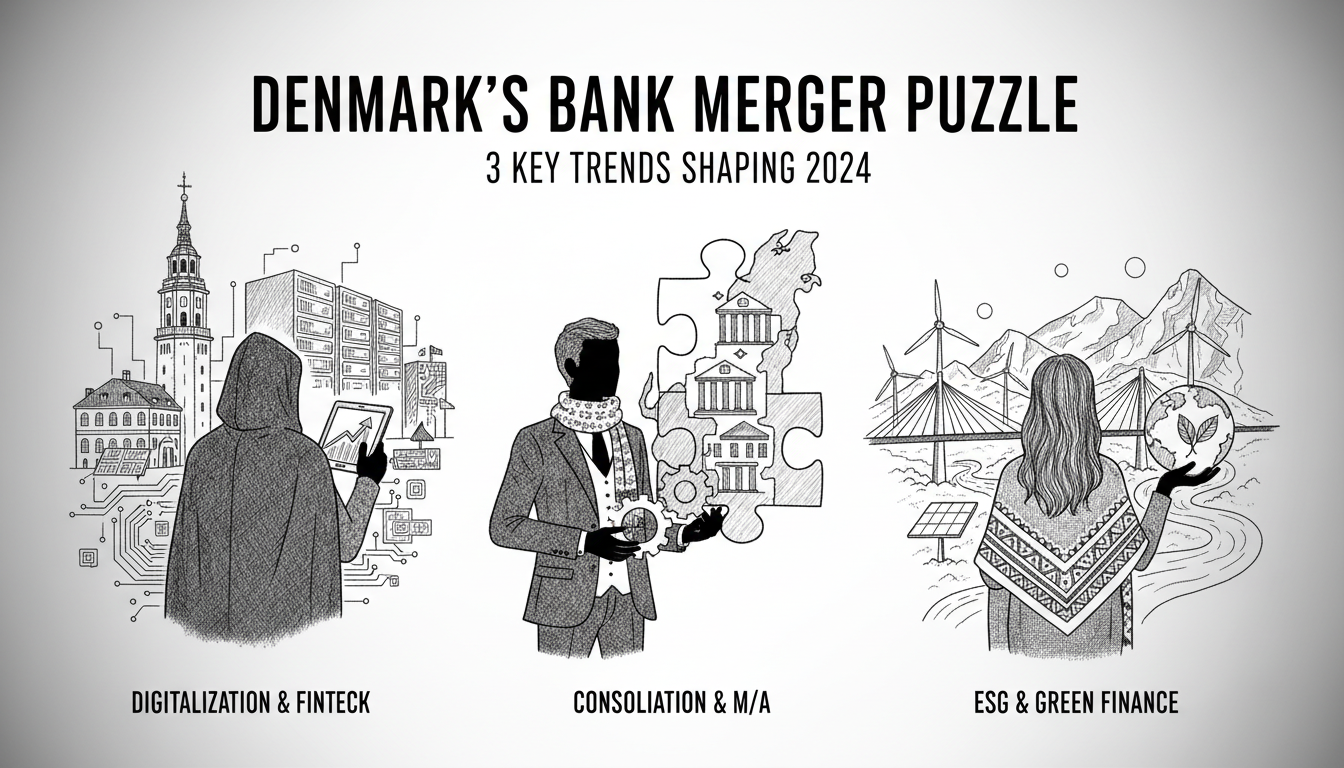
Denmark's banking sector is quietly reconfiguring its map, with mergers and strategic shifts creating a new financial landscape for customers. The recent buzz around a potential three-way merger between Sydbank, Arbejdernes Landsbank, and Vestjysk Bank, while not materializing as a single entity, highlights a broader and very real trend of consolidation. This ongoing reshaping forces customers to ask a fundamental question: are we moving toward fewer, larger banks, or a more diverse mix of specialized and community-focused institutions?
The Consolidation Calculus
The idea of banks merging is not new in Denmark. The sector has undergone significant contraction for decades, driven by a potent mix of economics and regulation. Following the financial crisis, stricter capital requirements from European and Danish authorities made it more expensive to operate. Simultaneously, prolonged periods of historically low interest rates squeezed the traditional profit margins banks earn from lending. 'The pressure to achieve scale for efficiency and to invest in expensive digital platforms is immense,' notes a Copenhagen-based financial analyst who spoke on background. 'For many smaller and mid-sized banks, merging can appear as the most viable path forward.' This environment has fueled a steady stream of mergers, particularly among smaller, regional banks. In 2023 alone, several mergers were finalized, including Nykredit Bank's acquisition of the branch operations of Alm. Brand Bank.
Diverging Strategies on Display
While the hypothetical AL Sydbank mega-merger did not happen, the strategies of the three named banks illustrate the different paths being chosen. Arbejdernes Landsbank (AL) has consistently focused on organic growth and its strong brand association with a broad Danish membership base. Sydbank, with its base in Southern Jutland, has been active in acquiring smaller regional players to solidify its position. Vestjysk Bank, after a period of restructuring, has emphasized its deep regional roots in Western Jutland. Their separate courses show that merger is just one option. 'We are seeing a bifurcation,' explains Peter S. Christensen, a senior lecturer in finance at Copenhagen Business School. 'Some institutions are pursuing scale through mergers to compete on digital innovation and national reach. Others are doubling down on their local identity, personal service, and niche expertise, believing that is their defensible advantage.'
What This Means for Your Wallet and Service
For the average Danish customer, these boardroom strategies translate into tangible changes. Mergers often promise cost savings through branch consolidations and streamlined operations. In practice, this can lead to the closure of local branches, particularly in areas where the merging banks have overlapping networks. Customers may find their familiar local bank has become a different brand, with new digital interfaces and potentially revised fee structures. The promised benefits, analysts say, can include slightly better interest rates on deposits or loans due to the merged entity's stronger balance sheet, and investment in more advanced mobile banking apps. However, the risk is a loss of personalized service and local decision-making power. 'A mortgage application that was once approved by a local manager who knows the community might now be processed by a centralized credit department using an algorithm,' says Christensen. The counter-trend is the niche bank that markets itself precisely on avoiding this impersonal approach.
Competition and the Future Landscape
The ultimate effect on competition is a key concern for regulators at Finanstilsynet, the Danish Financial Supervisory Authority. A series of mergers that create a few dominant players could reduce competitive pressure on fees and service quality. However, the Danish market retains a diverse mix, including large international banks, major Danish players like Danske Bank and Jyske Bank, cooperative banks like Arbejdernes Landsbank, and a network of smaller, local savings banks. The rise of digital-only 'neobanks' and financial technology firms also adds a new layer of competition for specific services like payments and investment. This dynamism suggests the future will not be a simple monopoly but a more complex ecosystem. Customers will likely have to choose between the extensive product range and digital convenience of a large bank and the tailored service of a local or niche provider.
Navigating the New Normal
So, what should a customer do as the landscape shifts? Financial advisors recommend a proactive approach. First, use the competition to your advantage. Regularly compare your bank's fees, mortgage rates, and deposit interest rates with those available elsewhere. Second, clarify what you value most: is it the absolute lowest loan rate, a flawless digital app, or having a personal advisor who knows your name? Your priority will guide your choice. Third, stay informed about any changes communicated by your own bank regarding terms, conditions, or branch structures. The Danish banking sector's evolution is a story of adaptation to global forces and local demands. For customers, it means the end of taking their bank for granted and the beginning of a more conscious, consumer-driven relationship with their finances. The question is no longer just who holds your money, but what strategy they are pursuing with it, and whether that strategy aligns with your own.