
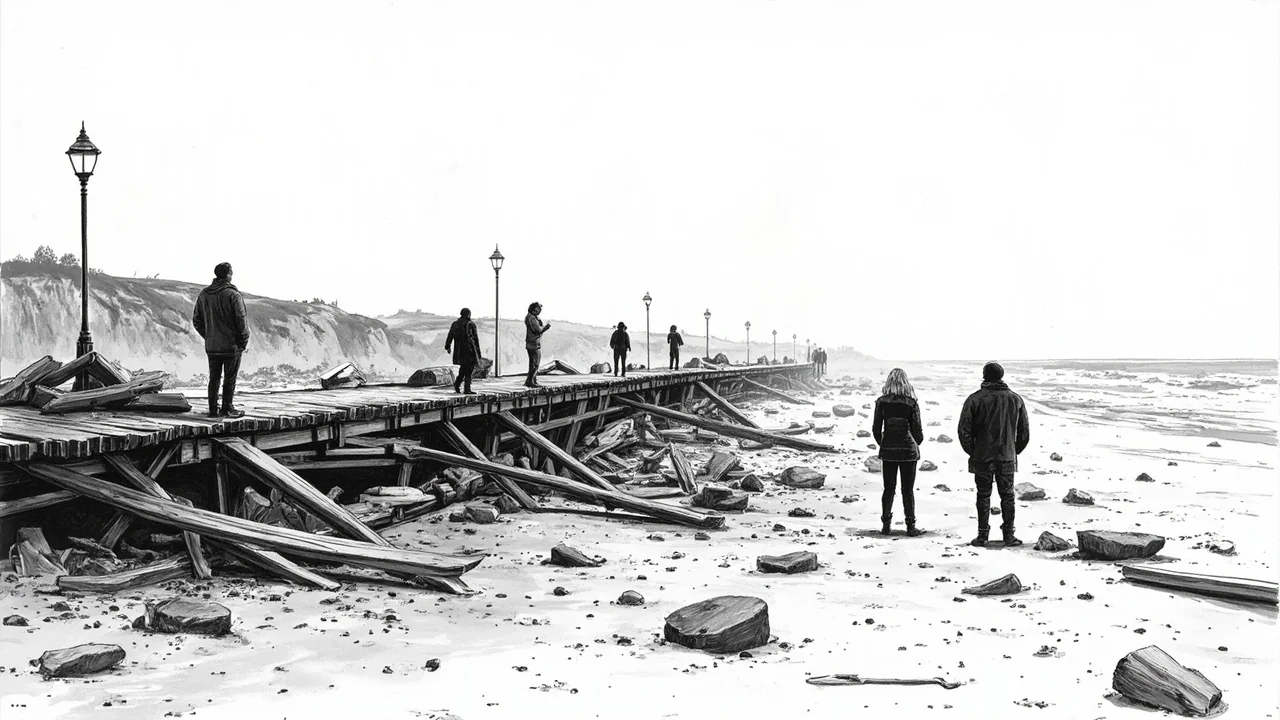
Denmark's southern coastline has suffered another significant blow from the North Sea's fury. A 100-meter stretch of the popular Sønderborg seaside promenade was destroyed Friday by powerful winds and high waves, marking the latest in a series of costly weather assaults on the vulnerable structure. The damage includes uprooted paving tiles and dislodged granite blocks designed as coastal protection, forcing the municipality into emergency cleanup and planning for yet another repair bill estimated between two and three million kroner.
This is not an isolated incident but a recurring pattern of destruction. The promenade, inaugurated with fanfare in 2017, has faced major damage in 2018, 2023, October 2024, and January 2025. Each storm chips away at municipal budgets and public patience, revealing a fundamental vulnerability in Denmark's relationship with its changing seas. The repeated failures point to a critical question for coastal communities nationwide: how do you build for a future where extreme weather is the norm?
A Promenade Under Siege
The scene in Sønderborg Saturday was one of familiar frustration. Municipal workers assessed the latest wreckage where the sea had triumphed over stone and concrete. The so-called 'granithammer'—large granite curb stones meant to shield the walkway—were knocked loose, their defensive purpose rendered useless by the storm's force. The paving tiles of the promenade itself were ripped from their bedding, scattered like broken teeth along the battered shore.
Sønderborg Municipality detailed the damage in a press release, outlining a clear sequence of destruction. High waves, driven by fierce winds, overwhelmed the existing coastal defenses. This specific 100-meter section bore the brunt, but the entire structure's resilience is now in question. The community has watched this cycle unfold multiple times, creating a sense of weary inevitability with each new weather warning.
The High Cost of Rebuilding
Financially, the toll is steep and repetitive. The upcoming repair, involving a new sealing joint and higher replacement stones, carries a price tag of 2-3 million Danish kroner (approximately €270,000-€400,000). This comes on top of the costs from repairs in 2018, 2023, and 2024. It represents a significant drain on local resources for a municipality of roughly 75,000 residents. Every krone spent rebuilding the same structure is a krone not spent on schools, elderly care, or other community infrastructure.
In June 2025, Sønderborg's Technical, Urban, and Housing Committee approved a new solution designed to finally fortify the promenade. The plan acknowledges that previous construction standards were insufficient. It proposes a fundamental reinforcement, but it is a reactive measure born from repeated failure. The economic logic is strained, prompting difficult conversations about long-term sustainability and the wisdom of continually rebuilding in a demonstrably vulnerable zone.
Engineering Meets a Changing Climate
The technical challenge here is immense. The promenade sits at the volatile interface between land and sea, a frontline exposed to the full energy of the North Sea. Traditional granite block defenses, while robust, can be undermined by powerful hydraulic action—water forced beneath and behind the stones by crashing waves. Each breach weakens the overall structure, making the next failure more likely.
Climate scientists have long warned of increasing storm intensity and rising sea levels in the region. What was considered a severe, once-in-a-decade storm event a generation ago may now be an annual occurrence. This shifts the goalposts for civil engineering and urban planning. Infrastructure designed for the climate of the past is failing in the climate of the present. Sønderborg's promenade is a physical testament to this lag between environmental change and adaptive response.
A National Conversation on Coastal Defense
Sønderborg's struggle is a microcosm of a national dilemma. Denmark has over 7,300 kilometers of coastline, much of it low-lying and developed. From the summer houses of North Jutland to the harbor fronts of Copenhagen, communities are grappling with how to protect billions of kroner in coastal assets. The strategy of 'hold the line' with hardened structures like promenades and seawalls is increasingly expensive and sometimes futile.
Alternative approaches exist but involve tough trade-offs. Managed realignment, where the coastline is allowed to move inland naturally, sacrifices land. Building further back from the shore limits development and access. Investing in massive, engineered defenses like those in the Netherlands carries astronomical costs. For a local municipality like Sønderborg, the options are constrained by budget and geography. Their promenade is a key public amenity and tourist draw; abandoning it is not a politically palatable solution.
The Human Element of Erosion
Beyond the budgets and engineering reports, there is a community watching its waterfront erode, both physically and experientially. The promenade is more than pavement; it's a place for evening strolls, family bike rides, and tourists enjoying the view of Als Sound. Its repeated closure and construction fencing create a barrier between the town and the sea it cherishes. This damages local quality of life and the tourist economy that many coastal Danish towns rely upon.
The psychological impact is subtle but real. When community infrastructure fails repeatedly, it fosters a sense of instability and vulnerability. It raises public anxiety about future storms and doubts about the authorities' ability to manage the threat. Trust in long-term planning erodes alongside the granite blocks. The municipality's communications emphasize action and new plans, but residents have seen those plans fail before.
Looking for a Durable Solution
The newly approved reinforcement plan represents hope for a more permanent fix. Replacing the granithammer with higher stones aims to create a more formidable barrier against wave overtopping. The new jointing system should better handle the immense hydraulic pressures. This is an upgrade, not a redesign, betting that stronger materials and better execution of the same concept will succeed where previous attempts failed.
Whether this will be enough remains the critical unknown. The forces exerted by the North Sea are monumental and unpredictable. Engineering can mitigate risk but cannot eliminate it, especially as climatic baselines shift. The project is a multi-million-krone gamble that the next storm will not exceed the new design specifications. For the citizens of Sønderborg, it is a gamble they desperately need to win.
A Warning for Denmark's Coast
The repeated destruction of the Sønderborg promenade serves as a stark warning to every coastal municipality in Denmark. It illustrates the compounding costs of climate adaptation delay and the limitations of incremental fixes. As national and regional governments develop broader climate adaptation strategies, cases like this provide hard data on failure costs and the urgency of action.
It also highlights a potential inequity. Wealthier municipalities may afford continuous reinforcement, while others might be forced to retreat. This could reshape Denmark's coastal geography in the coming decades, privileging some communities while leaving others exposed. The story of a damaged walkway in South Jutland is, therefore, a story about national resilience, economic prioritization, and the future shape of the Danish coastline.
The cleanup in Sønderborg continues this week, with repair work to follow. The stones will be replaced, the tiles relaid, and the promenade will reopen. But the underlying question will remain, waiting for the next forecast of kraftig vind—strong wind—to test the community's resolve and the sea's enduring power.