
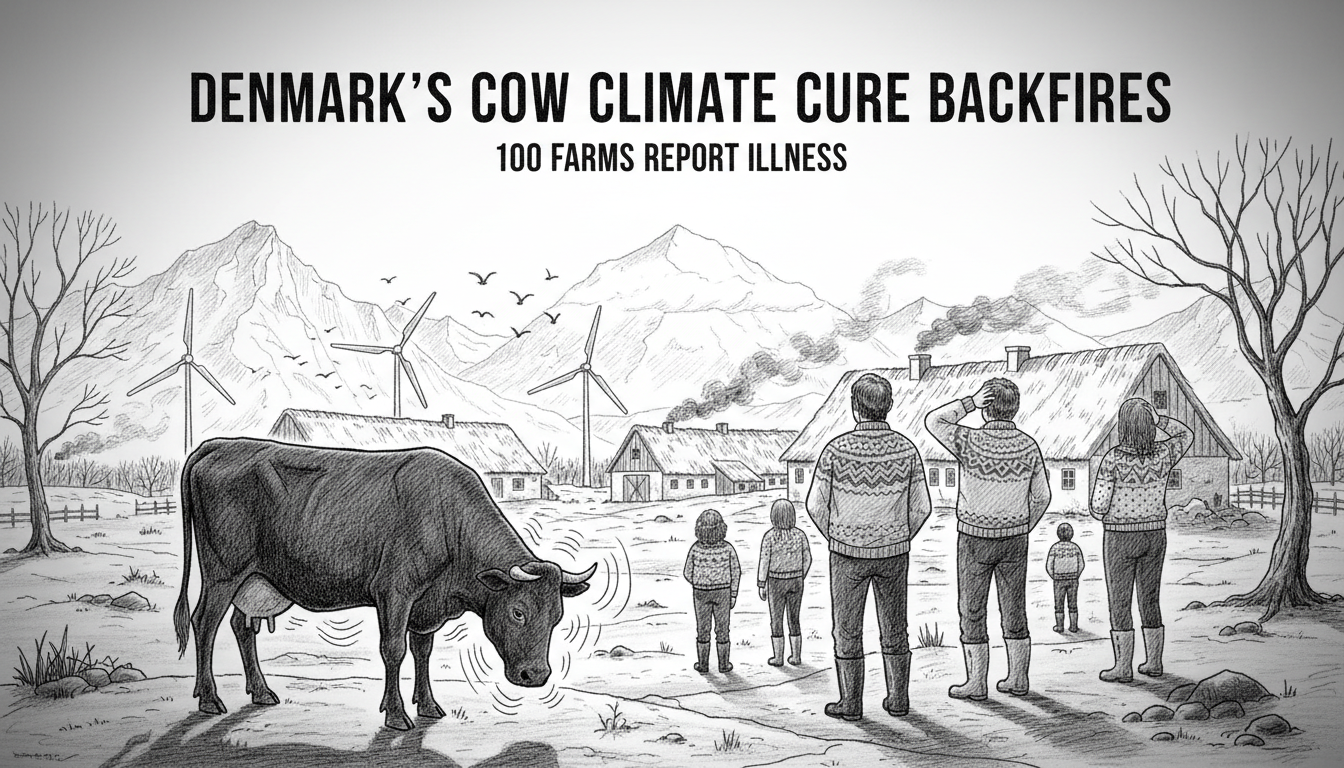
Denmark's mandated climate solution for cattle has triggered a wave of animal illness reports, pitting urgent methane reduction goals against fundamental animal welfare concerns. Over one hundred farmers reported cows losing appetite, collapsing, and producing less milk after consuming state-mandated feed additives. This controversy forced two ministers into a parliamentary hearing to defend a policy designed to make bovine burps more climate-friendly.
The additive, called Bovaer, is a powder mixed into feed that can cut a cow's methane emissions by about one third. Methane from livestock digestion is a potent greenhouse gas with 25 times the warming power of carbon dioxide over a century. With agriculture responsible for roughly 20% of Denmark's total emissions, the government made Bovaer mandatory for 80 days per year on conventional dairy farms starting January 1, 2024. The policy aimed to chip away at Denmark's legally binding target of a 70% reduction in greenhouse gas emissions by 2030.
Farmers Sound the Alarm
Reports began emerging in the autumn of 2024. A pattern of concerning symptoms appeared in herds across the country. "We saw animals that just weren't themselves," one Jutland-based farmer, who asked not to be named during the ongoing investigation, told me. "They stopped eating normally, milk yields dropped noticeably, and in the worst cases, we had cows go down and collapse. As a farmer, your first duty is to the health of your animals. It creates an impossible conflict when a state-mandated product seems to be harming them." The Danish Veterinary and Food Administration is now gathering data from these reports to determine any direct causal link.
During a tense parliamentary consultation, Agriculture Minister Jacob Jensen (Venstre) and Climate Minister Jeppe Bruus (Social Democrats) faced sharp criticism. Franciska Rosenkilde from the Alternative party opened the session by demanding an immediate ban on the additive to protect animal welfare. "When over a hundred farmers report the same serious health issues, the precautionary principle must apply," Rosenkilde argued. The ministers defended the policy, stating that Bovaer is approved by the European Food Safety Authority and used in other countries, emphasizing the critical need to reduce agricultural methane.
The Science of a Burp and a Dilemma
Bovaer works by inhibiting a specific enzyme in the cow's rumen, the first stomach, that is crucial for methane production. Its developer, DSM, and Danish authorities point to extensive trials showing its safety and efficacy. The Danish Agricultural and Food Council initially supported the mandate as a practical tool for the industry's green transition. However, the cluster of adverse reports suggests real-world conditions on diverse Danish farms may introduce variables not fully captured in controlled studies.
"This situation exposes the inherent tension in modern agricultural policy," explains Dr. Lars Mikkelsen, an agricultural policy analyst I spoke with. "We are pushing for rapid technological fixes to deep-rooted environmental problems. While the science behind the additive is sound in principle, its blanket application across all farms assumes uniform conditions. Factors like feed composition, herd genetics, and farm management can influence outcomes. The animal welfare reports, whether directly linked or not, highlight a need for more adaptable and monitored implementation."
The mandate currently applies only to conventional dairy farms, not organic ones. This distinction itself has sparked debate. Some argue it places an unequal burden on one sector, while others see it as a logical first step where uptake might otherwise be slow. The economic aspect is also significant. The state subsidizes the cost of the additive for farmers, but sickness in a dairy herd carries severe financial consequences from lost production and veterinary costs.
A Microcosm of a Global Challenge
Denmark's struggle with Bovaer is a localized symptom of a global challenge: decarbonizing livestock production. Methane reduction is a major focus worldwide, with feed additives, breeding programs, and manure management all seen as part of the solution. Denmark, as a major agricultural exporter with high environmental ambitions, is effectively a test case. The lessons learned here about policy design, farmer engagement, and monitoring will resonate far beyond its borders.
Critics from the left-wing parties, like Enhedslisten, use this incident to question the model of intensive livestock farming itself. They argue that true sustainability requires reducing herd sizes and shifting towards more plant-based production, rather than seeking technological workarounds. The government and industry retort that global food demand requires efficient production, and that innovations like Bovaer are essential for making it greener.
Searching for a Path Forward
The ministers did not agree to an immediate ban during the consultation. Instead, they emphasized enhanced monitoring and data collection. A key question is whether the reported illnesses are directly attributable to Bovaer, or if another factor, such as a specific feed interaction or a coincidental health issue, is to blame. The Danish Veterinary and Food Administration's findings will be crucial. Their investigation must untangle a complex web of biology, chemistry, and farm practice.
This episode will likely lead to calls for more phased introductions of similar future technologies. Options could include a voluntary period with strong support for reporting, mandatory use only after individual farm assessments, or dynamic mandates that adjust based on ongoing safety reviews. Trust between farmers, the government, and the public is now a central issue. Farmers need confidence that climate mandates won't jeopardize their livestock's health or their livelihoods.
For Jeppe Bruus and Jacob Jensen, the task is now one of balance. They must uphold Denmark's ambitious and legally binding climate targets, which rely heavily on agricultural reductions. Simultaneously, they must uphold the nation's equally strong ethical commitment to animal welfare. "The green transition cannot come at the expense of animal welfare," stated Franciska Rosenkilde. This simple sentence captures the core political and ethical dilemma now sitting in the ministers' laps.
The coming months will determine if Denmark can refine this climate tool for safe use, or if the policy itself needs a fundamental rethinking. The outcome will send a clear signal about how one of the world's most climate-ambitious nations navigates the tough, practical trade-offs on the road to net zero. Can a technological fix be successfully integrated into complex biological systems, or does this conflict point to a need for more profound change in how we produce food? Denmark's cows, and their carefully monitored burps, are now at the center of this critical search for answers.